
Bagan Nyior Travel Guide
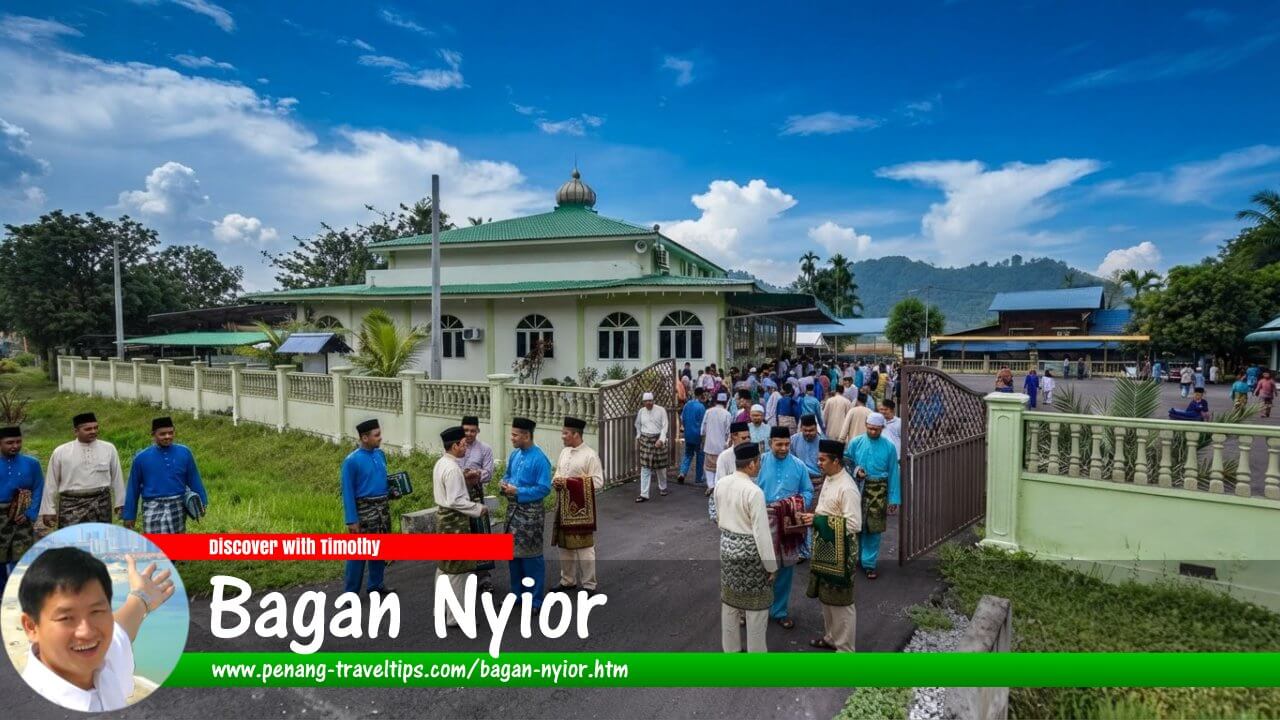 Bagan Nyior Travel Guide (AI generated on 18 October 2026 based on the mosque at Bagan Nyior)

Also available: Panduan Melawat Bagan Nyior
Bagan Nyior is a Malay village in Juru, Seberang Perai, Penang, situated on the southern bank of Sungai Juru, north of Kampung Sungai Semilang. It is a small residential settlement characterised by village life, local roads and its neighbourhood mosque, Masjid Bagan Nyior. Although it is not a major tourist destination, the village offers a glimpse into the traditional settlements that remain within the increasingly urbanised landscape of mainland Penang.
Fakta Ringkas
- Name: Bagan Nyior (also spelt Bagan Nyiur)
- Location: Juru, Seberang Perai, Penang, Malaysia
- Approximate coordinates: 5.32621, 100.41877
- Postal address: 14100 Simpang Ampat, Penang
- Locality: Malay village within the wider Juru area
- Geographical setting: Southern bank of Sungai Juru
- Main road: Jalan Bagan Nyior, connected to the local road network around Juru
- Nearby settlements: Kampung Sungai Semilang, Juru and Kuala Juru
- Main landmark: Masjid Bagan Nyior
- Character: Traditional village within the developing landscape of Seberang Perai Tengah
Geography and Location
Bagan Nyior is located in Juru, within the Central Seberang Perai area of Penang. It lies on the southern bank of Sungai Juru, a river that forms part of the mainland's physical landscape and drainage system. Kampung Sungai Semilang is situated to the south of the village, while other settlements in the wider Juru area are connected by a network of local roads.
The village is part of Seberang Perai, the mainland portion of Penang State. Unlike the densely built-up commercial centres of Butterworth and Bukit Mertajam, Bagan Nyior retains the character of a smaller village settlement. Its residential surroundings contrast with the industrial estates, highways and newer commercial developments found elsewhere in Juru.
Sungai Juru
Sungai Juru is an important geographical feature in the area. The river flows through parts of Seberang Perai Tengah before reaching the coastal area at Kuala Juru. Its drainage basin encompasses a landscape that includes older settlements, agricultural land and more recently developed urban and industrial areas.1
The river is part of the wider setting in which settlements such as Bagan Nyior developed. Rivers have historically influenced settlement patterns by providing access to water, supporting local livelihoods and shaping the routes connecting communities. However, the precise role of Sungai Juru in the early history of Bagan Nyior has not been conclusively documented.
Jalan Bagan Nyior
Jalan Bagan Nyior is the principal local road associated with the village. The settlement is also connected to the surrounding road network serving Juru, Kampung Sungai Semilang and other parts of Seberang Perai Tengah.
The road network is important for residents travelling to nearby shops, schools, workplaces and public facilities. For visitors, driving is generally the most practical way to reach the village and explore its immediate surroundings.
History of Bagan Nyior
The detailed history of Bagan Nyior is not extensively documented in readily available historical sources. The exact date of its establishment, the identity of its earliest settlers and the circumstances behind its original development cannot be stated with certainty without further documentary or oral-history evidence.
Nevertheless, Bagan Nyior can be understood within the broader history of settlement in Seberang Perai. Before the expansion of modern roads, housing estates and industrial development, much of the mainland landscape consisted of agricultural land, wetlands, waterways and scattered settlements. Villages developed in different locations according to access to land, water, transport routes and local economic opportunities.
Juru subsequently developed into a more connected settlement within central Seberang Perai. The expansion of roads, manufacturing industries and commercial activities transformed parts of the surrounding landscape, bringing residential communities closer to larger employment and service centres. Bagan Nyior remains one of the smaller village settlements within this changing environment.
Village Life and Community
Bagan Nyior's identity is closely associated with its residential character and local Muslim community. As in many Malaysian villages, the mosque is an important community institution, serving religious needs and providing a setting for communal activities.
The continued presence of a named village and its mosque illustrates how established settlements remain identifiable even as surrounding areas become more urbanised. For visitors interested in the geography of Penang, Bagan Nyior provides an example of a small community within the wider Juru area rather than a separate town or commercial centre.
Origin of the Name Bagan Nyior
The name Bagan Nyior consists of two Malay words: bagan and nyior, an alternative spelling of nyiur, meaning coconut palm.
In Malay place names, the word bagan can refer to a landing place, fishing platform or settlement associated with coastal and riverine activities. The word nyior refers to the coconut palm, a familiar plant in traditional Malaysian village landscapes.
It is possible that the name refers to a local geographical feature or the presence of coconut palms in the vicinity of an earlier settlement. However, a definitive historical explanation for the name has not been established in the sources consulted. The interpretation should therefore be treated as a linguistic possibility rather than a confirmed account of how the village received its name.
The village's name is also written as Bagan Nyiur, including in the official mosque directory. Both spellings refer to the same locality, although Bagan Nyior is used for the place name in this guide.
Places of Interest in Bagan Nyior
Masjid Bagan Nyior
Masjid Bagan Nyior, also known as Masjid Bagan Nyiur Juru, is the principal local landmark. It serves the Muslim community in and around the village and is the most readily identifiable place of interest for visitors exploring Bagan Nyior.
The mosque is listed in the Malaysian government's Sistem Maklumat Masjid Malaysia (SISMIM), which records its address as Juru, 14100, Bukit Mertajam, Seberang Perai Tengah, Penang. The directory also lists facilities that include a dining hall, a rest shelter, public toilets and accessibility provisions for people with disabilities.2
As an active place of worship, the mosque is primarily intended for religious and community use rather than tourism. Muslim visitors may use the mosque for prayers, subject to its arrangements. Other visitors should dress appropriately, observe the mosque's rules and seek permission before entering areas reserved for worshippers.
The Village and Its Surroundings
Beyond the mosque, Bagan Nyior is best appreciated as a residential village rather than a destination with a collection of formal attractions. Its local roads and houses offer a glimpse of everyday life in a settlement that remains distinct from the larger commercial and industrial areas of Juru.
Visitors should remember that the village is a living community. Walking or driving through the area should be done respectfully, without trespassing on private property, obstructing residents or photographing people without permission.
Things to Do in Bagan Nyior
Bagan Nyior is not a major sightseeing destination, and visitors should not expect museums, large shopping centres or purpose-built tourist facilities within the village itself. A visit is more suitable for travellers interested in local geography, village settlements and the quieter parts of Seberang Perai.
- Visit Masjid Bagan Nyior: Appreciate the mosque's role as the village's main religious and community landmark.
- Explore the local settlement: Observe the village's residential character and its relationship with the surrounding Juru area.
- Learn about Sungai Juru: Understand how the river forms part of the geographical setting of this part of Seberang Perai.
- Discover nearby communities: Combine the visit with a drive through other parts of Juru or towards Kuala Juru.
- Experience local food: Look for neighbourhood eateries in the wider Juru area rather than expecting a concentrated dining district within Bagan Nyior.
A brief visit may be sufficient to see the main local landmark and understand the village's location. Travellers planning a longer outing should include other nearby destinations to make better use of their time.
How to Get to Bagan Nyior
By Car
Driving is the most straightforward way to reach Bagan Nyior. The village is accessible through the local road network around Juru, with Jalan Bagan Nyior serving the settlement. Visitors should enter the name of the village or Masjid Bagan Nyiur Juru into a navigation application and check the route before departure.
For travellers arriving from other parts of Peninsular Malaysia, the North-South Expressway provides access to the Juru area. The Juru Interchange connects the expressway with the local road network serving Juru and surrounding parts of Seberang Perai.3 From there, visitors can continue along the appropriate local roads towards Bagan Nyior.
Road conditions and traffic vary with the time of day. Allow additional time when travelling during peak commuting periods, and park only where permitted without obstructing residents or other road users.
By Bus
Public buses serve parts of the wider Seberang Perai area, but a direct bus service into Bagan Nyior should not be assumed. Visitors wishing to travel by bus should check current routes and stops for Juru, then determine whether a local taxi or e-hailing vehicle is needed for the final part of the journey.
Because this is a village rather than a major transport hub, public transport may require more planning than a journey to central Butterworth or Bukit Mertajam.
By Train
There is no railway station in Bagan Nyior itself. Travellers arriving by KTM train can use a station serving the wider Seberang Perai area and continue by road. Butterworth and Bukit Mertajam are possible rail access points, but the most convenient option depends on the train service and the visitor's starting location.
Check current railway timetables and onward transport options before travelling. For the final leg of the journey, a taxi or e-hailing vehicle is likely to be more convenient than relying on a direct public transport connection to the village.
By Taxi or E-Hailing Service
Taxi and e-hailing services offer a practical way to reach Bagan Nyior from nearby towns and transport hubs. When booking, specify the village or Masjid Bagan Nyiur Juru as the destination to reduce the risk of confusion with similarly named places.
Visitors should also consider how they will return from the village, particularly if they are travelling during quieter periods when fewer vehicles may be available.
Where to Stay
Bagan Nyior is a small residential village and does not function as a major accommodation centre. Visitors who wish to stay nearby should look for hotels, guesthouses or other accommodation in the wider Juru area, Bukit Mertajam or other parts of Seberang Perai.
Juru may be a convenient base for travellers visiting local businesses and industrial areas. Bukit Mertajam offers access to a wider range of town facilities, while Butterworth is useful for visitors who need connections to trains and ferries serving Penang Island.
Travellers seeking heritage attractions, a broader selection of accommodation and more established visitor facilities may prefer to stay in George Town and visit Bagan Nyior as part of a mainland excursion. The best location depends on whether the priority is public transport, work, local exploration or access to Penang Island.
As accommodation availability and prices change, check current listings and confirm the location, transport options and facilities before booking.
What to Eat in Bagan Nyior
Bagan Nyior itself has a village setting rather than a recognised food district. Visitors may find small local food businesses in the surrounding area, but the selection and opening hours can vary. For a wider choice, explore Juru and nearby commercial areas.
Malay Food
In the wider Juru area, visitors can look for everyday Malaysian dishes such as nasi lemak, nasi campur, mee goreng and rice meals served with local curries and side dishes. Small eateries may operate mainly during breakfast or lunch, so it is worth checking opening times before making a special trip.
Muslim travellers should check the status of individual establishments if halal certification is important to them. The presence of a Malay village does not, by itself, establish the status of every food business in the surrounding area.
Local Coffee Shops and Hawker Food
The wider Juru area has a mixture of local eateries, coffee shops and food stalls serving residents and workers. Depending on the location, visitors may find noodle dishes, rice meals, snacks and local drinks.
Those who want to make food exploration a larger part of their trip should consider combining Bagan Nyior with other parts of Juru, where there are more commercial premises and dining options. Individual businesses may have different operating days and hours.
Getting Around Bagan Nyior
For most visitors, a private vehicle, taxi or e-hailing service is the most convenient way to move around Bagan Nyior and the surrounding villages. The distances between settlements and commercial areas can make walking an impractical option for a full exploration of the wider locality.
Walking within the village may be suitable for short distances, including a visit to the mosque and nearby streets. However, visitors should be mindful of traffic, the availability of pavements and the tropical heat. The village's roads are primarily intended to serve local residents rather than tourists.
For those cycling, use caution on roads shared with motor vehicles and avoid obstructing traffic. Visitors should also respect private property and refrain from entering fields, compounds or other areas without permission.
Best Time to Visit
Bagan Nyior can be visited throughout the year. If the intention is to walk around the village, early morning or late afternoon is generally more comfortable than midday, when temperatures can be high.
Rain showers may occur at any time of year, so visitors should be prepared for wet weather. If visiting the mosque, plan around prayer times and any activities that may affect access to its premises.
Suggested Itinerary
Bagan Nyior is best included as a short stop within a wider exploration of Juru and Seberang Perai. The following itinerary is a flexible suggestion for visitors travelling by car.
- Arrive in Bagan Nyior: Use the village name or mosque as a navigation point.
- Visit Masjid Bagan Nyior: Appreciate its role as a local religious landmark, observing the rules for visitors.
- Explore the village surroundings: Observe the residential landscape from public roads and avoid disturbing residents.
- Continue towards Juru or Kuala Juru: Explore nearby settlements and the wider local landscape.
- Stop for a meal: Find an eatery in the surrounding Juru area before continuing to another destination.
The itinerary can be shortened if the main purpose is simply to visit the village mosque, or extended to include other parts of Seberang Perai. Visitors should verify road conditions and any access restrictions before setting out.
Practical Information for Visitors
- Navigation: Use the coordinates 5.32621, 100.41877 or search for Masjid Bagan Nyiur Juru.
- Postcode: The village uses the postal address 14100 Simpang Ampat, Penang, although its geographical location is in Juru.
- Facilities: Do not expect a dedicated tourist information centre or a concentration of visitor services.
- Dress: Wear appropriate clothing when visiting the mosque or other religious premises.
- Photography: Respect residents' privacy and ask permission before taking close-up photographs of people or private property.
- Transport: Plan your return journey in advance if travelling without a private vehicle.
- Food: Check the opening hours of local eateries, particularly if visiting outside normal meal periods.
Conclusion
Bagan Nyior is a small Malay village in Juru, Seberang Perai, whose identity is shaped by its residential character, its position near Sungai Juru and the presence of Masjid Bagan Nyior. It does not have a large collection of conventional tourist attractions, but it remains a useful example of the village communities that form part of mainland Penang's geographical and cultural landscape.
For travellers interested in exploring beyond the state's better-known urban and heritage destinations, Bagan Nyior can be visited as a short stop during a wider trip around Juru and central Seberang Perai. Its quiet village setting offers a different perspective on a region increasingly associated with industrial development, expanding road networks and growing urban communities.
Bagan Nyior is  on the Map of Juru, Seberang Perai
 Sights in Bagan Nyior
- Masjid Bagan Nyiur (GPS: 5.32535, 100.41624)

References
- Penang Travel Tips, Bagan Nyior, Juru, Penang. Existing locality information, coordinates and the village's main landmark. https://www.penang-traveltips.com/bagan-nyior.htm
- Jabatan Kemajuan Islam Malaysia (JAKIM), Sistem Maklumat Masjid Malaysia, Masjid Bagan Nyiur Juru. Official directory entry containing the mosque's address and listed facilities. https://masjid.islam.gov.my/maklumatDetailMS/1/0701004
- Penang Travel Tips, Juru, Seberang Perai, Penang. Information on the wider locality, nearby villages and access via the Juru Interchange. https://www.penang-traveltips.com/juru.htm
- Penang Travel Tips, Sungai Juru. Background on the river's geographical setting and role in Seberang Perai. https://www.penang-traveltips.com/sungai-juru.htm
- Jabatan Kerja Raya Malaysia, Statistik Jalan. Road classification and route information can be consulted through the relevant public works road references. https://www.jkr.gov.my/
Page Details
This page was created on 18 October 2026. Hi, my name is Timothy and created it from my research, for my own entertainment, knowledge and to satisfy my curiosity. I am providing the information to you in good faith and hope it is useful. I try to get the details as accurate as possible. I also try to update the page whenever I stumble on new details. So this and all my other pages are perpetual work in progress. If you discover any error, please politely inform me, pointing out where the error lies, and I will correct it as soon as possible. Your helpfulness will keep this page accurate, relevant and helpful to those who need the information.Want to share your Penang travel experiences or get tips from fellow travellers?
Join the Penang Travel Tips Facebook GroupUseful guides for visiting Penang
My Videos of Penang
Latest Pages & Updates
Buy Me A Coffee
If you enjoy the information I provide and want to support the work I do, please buy me a coffee! I appreciate it immensely, thank you so much!
