
Boon San Tong Khoo Kongsi
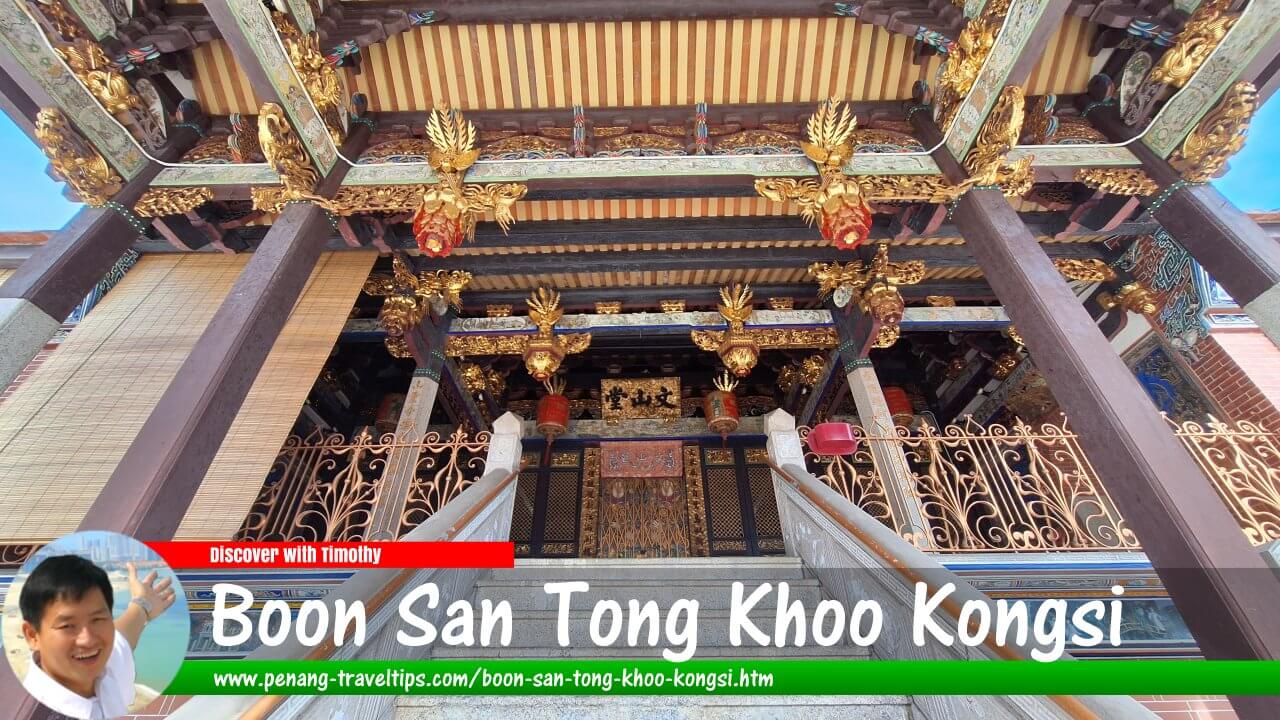 Boon San Tong Khoo Kongsi (19 November 2026)

Also Available: Boon San Tong Khoo Kongsi (Edisi Melayu) & 宝善堂邱公司
Boon San Tong Khoo Kongsi (GPS: 5.41235, 100.33692) is a historic Chinese clan temple located at 117A Victoria Street (Lebuh Victoria) in George Town, Penang. Established in 1878, it is the ancestral temple of the Hai Kee Kak branch of the Khoo clan and is historically associated with the larger Leong San Tong Khoo Kongsi. Although smaller and less prominent than its counterpart at Cannon Square, Boon San Tong is an important part of the history of the Khoo family and the Chinese community in Penang.
Quick Facts
- Name: Boon San Tong Khoo Kongsi
- Chinese clan: Khoo (邱氏)
- Clan branch: Hai Kee Kak
- Year established: 1878
- Type: Chinese ancestral temple and clan institution
- Address: 117A, Victoria Street, 10300 George Town, Penang, Malaysia
- GPS coordinates: 5.41235, 100.33692
- Telephone: +604-261 7054
- Published opening hours: 9:30am–4:30pm daily (confirm before visiting)
- Nearest transport hub: Weld Quay Ferry and Bus Terminal
- Nearby landmarks: Beach Street, Tan Kongsi, Chew Jetty and Leong San Tong Khoo Kongsi
Location and Geography
Boon San Tong Khoo Kongsi stands along Victoria Street, in the historic commercial district of George Town. This part of the city is characterised by traditional Chinese clan houses, ancestral temples, pre-war shophouses, former merchant premises and historic waterfront streets.
The temple is situated a short distance inland from Weld Quay, which was historically an important waterfront area for shipping, trading and passenger transportation. Its present location is particularly significant because the surrounding landscape has changed considerably since the 19th century.
When Boon San Tong was established in 1878, the land immediately in front of the temple was still part of the coastal waterfront. The temple originally faced the sea, with its entrance approached through passages connecting it to Beach Street. The shoreline was characterised by wooden piers, wharves and other structures associated with George Town's maritime trade.
Subsequent land reclamation extended the urban area towards the sea. The development of Victoria Street altered the relationship between the temple and the waterfront, leaving the building surrounded by an increasingly developed urban neighbourhood.
History of Boon San Tong Khoo Kongsi
Establishment in 1878
Boon San Tong was established in 1878 by a branch of the Leong San Tong Khoo Kongsi. It predates the present main Leong San Tong clan house at Cannon Square, which was completed in 1906.
The temple served as the ancestral institution of a particular branch of the Khoo family known as the Hai Kee Kak. This branch descended from Khoo Kong Oon, a fifth-generation member of the Leong San Tong Khoo lineage.
Chinese clan associations in Penang traditionally provided their members with a common institutional structure for ancestral worship, maintaining family records, managing communal affairs and representing the interests of people sharing the same surname and ancestral origins. Boon San Tong performed these functions for its particular branch of the Khoo family.
The Hai Kee Kak Branch
Hai Kee Kak was one of the important branches within the wider Khoo clan organisation. The name is also rendered as Sea Edge Pillar in English. The branch maintained its own ancestral temple while remaining institutionally connected to Leong San Tong Khoo Kongsi.
One of its most prominent historical figures was Khoo Thean Teik, who played an important role in the development and influence of Boon San Tong. He was among its founding figures in 1878 and helped establish the branch as a powerful component of the wider Khoo clan organisation.
Khoo Thean Teik was also a prominent figure in the 19th-century Chinese community of Penang. His influence extended beyond clan affairs, and his name is commemorated in places such as Jalan Thean Teik and Thean Teik Estate on Penang Island.
Relationship with Leong San Tong Khoo Kongsi
Boon San Tong is not an entirely independent clan organisation in the historical sense. It forms part of the wider Leong San Tong Khoo Kongsi structure, which brings together different branches of the Khoo family.
According to the historical account of the association, Boon San Tong was one of four principal components of Leong San Tong. It held a quarter share in the main clan association and was entitled to representation on its governing board.
This arrangement illustrates how Chinese clan organisations were structured internally. While individual family branches could maintain their own ancestral temples and local institutions, they remained connected through a larger association representing the wider surname group.
Victoria Street and the Changing Entrance
One of the most interesting aspects of Boon San Tong is its relationship with the development of Victoria Street.
Before Victoria Street was established, the main approach to the temple was through a narrow passageway connected to Beach Street. The temple faced the waterfront, and its elevated verandah would originally have offered an unobstructed view towards the sea and the opposite mainland.
During the late 19th and early 20th centuries, land reclamation transformed this section of George Town. The newly created land provided additional space for commercial development, including warehouses, trading premises and roads serving the expanding port district.
By 1907, Victoria Street had become the new approach to the temple. Its entrance was consequently reoriented towards the street. The year 1907 is inscribed on the entrance gates and provides an indication of this change.
The original compound of Boon San Tong appears to have extended further towards the former shoreline. A pair of stone gates standing across Victoria Street from the temple may have formed part of its earlier entrance. These gates are an important physical reminder of the temple's original relationship with the waterfront, although their precise original function should be regarded as uncertain.
Architecture and Features
Boon San Tong is a traditional Chinese ancestral temple. Its architectural features reflect the religious and cultural traditions of the Chinese community that established it during the late 19th century.
Entrance and Gates
The present entrance faces Victoria Street. The gates bear the initials BST and the year 1907, marking the period when the entrance was changed to face the newly developed street.
Across the road, the surviving stone gates are particularly interesting because they may indicate the earlier extent of the temple compound. Together, these structures help illustrate how land reclamation and urban development altered the original setting of the building.
Elevated Verandah and Granite Pillars
The temple features an elevated entrance porch supported by substantial granite pillars. This raised frontage is one of its distinctive architectural characteristics and reflects the building's original orientation towards the waterfront.
The verandah would have provided a prominent viewing position when the sea was still visible directly in front of the building. Today, it faces Victoria Street and the surrounding urban development instead.
Roof and Traditional Ornamentation
The roof incorporates traditional Chinese decorative elements, including ornamental ridge details known as jian nian (剪粘). This decorative technique involves arranging small pieces of coloured ceramic material to create ornamental figures and patterns.
Compared with the elaborate roof ornamentation of the main Leong San Tong clan house, the roof of Boon San Tong is relatively restrained. Nevertheless, its traditional construction and decorative details contribute to its architectural significance.
Ancestral Hall and Tablets
The principal religious function of Boon San Tong is the veneration of the ancestors of the Hai Kee Kak branch. Ancestral tablets are maintained within its ancestral hall, representing successive generations of the family.
Ancestral tablets are an important feature of traditional Chinese clan temples. They provide a place for descendants to pay their respects to deceased family members and maintain the continuity of ancestral worship across generations.
The ancestral tablets associated with the Hai Kee Kak lineage are also represented within the wider Leong San Tong institution, reflecting the relationship between the branch temple and the main clan association.
Meaning of the Name
The name Boon San Tong is the English romanisation of the temple's Chinese name. The name is associated with the identity of the ancestral institution rather than being a geographical name derived from Victoria Street.
Its historical identity is closely connected to the Hai Kee Kak branch of the Khoo clan. The expression Hai Kee Kak is rendered as Sea Edge Pillar, referring to the particular lineage represented by the temple.
The term Khoo Kongsi refers to the Khoo clan association. In the Chinese community of Penang, a kongsi could function as an ancestral institution, a family association and an organisation responsible for communal affairs. The ancestral temple was an important physical centre of this organisation.
Visiting Boon San Tong Khoo Kongsi
Boon San Tong is located within George Town's UNESCO World Heritage Site. It can be included in a walking exploration of the historic commercial district around Victoria Street, Beach Street and Weld Quay.
Unlike the larger Leong San Tong Khoo Kongsi at Cannon Square, Boon San Tong is a smaller ancestral temple with a more specialised historical association. Visitors interested in Chinese clan history, family institutions and the development of George Town's waterfront may find its history particularly relevant.
Visitors should be mindful that this is an ancestral and religious institution, rather than simply an architectural exhibition. Access to the interior may be subject to the arrangements of the temple's management. Photography should be undertaken respectfully, particularly around ancestral tablets and places of worship.
Opening Hours and Admission
- Opening hours: Published hours are 9:30am to 4:30pm daily.
- Admission: Confirm the current admission arrangements with the management.
- Telephone: +604-261 7054.
Opening hours and access arrangements may change during religious observances, family ceremonies or maintenance. It is advisable to telephone ahead before making a special journey to visit the temple.
How to Get to Boon San Tong Khoo Kongsi
From Weld Quay Ferry and Bus Terminal
Weld Quay is one of the most convenient starting points for reaching Boon San Tong. The temple is approximately 430 metres from the ferry and bus terminal, making it accessible on foot.
From the terminal, cross towards the historic waterfront district and walk along Pengkalan Weld. Continue towards Gat Lebuh Chulia, turn inland and proceed towards Victoria Street. The temple is located along Victoria Street.
Depending on the exact starting point and walking route, the journey takes approximately 5 to 10 minutes.
From KOMTAR
Visitors travelling from KOMTAR can take a taxi or e-hailing vehicle to Victoria Street. Walking is also possible, although the distance is longer. The journey passes through the commercial and heritage districts of central George Town.
By Bus
Rapid Penang operates the Central Area Transit (CAT) shuttle bus service around central George Town. The service connects Weld Quay with several parts of the heritage district and KOMTAR.
Visitors can use the CAT service to reach the general vicinity of Victoria Street, then continue on foot. As bus stops and operating arrangements may change, check the latest route information before travelling.
By Taxi or E-hailing
Taxis and e-hailing services such as Grab can take visitors directly to Victoria Street. This is a convenient option for those arriving from Penang International Airport, hotels outside the heritage district or other parts of the island.
However, Victoria Street is part of George Town's older street network, where roads can be narrow and parking space limited. Visitors arriving by private car should use a designated public car park rather than assume that parking is available directly outside the temple.
Where to Stay Near Boon San Tong Khoo Kongsi
George Town offers accommodation ranging from restored heritage shophouses and boutique hotels to contemporary hotels and budget guesthouses. Visitors wishing to explore Boon San Tong and other historic buildings on foot may consider staying within the central heritage district.
The following areas provide convenient access to the temple:
- Victoria Street: Accommodation around Victoria Street places visitors close to Boon San Tong, Beach Street and the historic waterfront district.
- Beach Street: This historic commercial street provides convenient access to the clan temples, former trading premises and Weld Quay.
- Armenian Street: The surrounding neighbourhood has restored shophouses, boutique accommodation, cafés and heritage attractions.
- Chulia Street: This area has a wider selection of hotels, guesthouses, restaurants and budget accommodation.
- Penang Road and KOMTAR: These areas provide access to larger hotels, shopping facilities and public transportation.
Staying within George Town's heritage district makes it possible to visit several historic attractions without relying on a vehicle. Accommodation rates vary according to the property, room category, season and booking period.
Food and Dining Near Boon San Tong Khoo Kongsi
The area surrounding Boon San Tong is part of George Town's historic Chinese commercial district, where traditional coffee shops, restaurants, food stalls and contemporary cafés operate alongside older trading premises.
Visitors can explore the following nearby food areas:
- Beach Street: The surrounding commercial neighbourhood has traditional coffee shops and local eateries serving Chinese-style breakfasts, noodles and rice dishes.
- Weld Quay: The waterfront neighbourhood has local food stalls and coffee shops, including establishments serving traditional Penang Chinese dishes.
- Chulia Street: This area has restaurants and street-food establishments serving a variety of Malaysian and Chinese dishes.
- Little India: Located within walking distance, this neighbourhood has Indian restaurants, banana-leaf rice, roti, curries and other South Indian and Malaysian Indian dishes.
- Armenian Street and its surroundings: This neighbourhood has cafés, bakeries, restaurants and coffee shops operating in restored heritage buildings.
Among the local dishes visitors may encounter in George Town are char koay teow, Hokkien mee, curry mee, wantan mee, koay teow th'ng and nasi kandar. These dishes reflect the different culinary traditions that developed through Penang's multicultural population.
Getting Around the Neighbourhood
Walking is the most practical way to explore the immediate surroundings of Boon San Tong. The temple is located within a relatively compact heritage district, where many historic buildings and streets are within a short distance of one another.
Visitors can combine a visit to Boon San Tong with nearby clan temples, historic commercial buildings and the waterfront settlements along Weld Quay.
The CAT shuttle bus is useful for covering longer distances within central George Town, while taxis and e-hailing services provide convenient transportation to attractions outside the central district.
LinkBike bicycle-sharing services have also operated in parts of George Town. Visitors should check the current availability of bicycles and docking facilities before relying on this option.
Nearby Places of Interest
Boon San Tong is surrounded by several historic sites associated with the Chinese community and the development of George Town as a trading port.
- Tan Kongsi: A Chinese clan association and ancestral temple located in the historic Beach Street neighbourhood.
- Leong San Tong Khoo Kongsi: The main Khoo clan house at Cannon Square, recognised for its elaborate architecture and historical importance.
- Cheah Kongsi: A historic clan association of the Cheah family, situated within George Town's heritage district.
- Chew Jetty: One of the traditional Chinese clan jetties along Weld Quay, consisting of houses and community structures built over the water.
- Eng Tai Association: A historic Chinese association in the Beach Street area.
- Armenian Street: A historic street known for its traditional shophouses, heritage buildings and cultural attractions.
- Acheen Street Mosque: A historic mosque associated with the early Muslim trading and pilgrimage community of George Town.
- Dr Sun Yat Sen's Penang Base: A heritage building associated with Sun Yat Sen's political activities in Southeast Asia during the early 20th century.
These sites provide additional context for understanding the historical development of George Town and the various communities that contributed to its commercial, religious and cultural landscape.
Contact Information
Boon San Tong Khoo Kongsi
117A, Victoria Street,
10300 George Town,
Penang, Malaysia.
- Telephone: +604-261 7054
- Opening hours: 9:30am–4:30pm daily (subject to confirmation)
- GPS: 5.41235, 100.33692
Pictures of Boon San Tong Khoo Kongsi

Left side view of Boon San Tong (29 November 2012)
The above photo shows the side passage that once led to Beach Street, across from Tan Kongsi. In the old days, Boon San Tong was approach from the rear. At the time it was built, it commanded a good view of the sea.

Right side view, Boon San Tong (29 November 2012)
And this shot, above, of the right side of Boon San Tong shows the other passageway that once led to Beach Street. Do you notice the iron wok by the grand staircase? It has been there on the same spot for the past seven years between the two different times I shot this building (in 2005 and 2012).

Front entrance, Boon San Tong (29 November 2012)
The above photo shows the front entrance of Boon San Tong. The spot where I stood to take the shot was originally the sea. If we turn back time to the late 19th century, we can picture a beach scene here - not a sandy beach with vacationers under beach parasols, but a merchantile shoreline with the wharf punctuated by piers and ghauts at irregular intervals. Standing on the elevated verandah of Boon San Tong, a person would enjoy an uninterrupted view of the sea, all the way to Prai.
In 1907, with the creation of Victoria Street on what was previously sea, the entrance to the temple was changed to the newly created street. Note the year 1907 on its gates as you enter. In all likelihood, the same craftsmen who worked on the Leong San Tong a year before was also the ones who completed the Boon San Tong.

These may be the original gates of Boon San Tong, located across Victoria Street (22 May 2011)
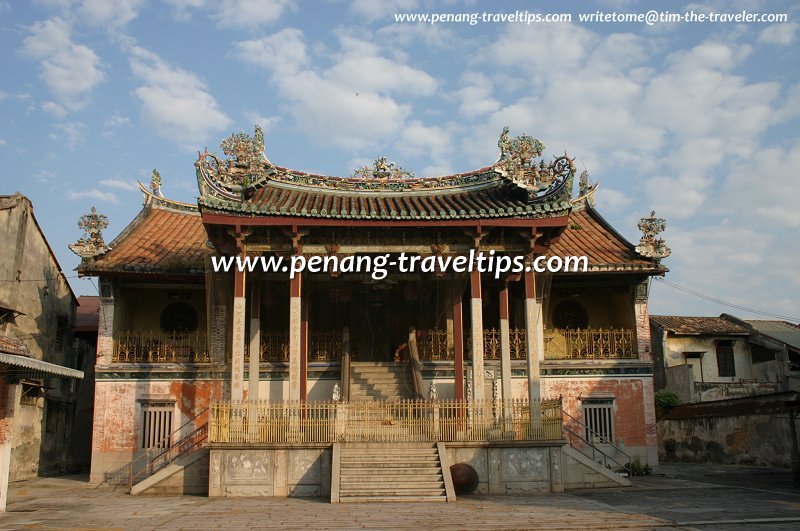
Boon San Tong Khoo Kongsi (29 January 2005)

Close-up of the clan temple. Note the chien nien roof ornamentation. To prevent defacement by birds and bats, a netting is wrapped over the temple. (29 January 2005)
Across Victoria Street from Boon San Tong is a pair of stone gates which may have been the original entrance gate to the ancestral temple. Victoria Street may have been carved through the original compound of Boon San Tong, which until then extended to the shore.
Within Boon San Tong are the ancestral tablets of the Hai Kee Kak. These are in the main ancestral hall as well as the Boon San Tong. As one of the four main components of the Leong San Tong, the Boon San Tong owns a quarter share in the main clan association, and have representatives sitting in the Leong San Tong board.

BST and year 1907 are inscribed on the gates of the Boon San Tong. (29 January 2005)
References
- George Town City – Street Stories: Victoria Street
- Penang Global Tourism – Leong San Tong Khoo Kongsi and the Hai Kee Kak lineage
- Penang Travel Tips – Boon San Tong Khoo Kongsi (historical photographs and account)
- Prasarana Malaysia – CAT Bus in George Town
- Penang Global Tourism – Accommodation in George Town
Page Details
This page was created on 19 November 2026.Want to share your Penang travel experiences or get tips from fellow travellers?
Join the Penang Travel Tips Facebook GroupUseful guides for visiting Penang
My Videos of Penang
 Latest Pages & Updates
Buy Me A Coffee
If you enjoy the information I provide and want to support the work I do, please buy me a coffee! I appreciate it immensely, thank you so much!
