
Cherok Tokun, Bukit Mertajam
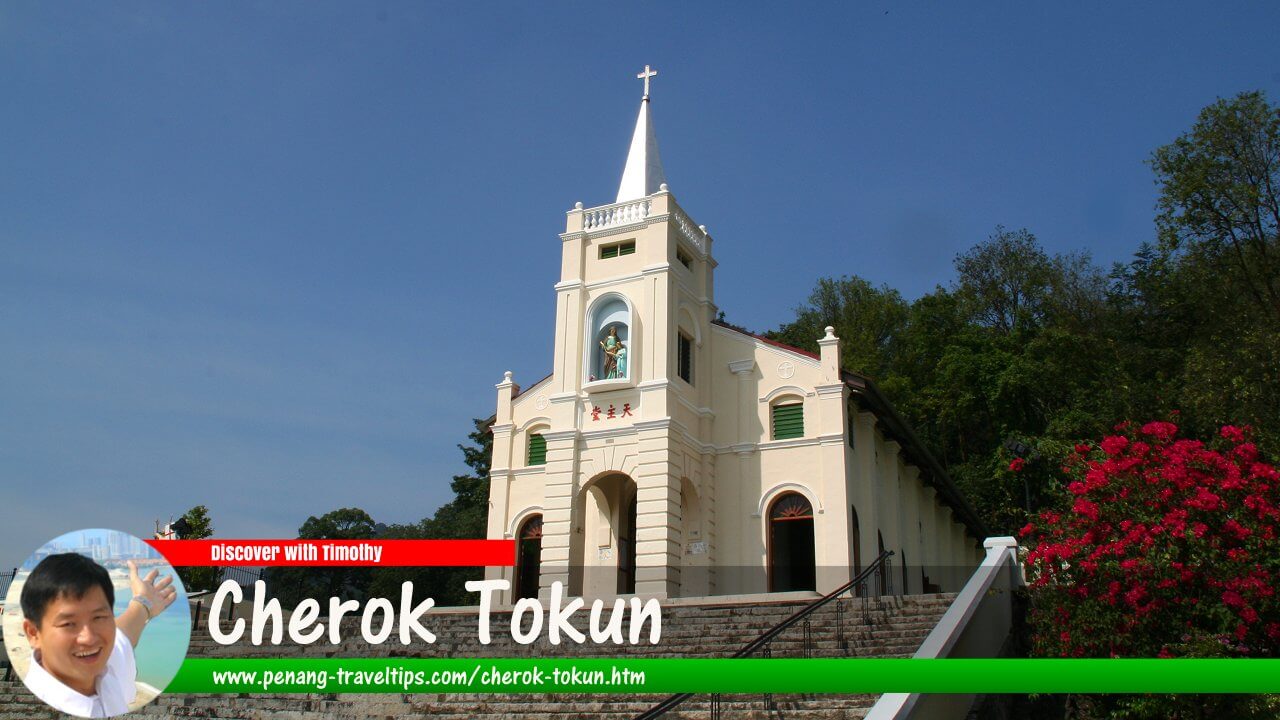 Cherok Tokun, Bukit Mertajam (AI generated on 22 October 2026)

Also available: Cherok Tokun, Bukit Mertajam (Edisi BM)
Cherok Tokun (GPS: 5.34683, 100.48665) is a Malay locality on the eastern side of Bukit Mertajam, in Seberang Perai Tengah, Penang. Situated along Jalan Kulim, the road connecting Bukit Mertajam with Kulim in Kedah, it is known for the Minor Basilica of St Anne, the ancient Cherok Tokun inscribed boulder, and the nearby Bukit Mertajam Recreational Forest. The locality brings together religious heritage, archaeological interest and the natural landscape of Cherok Tokun Hill, making it an important area for understanding the history and attractions of mainland Penang.1
Quick Facts
- Name: Cherok Tokun
- Alternative spellings: Cherok Tok Kun, Cherok To'Kun and Cherok Tokun
- Location: Bukit Mertajam, Seberang Perai Tengah, Penang, Malaysia
- GPS coordinates: 5.34683, 100.48665
- Main road: Jalan Kulim
- Nearby localities: Bukit Mertajam town, Alma and Machang Bubok
- Natural landmark: Cherok Tokun Hill
- Heritage landmark: Cherok Tokun Inscribed Boulder
- Religious landmark: Minor Basilica of St Anne
- Nature attraction: Bukit Mertajam Recreational Forest
- Other place of interest: Nandaka Vihara Buddhist Monastery
- Character: Residential locality, religious centre, archaeological site and gateway to a forest reserve
Geography and Location
Cherok Tokun is situated east of Bukit Mertajam town centre, north of Alma and west of Machang Bubok. It lies in the foothills of the Cherok Tokun hill range, which rises above the surrounding lowland settlements of Seberang Perai. The combination of residential development, religious institutions and forested hills gives the locality a character distinct from the commercial centre of Bukit Mertajam.
Jalan Kulim is the principal road through the area. It connects Bukit Mertajam with Kulim in neighbouring Kedah and provides access to several landmarks along the foothills. The entrance to Bukit Mertajam Recreational Forest, the Minor Basilica of St Anne and Nandaka Vihara Buddhist Monastery are among the places associated with this road corridor.
The most prominent geographical feature is Cherok Tokun Hill, which forms part of the Bukit Mertajam Forest Reserve. The forested slopes provide a green backdrop to the built-up areas and are important for recreation, biodiversity and the conservation of native vegetation. The state forestry department describes the forest as containing both lowland and hill dipterocarp forest.2
Although the locality is close to Bukit Mertajam town, its landscape changes noticeably towards the hill. Commercial buildings and residential neighbourhoods give way to religious compounds, forest entrances and roads leading into the foothills. This geographical transition is one of the defining characteristics of Cherok Tokun.
History of Cherok Tokun
Early Settlement and the Development of Bukit Mertajam
Cherok Tokun forms part of the wider historical landscape of Bukit Mertajam. The surrounding area developed through agriculture, settlement and the growth of transport connections across mainland Penang. The foothills provided a setting for religious institutions, while the nearby lowlands supported village communities and agricultural activities.
The history of Cherok Tokun is particularly notable for the survival of an ancient inscribed boulder and the establishment of Christian institutions in the foothills. These features illustrate different periods of the area's history, from early cultural contacts in the Malay Peninsula to the development of the Catholic community in the nineteenth century.
The Cherok Tokun Inscribed Boulder
One of the most important historical objects in Cherok Tokun is the Cherok Tokun Inscribed Boulder, also known as Batu Bersurat Cherok Tok Kun. It is a large granite boulder bearing an inscription in an ancient Indian script associated with Sanskrit. The inscription is an important piece of evidence for studying early cultural and linguistic connections between the Malay Peninsula and the wider Indian-influenced world of Southeast Asia.3
The boulder was documented by Colonel James Low in 1845. Low, a British colonial officer with an interest in archaeology and antiquities, recorded the inscription during his investigations in Penang. His discovery brought attention to a historical object that predates the establishment of modern Bukit Mertajam by many centuries.
The inscription is generally associated with the early centuries of the first millennium, often dated to around the fifth century CE. Its precise interpretation and historical significance require specialist study, and the surviving text does not provide a complete account of the society that produced it. Nevertheless, the boulder is evidence of the use of an Indian-derived writing tradition in this part of the Malay Peninsula.
The inscribed boulder is preserved within the grounds of the Minor Basilica of St Anne. A protective shelter has been provided to help safeguard the stone from the weather and other forms of deterioration. The site is recognised as an important heritage asset under Malaysia's National Heritage Act 2005.3
For visitors, the boulder offers a connection to a period of history that is not immediately apparent from the modern townscape. Its importance lies not in its size or appearance alone, but in the surviving inscription and the evidence it provides for early cultural exchanges in the region.
The Catholic Community and St Anne's Church
The Catholic history of Cherok Tokun is closely associated with the establishment of St Anne's Church in the foothills of Bukit Mertajam. According to Penang's official tourism directory, the Catholic community began taking shape in the area in 1833, when Chinese and Indian Catholics from Batu Kawan settled near the hill to clear land for cultivation. A small chapel was subsequently established on the hill between 1840 and 1860.4
The church grew alongside the local Catholic community and eventually became one of the best-known Catholic pilgrimage centres in Malaysia. Its annual Feast of St Anne attracts large numbers of pilgrims and visitors, including people travelling from other parts of Malaysia and overseas.
As the congregation expanded, new church buildings and facilities were developed to accommodate worshippers. The present church complex includes a large basilica and other facilities serving religious services and pilgrimage activities. The site is now known as the Minor Basilica of St Anne, reflecting its importance within the Catholic Church.
The church grounds also preserve the Cherok Tokun Inscribed Boulder, bringing together religious heritage and archaeology within one compound. The coexistence of these landmarks makes the site particularly significant in the history of Bukit Mertajam.
Development of the Recreational Forest
The forested slopes of Cherok Tokun became an important recreational area as Bukit Mertajam grew. The forest reserve protects native vegetation and provides opportunities for walking, hiking, nature observation and outdoor recreation.
Known as Bukit Mertajam Recreational Forest, Hutan Lipur Cherok To'Kun or Taman Eko Rimba Bukit Mertajam, the area is managed as a forest recreation destination. The state forestry department identifies it as part of the Bukit Mertajam Forest Reserve and describes its vegetation as including lowland and hill dipterocarp forest.2
The forest has become a familiar destination for residents seeking outdoor activities close to town. Its trails and wooded environment offer a contrast to the surrounding urban and residential areas, while its natural features contribute to the environmental importance of the Cherok Tokun hills.
Origin of the Name Cherok Tokun
The place name is commonly written as Cherok Tokun, although variations such as Cherok Tok Kun and Cherok To'Kun also appear in official and historical sources. The variation reflects differences in spelling and transliteration rather than necessarily indicating separate places.
In Malay place names, ceruk or the variant spelling cherok can refer to a recess, hollow or secluded area of land. The second element, Tokun, is associated with the established local name. However, a definitive historical explanation of how the complete name originated has not been established in the sources consulted.
It is therefore preferable to retain the established place name rather than attribute it to a particular person, legend or physical feature without reliable supporting evidence. The name is used for the locality as well as the nearby hill and recreational forest.
Places of Interest in Cherok Tokun
Minor Basilica of St Anne
The Minor Basilica of St Anne is one of the most prominent landmarks in Cherok Tokun. The church stands along Jalan Kulim and serves the Catholic community of Bukit Mertajam and the surrounding region. Its grounds contain religious buildings, devotional areas and the historic inscribed boulder.
The basilica is particularly well known for the annual Feast of St Anne, a major religious celebration that draws pilgrims in large numbers. The event typically includes liturgical services, prayers and other devotional activities. During the festival period, traffic and visitor numbers around the church can increase considerably.
Outside the festival, the church remains a place of worship and a point of interest for visitors studying the religious history of Penang. Visitors should respect ongoing services, observe the church's rules and dress appropriately when entering religious areas.
Cherok Tokun Inscribed Boulder
The inscribed boulder is a major archaeological landmark within the grounds of St Anne's Church. Its ancient writing gives it importance beyond the local history of Bukit Mertajam, as it contributes to the study of early literacy and cultural interaction in Southeast Asia.
The stone is protected beneath a shelter. Visitors should observe it without touching or marking the inscription, and should follow any access instructions displayed at the site. As the boulder is a protected heritage object, its preservation is more important than obtaining close-up photographs.
Bukit Mertajam Recreational Forest
Bukit Mertajam Recreational Forest lies at the foot of Cherok Tokun Hill and extends into the forest reserve. It is one of the principal nature attractions in mainland Penang, offering forest trails, shaded areas and opportunities to observe tropical vegetation.
The forest is used for hiking, walking, picnicking and other outdoor activities. Some trails lead farther up the hill, while other areas are more suitable for visitors who prefer a shorter nature outing. The terrain becomes steeper along routes leading towards higher ground, so visitors should select a trail appropriate to their fitness and experience.
The forest is also of ecological interest. Its vegetation includes native forest trees, ferns, epiphytes and other plants, while birds, butterflies and insects form part of its wildlife. Visitors should avoid disturbing animals or removing plants and should carry rubbish out of the forest.
The forest's access arrangements, opening hours and facilities may change, especially during periods of heavy rain, landslides or maintenance. Check current notices from the state forestry department before visiting. Temporary closures must be observed, even if the entrance appears accessible.2
Nandaka Vihara Buddhist Monastery
Nandaka Vihara is a Buddhist monastery located along the Jalan Kulim corridor near the foothills of Cherok Tokun. It provides a place for Buddhist religious practice and adds to the religious diversity of the area.
The monastery is of interest to visitors exploring the religious institutions around Bukit Mertajam. As with the church, visitors should remember that it is primarily a religious establishment rather than a conventional tourist attraction. Access to buildings and prayer areas may be subject to local rules, ceremonies and the availability of monastery personnel.
How to Get to Cherok Tokun
By Car
Driving is one of the most convenient ways to reach Cherok Tokun. From central Bukit Mertajam, follow Jalan Kulim eastwards towards Kulim. The Minor Basilica of St Anne, the inscribed boulder and the access road to the recreational forest are associated with this corridor.
Travellers approaching from Alma or Machang Bubok can use the local road network to reach Jalan Kulim. Navigation applications can help identify the church and forest entrance, but visitors should check the exact destination before starting their journey because the locality, hill and recreational forest are related but distinct geographical features.
Parking arrangements depend on the destination. The church has its own grounds and visitor arrangements, while parking for the forest is governed by the facilities available at the entrance. During the Feast of St Anne, special traffic arrangements and heavy congestion may affect access.
By Motorcycle
A motorcycle is a practical option for travelling along Jalan Kulim and the surrounding roads. Riders should exercise caution near the church entrance, residential junctions and the forest access road, particularly during busy pilgrimage periods and weekends.
By Public Transport
Visitors using public transport can travel to Bukit Mertajam and continue by taxi or ride-hailing service to Cherok Tokun. The suitability of a bus journey depends on the route and schedule available at the time of travel. Direct services to each attraction should not be assumed.
For the recreational forest, arrange the return journey in advance if relying on a taxi or ride-hailing service. Availability may be less predictable near the forest entrance than in the town centre.
Where to Stay
Cherok Tokun is close to Bukit Mertajam, where visitors can find accommodation and everyday amenities. Staying in the town is convenient for exploring the church, the inscribed boulder and the recreational forest, as well as other attractions in Seberang Perai Tengah.
Visitors who prefer a wider choice of hotels, restaurants and transport connections may consider staying in other established urban areas of Seberang Perai. The most suitable base depends on whether the main purpose of the trip is religious pilgrimage, hiking, heritage exploration or a broader tour of Penang.
During the Feast of St Anne, accommodation demand may rise because of the large number of pilgrims visiting the basilica. Travellers planning to visit during this period should book early and allow additional time for traffic and parking.
Accommodation availability, prices and facilities change over time. Check current listings before booking rather than assuming that a particular hotel or guesthouse is still operating.
What to Eat in Cherok Tokun
Cherok Tokun is not primarily a food district, but its location near Bukit Mertajam means visitors can find a range of local eateries within a short drive. Food options are generally more extensive around the town centre and its commercial neighbourhoods than along the forested slopes.
Depending on the outlets operating at the time, visitors may find familiar Penang and Malaysian dishes such as char koay teow, curry mee, Hokkien mee, nasi lemak, roti canai and rice-based meals. These are examples of food commonly available in the wider Bukit Mertajam area, rather than a verified list of stalls within Cherok Tokun itself.
Visitors attending church services or the Feast of St Anne may find food stalls and temporary vendors operating around the pilgrimage area during festival periods. The selection and opening times can vary from year to year, and crowds may be substantial during major celebrations.
Those planning to hike should bring sufficient drinking water and any necessary snacks. Food and drink facilities should not be assumed to be available along the forest trails.
Getting Around Cherok Tokun
A car or motorcycle is useful for travelling between the church, the inscribed boulder, the monastery and the recreational forest. Although these places are associated with the same locality, they do not all form one single attraction complex, and visitors should check the distance and access arrangements for each destination.
Walking is possible within individual compounds and at designated forest recreation areas. However, Jalan Kulim carries regular traffic, and not all stretches of road are suitable for pedestrians. Visitors should avoid walking along narrow road shoulders where visibility is limited.
For hiking, use designated trails and follow instructions issued by the forestry authorities. Wear suitable footwear, bring drinking water and avoid entering closed or restricted sections of the forest. Wet weather can make slopes and paths slippery, while fallen branches and other natural hazards may occur after storms.
Practical Information for Visitors
- For heritage enthusiasts: Visit the Cherok Tokun Inscribed Boulder and learn about the ancient inscription and its preservation.
- For religious visitors: The Minor Basilica of St Anne is a major Catholic pilgrimage site. Check service and festival arrangements before travelling.
- For nature lovers: Bukit Mertajam Recreational Forest offers opportunities for forest walks and hiking, subject to current access conditions.
- For cultural exploration: Nandaka Vihara provides another perspective on the religious landscape of the area.
- For drivers: Allow extra time during the Feast of St Anne and follow any temporary traffic arrangements.
- For hikers: Check weather forecasts and official forest notices, and do not enter during a closure.
- For all visitors: Respect religious customs, protect the heritage site and leave the natural environment undisturbed.
Conclusion
Cherok Tokun is an important locality in Bukit Mertajam because of the combination of historical, religious and natural attractions found around its foothills. The ancient inscribed boulder provides evidence of early cultural connections in the Malay Peninsula, while the Minor Basilica of St Anne reflects the development of the Catholic community in the nineteenth century and its continuing importance as a pilgrimage centre.
The nearby Bukit Mertajam Recreational Forest adds another dimension to the locality, offering access to the forested slopes of Cherok Tokun Hill. Together with Nandaka Vihara and the surrounding residential area, these places make Cherok Tokun a useful destination for understanding the heritage and landscape of mainland Penang. Visitors should plan their journeys around current access arrangements, particularly during religious festivals or periods when the forest is temporarily closed.
Map of Cherok Tokun, Bukit Mertajam
 Sights in Cherok Tokun
- Bukit Mertajam Recreational Forest (GPS: 5.35901, 100.49344)

- Cherok Tokun Jiu Long Gong Temple (GPS: 5.3547, 100.49198)

- Cherok Tokun Relics (GPS: 5.35277, 100.47659)

- Masjid Jamek Cherok Tokun Bawah (GPS: 5.34674, 100.48617)

- Nandaka Vihara Buddhist Monastery (GPS: 5.3561, 100.49554)

- St Anne Church (GPS: 5.35272, 100.47722)

Petrol Stations in Cherok Tokun
- BHP Jalan Kulim (GPS: 5.348456, 100.483375)
- Petron Cherok Tokun (GPS: 5.34435, 100.48719)
- Petronas Cherok Tokun (GPS: 5.344810, 100.491952)
References
- Penang Travel Tips, “Cherok Tokun, Bukit Mertajam, Penang”. Existing location information and an overview of the locality.
- Forestry Department of Peninsular Malaysia, “Bukit Mertajam Forest Eco Park”. Official information about the recreational forest, its location, vegetation and visitor facilities.
- Penang Global Tourism, “Batu Bersurat Cherok Tok Kun”. Background on the inscribed boulder, its discovery by Colonel James Low in 1845, heritage status and preservation at St Anne's Church.
- Penang Global Tourism, “Minor Basilica of St Anne”. Historical information about the Catholic community, the church and the annual Feast of St Anne.
- Penang Heritage Trust, “Cherok To' Kun and Beyond: Gems of Bukit Mertajam from Ancient to Colonial Times”. Historical discussion of the inscribed boulder, the church and other heritage features in the area.
- Penang State Forestry Department, “Public Notices”. Official notices concerning temporary forest closures and visitor safety.
Page Details
This page was created on 22 October 2026. Hi, my name is Timothy and created it from my research, for my own entertainment, knowledge and to satisfy my curiosity. I am providing the information to you in good faith and hope it is useful. I try to get the details as accurate as possible. I also try to update the page whenever I stumble on new details. So this and all my other pages are perpetual work in progress. If you discover any error, please politely inform me, pointing out where the error lies, and I will correct it as soon as possible. Your helpfulness will keep this page accurate, relevant and helpful to those who need the information.Want to share your Penang travel experiences or get tips from fellow travellers?
Join the Penang Travel Tips Facebook GroupUseful guides for visiting Penang
My Videos of Penang
Latest Pages & Updates
Buy Me A Coffee
If you enjoy the information I provide and want to support the work I do, please buy me a coffee! I appreciate it immensely, thank you so much!
