
Jicama (hongkuak, turnip, mangkuang, sengkuang)
 Go Back - HOME | Latest PENANG | Travel Tips | Penang Hokkien : Dictionary | YouTube | Facebook | Contact Me
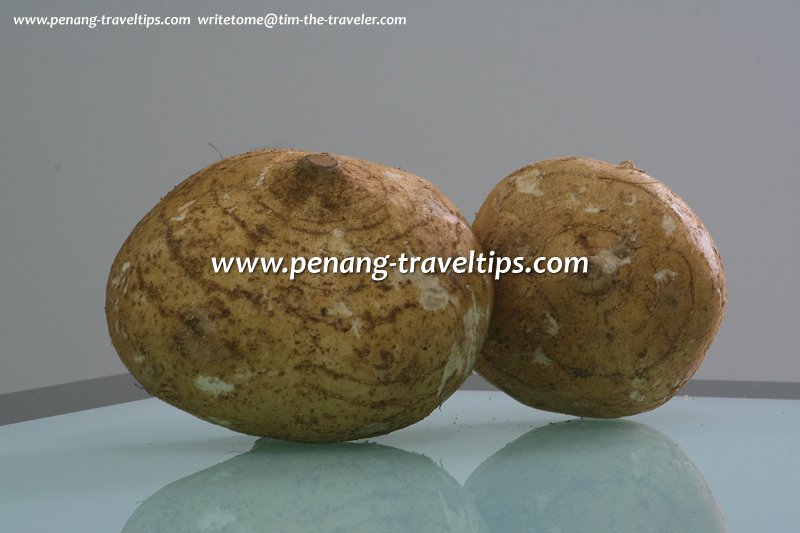 Jicama (also called hongkuak, turnip, mangkuang and sengkuang) (16 August 2008)
Jicama is the English name for hongkuak. To be precise, you might even want to spell it jícama, and pronounce that as hee-kah-mah, as it's really a Spanish word. You can also call it yam bean, although I would not understand why it should be given the name "bean" when there's nothing leguminous about it. Scientifically, it comes from the genus Pachyrhizus. Some people call it turnip, which is acceptable but not quite right, as the turnip also refers to an entirely different type of vegetable.
In Penang, jicama is called hongkuak as well as mangkuang in Hokkien. In Malay, it is known as sengkuang.
The jicama, as you would have guessed from its name, originated in Mexico. It is a member of the morning glory family and a cousin of the sweet potato. In Nyonya cooking, jicama is used in jiu hoo char (fried cuttlefish floss). You also find it in popiah. In the raw form, jicama appears in rojak and pasembur.
Jicama is composed of 80-90% water, and only trace amounts of protein and lipids. It is high in dietary fiber, low in sodium and high in potassium. If you close your eyes and take a bite at the jicama, you'd almost think you are eating water chestnuts. The sweetness comes from the chemical oligofrutose inulin. Jicama stored in a cool, dry place can last for one or two months.
Buy Me A Coffee
Buy Me A Coffee
If you enjoy the information I provide and want to support the work I do, please buy me a coffee! I appreciate it immensely, thank you so much!

Copyright © 2003-2026 Timothy Tye. All Rights Reserved.