
Tun Dr Lim Chong Eu, the Architect of Modern Penang
Lim Chong Eu (Chinese: 林苍祐; Pinyin: Lín Cāngyòu; Pe̍h-ōe-jī: Lîm Chhong-iū) was a Malaysian politician, physician’s son, and statesman who served as the second and longest-serving Chief Minister of Penang from 1969 to 1990. Widely known as the “Architect of Modern Penang,” he played a transformative role in shaping the island’s economic, social, and political landscape during a pivotal period in Malaysian history. His legacy is one of vision, pragmatism, and enduring development, remembered not only in Penang but throughout Malaysia.
Early Life and Family Background
Born on 28 May 1919 in Penang, Lim Chong Eu was the son of Dr. Lim Chwee Leong (林水龙), a respected paediatrician and community leader. Dr. Lim was remembered not only for his medical skill but also for his compassion: through his Soo Beng Dispensary near Prangin Market, he ran a People’s Clinic that dispensed free medicine to the poor. This deep sense of social responsibility left a lasting impression on his son. Growing up in a family that combined education, service, and leadership, young Chong Eu absorbed the values of discipline and duty that would guide his career.
His father’s achievements set a high bar: Dr. Lim was an award-winning medical graduate, president of the Hu Yew Seah, and an active member of the Straits Chinese British Association. These influences, along with the multicultural environment of Penang, helped shape Chong Eu into a cosmopolitan leader attuned to both local concerns and global developments.
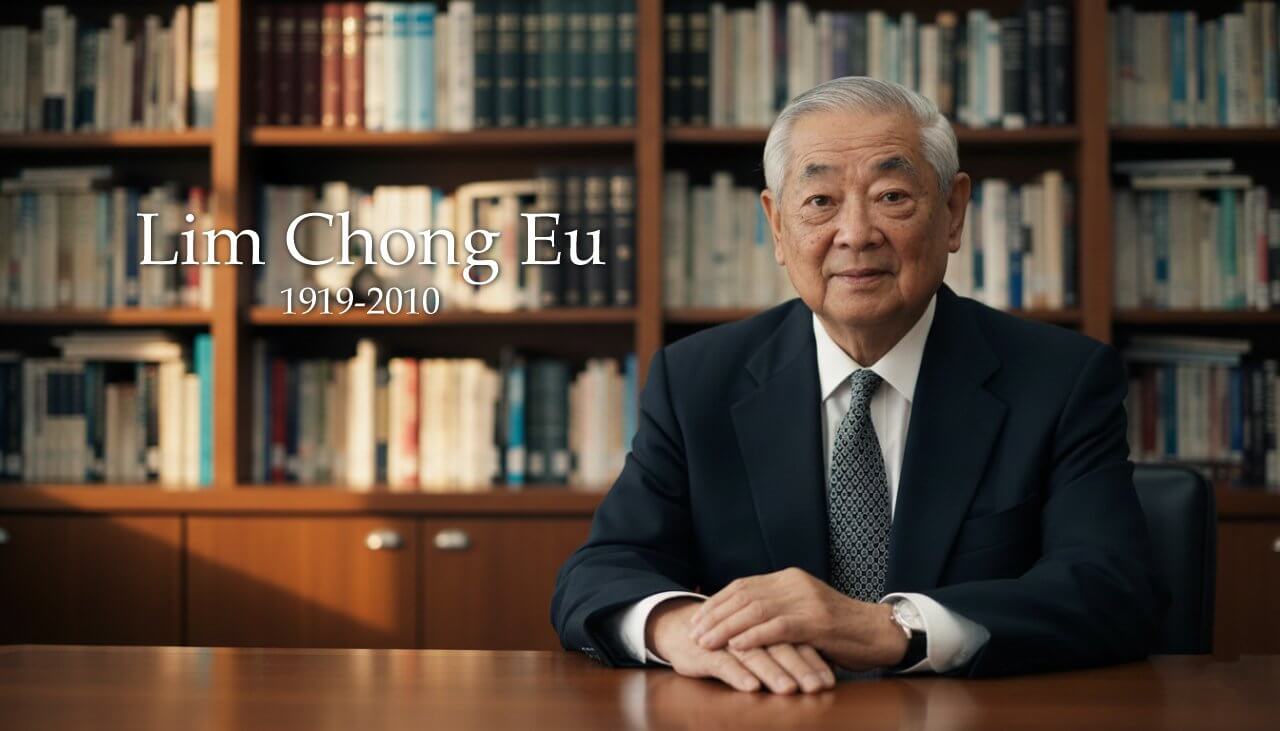 AI-edited image of Tun Dr Lim Chong Eu, SSM, DUPN, DA (4 October 2025)
Education and Medical Training
Lim Chong Eu’s educational path reflected his ambition and intellect. He began his studies at Penang Free School before moving on to King Edward VII College of Medicine in Singapore, the same institution where his father had studied. However, Chong Eu was not content to remain within the Straits Settlements’ orbit. He went on to pursue further medical studies in Edinburgh, Scotland, earning his medical degree. This overseas education broadened his worldview, exposed him to new ideas, and reinforced his belief that Penang and Malaya needed forward-looking leadership to thrive in the modern age.
Entry into Politics
In the late 1940s and early 1950s, Malaya was undergoing rapid political change. Nationalism was rising, colonial authority was waning, and the question of self-governance was at the forefront. Lim Chong Eu, inspired by these currents, entered politics with the belief that Malaya needed leaders who could bridge communities and lead the country toward independence. In 1951, he co-founded the Radical Party in Penang, one of the earliest multi-ethnic political parties in Malaya, reflecting his inclusive vision.
His talents were soon recognized on the national stage. In 1953, he joined the Malayan Chinese Association (MCA), quickly rising through its ranks. By 1958, he was elected President of the MCA, a remarkable achievement that placed him at the heart of Malayan politics just a year after independence was achieved in 1957.
MCA Presidency and National Role
As MCA President from 1958 to 1959, Lim Chong Eu faced enormous challenges. The MCA was a key partner in the Alliance coalition, alongside the United Malays National Organisation (UMNO) and the Malayan Indian Congress (MIC). However, tensions within the coalition and rising demands from the Chinese community put him in a difficult position. Lim advocated for greater equality in education and economic opportunity, famously pushing for 40 parliamentary seats for the MCA in the 1959 elections. This proposal met resistance, and his confrontations with UMNO leaders led to his resignation as MCA President in 1959.
This episode reflected both his independent spirit and his refusal to compromise his principles. Though it ended his leadership of the MCA, it opened the door to a new political path, one that would eventually reshape Penang.
Formation of the United Democratic Party and Gerakan
After leaving the MCA, Lim Chong Eu formed the United Democratic Party (UDP) in 1962. Though the UDP had limited success, it marked an important step in his political journey, emphasizing his belief in multi-ethnic cooperation. In 1968, he co-founded Parti Gerakan Rakyat Malaysia (Gerakan), which quickly grew into a major political force.
Gerakan’s appeal was especially strong in Penang, where the electorate resonated with its platform of integrity, reform, and multi-ethnic unity. In the watershed general election of 1969, Gerakan achieved a stunning victory in Penang, capturing the state government and ending the dominance of the Alliance coalition on the island. Lim Chong Eu was sworn in as Chief Minister of Penang in May 1969.
Chief Minister of Penang (1969–1990)
Lim Chong Eu’s two decades as Chief Minister transformed Penang. His tenure was defined by bold policies, pragmatic leadership, and a vision that looked beyond Penang’s traditional economic base.
Industrialization and the Free Trade Zone
One of Lim’s greatest achievements was the establishment of the Bayan Lepas Free Trade Zone (FTZ) in 1972. At a time when Penang’s economy was stagnating due to the decline of its port, Lim sought to diversify by attracting multinational corporations to invest in electronics manufacturing. Companies such as Intel and Hewlett-Packard were among the first to set up operations in Penang, earning the island its reputation as the “Silicon Valley of the East.”
This bold initiative not only revived Penang’s economy but also laid the foundation for decades of growth, creating jobs, improving infrastructure, and raising Penang’s international profile. It remains one of the most significant economic legacies of any Malaysian leader.
Urban Development and Infrastructure
Beyond industrialization, Lim oversaw major infrastructure projects. He supported housing developments, urban renewal, and the expansion of transport links. His government also sought to balance growth with heritage, though this balance was not always without controversy. In many ways, his administration redefined the physical and economic landscape of Penang.
Leadership Style
Lim Chong Eu was known for his discipline, pragmatism, and no-nonsense approach. He was a leader who valued efficiency and results, often described as austere in demeanor but deeply committed to his work. His ability to bridge communities, think long-term, and take calculated risks made him a statesman ahead of his time.
Later Years as Chief Minister
By the 1980s, Penang had undergone a dramatic transformation under Lim’s stewardship. However, political challenges mounted. Gerakan eventually rejoined the Barisan Nasional coalition in 1972, aligning with UMNO and MCA, which allowed Lim to maintain stability but also drew criticism from some quarters.
In the 1990 general election, Lim and his government were defeated by the Democratic Action Party (DAP), ending his 21-year tenure as Chief Minister. His departure from office marked the end of an era in Penang politics.
Retirement and Later Life
After retiring from politics, Lim Chong Eu lived a quieter life, though he remained a respected elder statesman. He occasionally offered his insights on national and state affairs, always emphasizing moderation, pragmatism, and unity. His contributions were recognized with the title of Tun, one of Malaysia’s highest honors.
On 24 November 2010, Lim Chong Eu passed away at the age of 91 in Penang. His death was widely mourned across Malaysia, with leaders and citizens alike paying tribute to his legacy. His funeral was accorded the highest honors, reflecting the nation’s gratitude for his decades of service.
Legacy
Lim Chong Eu’s legacy is most visible in the Penang of today. The Bayan Lepas Free Trade Zone continues to power the state’s economy. Generations of Penangites have benefited from the industries, infrastructure, and opportunities he set in motion. Streets, institutions, and memorials bear his name, ensuring that his contributions are not forgotten.
But beyond physical achievements, his legacy lies in his vision: the belief that Penang could adapt, compete, and thrive in a changing world. He exemplified leadership rooted in pragmatism and service, qualities that continue to inspire Malaysians across political divides.
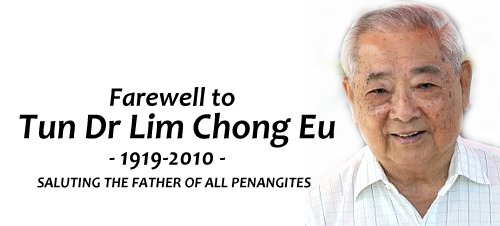
My tribute to Tun Dr Lim Chong Eu at his passing
Tun Dr. Lim Chong Eu was the second Chief Minister of Penang. He is acknowledged as the person who did more to develop Penang than anyone else, living or dead. Dr Lim served Penang for twenty-one years, from 1969 to 1990, during which time he oversaw the transformation of an aging tourist island into a booming state that enjoys one of the highest standard of living in the country.
You could easily read his biography in Wikipedia and other sources. On this page, I will provide you my take on this man, as a Penangite.
Dr Lim Chong Eu was born on 28 May 1919. He went to the same school as my father, who was ten years older, but died thirty years earlier than him. As with Dr Lim, my father was involved in politics, and he had much admiration for Dr Lim. Although I have no interest whatsoever in politics, I admire and esteem Dr Lim for all the good things he has done.
It was Dr Lim who dared the people of Penang to think big and stand proud. Without Dr Lim, the people of Penang would not have jobs in many of the world-famous multinational companies today. Without Dr Lim, Penang would have become a backwater state. Without Dr Lim, there is no Bayan Lepas Free Industrial Zone. Without Dr Lim, there is no Penang Bridge. Without Dr Lim, there is no Komtar. Without Dr Lim, Penangites would not have "free trade zone" and "foreign direct investment" added to their vocabulary. Indeed, without Dr Lim, I would have so much fewer pages to write in Penang Travel Tips, because the state will be so much poorer with much fewer sights to document. Directly for a few and indirectly for all, everyone in Penang has been blessed, from the jobs they hold, the money they keep in the bank, and the malls they visit, because Dr Lim created the environment to make it all possible.
It is not just the people of Penang that have been blessed, it includes many Malaysians who are working in Penang, and the whole Malaysia. It was Dr Lim who brought the electronic factories to Penang, so that today people from other states are working here, buying properties here. Because of Dr Lim, the people of Penang can enjoy prices of real estate that are some of the highest in the country - for better or otherwise - due to his making the island such a choice location to be called home.
Throughout his tenure as the Chief Minister of Penang, Dr Lim has shunned all awards and titles, only to accept the highest title of Tun, upon his retirement. His defeat in the 1990 general election is a black day for Penangites. Although I respect the person who brought Dr Lim's political career to an end, and his son who is now the Penang Chief Minister, I can't say the same of the one who took over the Chief Ministership in 1990, and under whose helm the state was set adrift. That's the case of, when elephants went to war, it's the mousedeer that won.
Upon his retirement, Dr Lim disappeared from the political radar. Although his name crops up here and there in relation to education and horse breeding, he practically receded from public view. Intensely private, he refused to give any interviews to journalists.
I was devastated by the news of his passing on Wednesday, 24 November, 2010 at 9:07 pm. It feels like I have lost a member of my own family. Up until his death there is no road named after him, no monument named in his honour. And I hope none is ever erected, for none can be as big as the one in the heart.
In recognition of Dr Lim's contribution to Penang, the entire length of the Jelutong Expressway and Bayan Lepas Expressway is from 26 November 2010 renamed the Tun Dr Lim Chong Eu Expressway - finally, an instance when he cannot refuse.
Lim Chong Eu Biography on Video
References
- The Star – Obituary: Tun Dr. Lim Chong Eu
- Singapore Infopedia – Lim Chong Eu
- Penang State Government – Tun Dr. Lim Chong Eu
- Penang Monthly – Penang’s Silicon Valley of the East
Page Details
This page was created on 4 October 2025. Hi, my name is Timothy and created it from my research, for my own entertainment, knowledge and to satisfy my curiosity. I am providing the information to you in good faith and hope it is useful. I try to get the details as accurate as possible. I also try to update the page whenever I stumble on new details. So this and all my other pages are perpetual work in progress. If you discover any error, please politely inform me, pointing out where the error lies, and I will correct it as soon as possible. Your helpfulness will keep this page accurate, relevant and helpful to those who need the information.List of Penang's Who's Who
Want to share your Penang travel experiences or get tips from fellow travellers?
Join the Penang Travel Tips Facebook GroupUseful guides for visiting Penang
My Videos of Penang
 Latest Pages & Updates
Buy Me A Coffee
If you enjoy the information I provide and want to support the work I do, please buy me a coffee! I appreciate it immensely, thank you so much!
