
Labuan Travel Guide
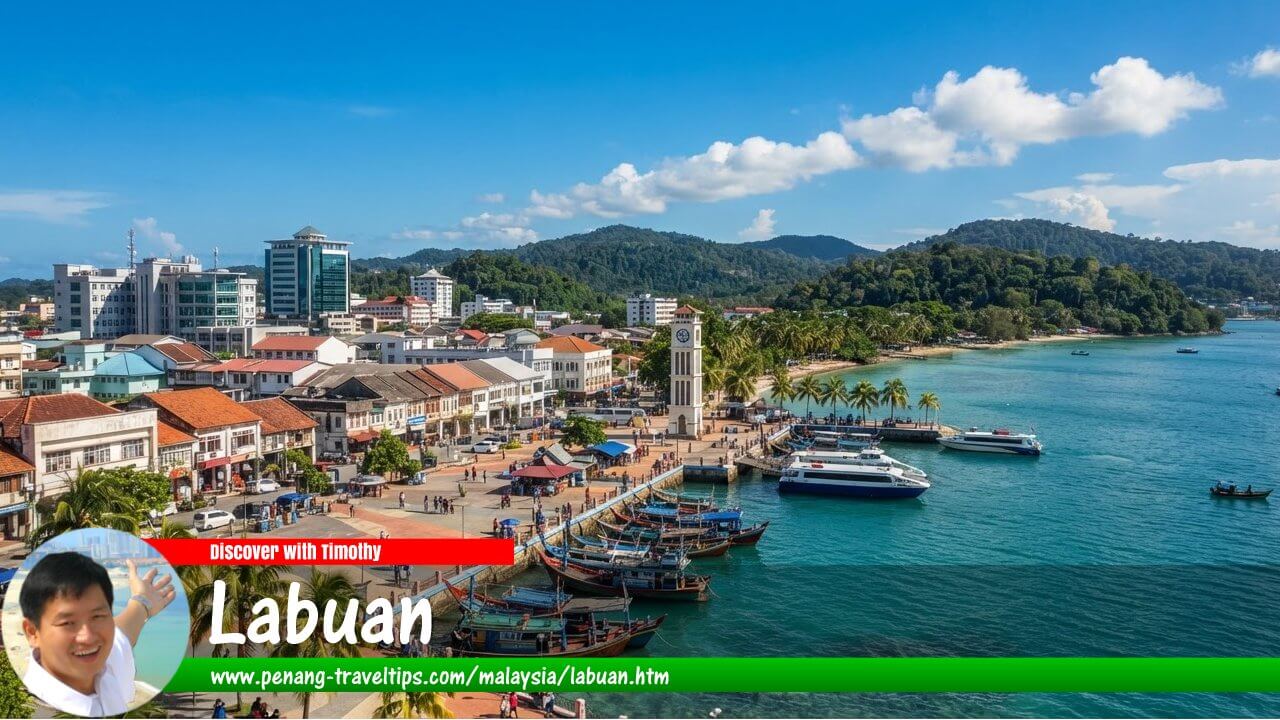 Labuan (AI generated on 22 July 2026)
Also available: Panduan Melawat Labuan
Labuan, officially known as the Federal Territory of Labuan (Malay: Wilayah Persekutuan Labuan), is an island federal territory of Malaysia situated off the west coast of the state of Sabah in East Malaysia.1 Nicknamed Pulau Mutiara Borneo, or "The Pearl of Borneo," the territory comprises Labuan Island together with six smaller surrounding islands, lying at the mouth of Brunei Bay facing the South China Sea.2 Covering an area of roughly 92 square kilometres, Labuan is best known internationally as a duty-free port, an offshore financial and business centre, and an offshore support hub for the region's deepwater oil and gas industry.1 Its capital, Victoria, serves as the administrative and commercial heart of the territory. Beyond its economic role, Labuan carries a rich and layered history, from its origins as a British Crown colony and coaling station to its status today as one of only three federal territories governed directly by Malaysia's federal government.3
Quick Facts
- Official name: Federal Territory of Labuan (Wilayah Persekutuan Labuan)
- Capital: Victoria
- Location: Off the west coast of Sabah, East Malaysia, at the mouth of Brunei Bay
- Area: Approximately 92 square kilometres, comprising Labuan Island and six smaller islands
- Population: Around 137,000 (2025 estimate)
- Government: Direct federal administration, run by the Labuan Corporation
- Federal Territory since: 16 April 1984
- Key industries: Offshore financial services (Labuan IBFC), oil and gas support services, duty-free trade, tourism
- Nickname: Pulau Mutiara Borneo ("The Pearl of Borneo")
- Time zone: UTC+8 (Malaysia Standard Time)
Geography and Climate
Labuan lies just off the coast of Sabah, separated from the Bornean mainland by a narrow strait and positioned close to the Malay state of Brunei, which it faces across Brunei Bay. The territory consists of the main island, Labuan Island, along with six smaller islands: Papan, Rusukan Besar, Rusukan Kecil, Kuraman, Burung, and Daat.2 The terrain is generally low-lying and flat, ringed by sandy beaches, mangrove areas, and coral reefs, which contribute both to its appeal as a tourist destination and to its ecological value as a recognised geopark.4
As with the rest of Malaysia, Labuan experiences a tropical rainforest climate characterised by consistently high humidity and warm temperatures throughout the year. Rainfall is distributed across the seasons, though the drier months, from roughly March to October, are generally considered the best time for outdoor and diving activities, when underwater visibility is at its clearest.4
History
Early History and British Rule
Long before it became a federal territory, Labuan was under the control of the Sultanate of Brunei. Its natural harbour and strategic position along Southeast Asian trade routes made it a useful stop for merchants and mariners.5 On 24 December 1846, the Sultan of Brunei ceded Labuan to the British Crown, with the British flag raised at what is now known as Ramsey Point.6 Under British administration, the island became part of the Straits Settlements and later developed as a coaling station, supplying coal to steamships of the British Royal Navy travelling through the region.5 Remnants of this era survive today in the form of the mysterious 32-metre brick Chimney, built with more than 23,000 imported bricks, whose exact original purpose remains debated among historians.5
World War II
Labuan played a significant role during the Second World War as part of the Borneo Campaign. Japanese forces occupied the island during the war, and it later became the site of a major Allied landing and, eventually, the formal Japanese surrender in Borneo. On 9 or 10 September 1945, depending on the historical account, Lieutenant General Masao Baba of the Japanese Imperial Army formally surrendered to Major General George Wootten of the Australian Imperial Forces at what is now preserved as Surrender Point.7 The Labuan War Cemetery, maintained today by the Commonwealth War Graves Commission, stands as the largest war memorial of its kind in Malaysia, with more than 3,900 Allied soldiers from Australia, Britain, India, and other nations laid to rest there, many of whom perished during the notorious Sandakan-Ranau death marches.8
Path to Federal Territory Status
After the war, Labuan was returned to North Borneo and its duty-free status, first granted decades earlier, was reinstated in 1956.6 In 1963, Labuan joined the newly formed Federation of Malaysia together with Sabah and Sarawak, becoming part of the state of Sabah. This arrangement changed on 16 April 1984, when the Sabah state government agreed to cede Labuan to the federal government, and it was officially gazetted as Malaysia's second Federal Territory, following Kuala Lumpur.9 The move was driven largely by economic strategy: the federal government envisioned Labuan as an international offshore financial centre that could rival other regional hubs, a vision formalised on 1 October 1990 when Labuan was officially legislated into that role.1
Government and Administration
Unlike Malaysia's thirteen states, Labuan does not have its own state government or Chief Minister. Instead, it is administered directly by the federal government through the Ministry of Federal Territories, alongside Kuala Lumpur and Putrajaya.3 Day-to-day municipal governance is carried out by the Labuan Corporation (Perbadanan Labuan), a statutory body headed by a chairman appointed to oversee local development, infrastructure, and administration.10 This structure of direct federal administration is intended to keep Labuan's development closely aligned with national economic policy, particularly given its specialised role as a financial and business centre.
Economy
Labuan International Business and Financial Centre
The cornerstone of Labuan's modern economy is Labuan IBFC, the Labuan International Business and Financial Centre, which has operated as Malaysia's offshore financial hub since 1990.2 Companies incorporated in Labuan can benefit from a notably favourable tax regime, including a corporate tax rate as low as 3 percent for qualifying trading activities, exemptions on certain non-trading offshore income, provisions for full foreign ownership, and duty-free status with no import or export tariffs on many goods.6 These incentives have attracted a wide range of financial institutions, insurance companies, and holding entities, positioning Labuan as a competitive alternative to other Asian offshore centres.
Oil, Gas, and Maritime Services
Labuan also functions as a key offshore support base for the oil and gas industry operating in the surrounding waters of Sabah and Sarawak. Its port facilities and logistics infrastructure support deepwater exploration and production activities, making the territory an important, if lesser-known, contributor to Malaysia's energy sector.2 Despite its relatively small population, Labuan generates a disproportionately large economic output, with gross domestic product figures reported in the billions of ringgit, reflecting the concentrated value of its financial and energy-related industries.6
Duty-Free Trade
As the only duty-free port in East Malaysia, Labuan draws shoppers and day-trippers seeking tax-free alcohol, chocolate, cigarettes, and other goods, particularly visitors arriving by ferry from Sabah's mainland or from neighbouring Brunei.4 This trade supplements tourism revenue and supports a retail sector geared toward both residents and visiting travellers.
Demographics and Culture
Labuan is home to a population of roughly 137,000 people as of recent estimates, a relatively small figure that nonetheless reflects considerable ethnic and cultural diversity.3 The population includes Malays, Bruneian Malays, Chinese, Kadazan-Dusun, and other indigenous Bornean communities, alongside smaller groups such as Sikh residents, giving the territory a genuinely multicultural character for its size.11 This diversity is visible in the island's places of worship and cultural sites, including the Labuan State Mosque and the Gurdwara Sahib, as well as in the water villages inhabited by Brunei-Malay communities.11
Malay is the predominant language, though English is widely used in business and financial circles given Labuan's role as an international centre, and Chinese dialects and various indigenous languages are also spoken within their respective communities. Islam is the majority religion, but Buddhism, Christianity, Sikhism, and other faiths are practised as well, and the island's calendar of festivals reflects this blend, with celebrations spanning Islamic holidays, Chinese New Year, national independence festivities, and multicultural heritage events.4
Tourism and Attractions
While long overshadowed by better-known Malaysian destinations, Labuan has steadily developed into a tourist stop for travellers passing through Sabah, visitors from Brunei, and scuba diving enthusiasts.2 Its attractions span history, nature, and marine adventure.
Historical Sites
- Labuan War Cemetery — a solemn, immaculately maintained Commonwealth War Graves Commission site honouring more than 3,900 Allied servicemen who died during the Borneo Campaign.8
- Surrender Point — the waterfront location where Japanese forces formally surrendered to Australian troops in September 1945, marking the end of World War II in Borneo.7
- Peace Park — a landscaped memorial garden funded by Japan as a gesture of remembrance and reconciliation, featuring a stone inscribed "Peace is Best" in Japanese and English.9
- The Chimney — a 32-metre brick structure from the British colonial era whose original function remains a subject of local legend and historical debate.5
- Labuan Museum and Labuan Marine Museum — smaller museums covering local history, wartime artefacts, and maritime heritage.9
Nature and Recreation
- Labuan Botanical Garden — a tranquil green space showcasing tropical flora native to Borneo and Southeast Asia.11
- Labuan Bird Park — a family-friendly attraction on the island's northeast point, home to a variety of bird species.11
- Labuan Marine Park — a protected marine area recognised as a geopark, encompassing coral reefs and diverse underwater ecosystems.4
Scuba Diving
Labuan is regarded as one of Southeast Asia's more distinctive diving destinations thanks to its four well-known wreck dive sites: the Blue Water Wreck, the Australian Wreck, the American Wreck, and the Cement Wreck.12 These sunken vessels, several dating to the World War II era, attract divers of varying experience levels and support a small but dedicated diving tourism industry, best enjoyed during the drier months when water visibility is highest.13
Connectivity and Infrastructure
Labuan is served by Labuan Airport, which connects the territory to Kota Kinabalu and other domestic destinations, as well as by a ferry terminal offering regular services to Sabah's mainland and to Brunei.3 Development authorities have periodically explored plans to expand airport facilities and attract direct international flights, particularly from Northeast Asian markets, with the aim of boosting inbound tourism and reducing reliance on transit through Kota Kinabalu.1
Conclusion
From its origins as a Brunei-controlled trading post and British coaling station to its transformation into a modern offshore financial and energy services hub, Labuan's story reflects a small island punching well above its size in economic and strategic significance. Its layered history, encompassing colonial-era landmarks, sobering World War II memorials, and a distinctly multicultural population, gives the territory a depth that belies its modest 92 square kilometres. Combined with its duty-free trade status, scuba diving opportunities, and steadily growing tourism profile, Labuan remains a federal territory whose relevance to Malaysia extends well beyond its geography, quietly anchoring the country's presence in international finance and offshore energy while offering visitors a genuinely distinctive corner of Borneo to explore.
References
- Baidu Wiki. "Labuan (a Federal Territory of Malaysia)."
- Malaysia Wiki, Fandom. "Labuan."
- Wikipedia. "Labuan."
- Labuan Tourism. "Discover Labuan – The Pearl of Borneo."
- Business Today. "The Real Reason Labuan Became A Federal Territory."
- Cilisos. "In 1984, Sabah gave up Labuan to make it a Federal Territory. But why?"
- Visit Malaysia. "Labuan Island - Discover the Wonder of Labuan."
- Travel.com. "Labuan Island, Malaysia: Best Things to Do."
- HolidayGoGoGo. "Labuan Tourist Attractions, Activities and Hotels Guide."
- Valsen Corporate. "About Labuan."
- Malaysia Uncovered. "16 Top Things To Do In Labuan, Malaysia."
- Grab. "Top 10 Attractions in Labuan Malaysia You Shouldn't Miss."
- Live in Malaysia. "LABUAN Island in Malaysia: what to know, how, where, beaches."
Page Details
This page was created on 22 July 2026. Hi, my name is Timothy and created it from my research, for my own entertainment, knowledge and to satisfy my curiosity. I am providing the information to you in good faith and hope it is useful. I try to get the details as accurate as possible. I also try to update the page whenever I stumble on new details. So this and all my other pages are perpetual work in progress. If you discover any error, please politely inform me, pointing out where the error lies, and I will correct it as soon as possible. Your helpfulness will keep this page accurate, relevant and helpful to those who need the information.My Videos of Malaysia
 Latest Pages & Updates
Buy Me A Coffee
If you enjoy the information I provide and want to support the work I do, please buy me a coffee! I appreciate it immensely, thank you so much!
