
Mentakab Travel Guide
 Mentakab Travel Guide (AI generated on 10 September 2026)
Also available: Panduan Melawat Mentakab
Mentakab is a historic town in central Pahang, Malaysia, situated in Temerloh District and approximately 9 kilometres northwest of Temerloh. Once considered as a possible capital of Pahang, Mentakab developed into an important transport and commercial centre, particularly after the arrival of the railway. Today, it is a modest but lively Malaysian town surrounded by rivers, agricultural land and forest, and serves as a convenient base for exploring the wider Temerloh area.1
Quick Facts
- Location: Temerloh District, central Pahang, Peninsular Malaysia
- Distance from Temerloh: About 9 km
- Distance from Kuala Lumpur: About 82 km
- District: Temerloh
- Known for: Railway heritage, old-town atmosphere, local food and its proximity to Temerloh's rivers and natural attractions
- Historical name: Pasir Rawa
- Railway: KTM Intercity East Coast Line
- Nearby town: Temerloh
- Local recreation: Chatin Lake Recreation Forest and other nearby riverside and nature attractions
- Best suited to: Road trips, railway journeys, food trips, short stopovers and exploration of central Pahang
About Mentakab
Mentakab is one of the principal towns of central Pahang and one of the two major urban centres in Temerloh District, the other being Temerloh. The two towns are close enough that they are often experienced together by visitors. Mentakab has its own commercial centre, railway station, residential areas and industrial activities, while Temerloh is particularly associated with the Pahang River, freshwater fish and riverside recreation.1
For travellers, Mentakab is not a conventional resort destination. Instead, it offers an opportunity to experience an ordinary but historically interesting Pahang town. Its appeal lies in its townscape, railway heritage, local food, markets and position as a gateway to the surrounding countryside.
Mentakab is particularly useful as a stop on a journey through central Pahang. It is connected by road with Kuala Lumpur, Temerloh and other towns, while the KTM Intercity railway provides a direct rail connection along the East Coast Line. Visitors who enjoy travelling by train may therefore find Mentakab more interesting than its relatively quiet appearance initially suggests.
Geography and Setting
Mentakab lies in central Pahang, within the wider Temerloh area. The town is situated northwest of Temerloh and is part of a landscape dominated by low hills, river valleys, agricultural land and tropical vegetation. The wider Temerloh district lies around the confluence of the Pahang River and Semantan River, giving the area a strong connection with river-based settlement and transportation.2
The surrounding countryside is considerably more rural than the town itself. Outside the built-up area, visitors encounter villages, plantations, farms and stretches of undeveloped vegetation. This makes Mentakab a useful starting point for exploring the less urban side of central Pahang.
Mentakab's geographical importance is also related to its position between western and eastern parts of the peninsula. Roads and railways passing through the area historically helped connect the interior of Pahang with the more developed west coast. This role continues today, although modern expressways have changed the principal travel patterns.
History of Mentakab
From Pasir Rawa to Mentakab
Mentakab was formerly known as Pasir Rawa. During the late 19th century, the settlement emerged at an important period in the development of central Pahang. The area was considered strategically significant because of its relatively central location within the state.3
The development of Mentakab was closely connected with the wider administrative reorganisation of Pahang during the late 19th century. When the British administration became established in the state, Pahang was divided into several administrative districts, including Temerloh. At that time, Kuala Semantan was the principal town in the area, while the newer town of Temerloh subsequently developed to the west.4
A candidate for the capital of Pahang
One of the most interesting episodes in Mentakab's history was its consideration as a possible capital of Pahang. During the late 19th century, the state government was looking for a suitable location to replace Pekan as the administrative centre.
Mentakab and the Temerloh area were among the locations considered. However, Mentakab ultimately lost out to Kuala Lipis, which became the state capital in 1898. The state administrative centre was subsequently moved from Kuala Lipis to Kuantan in 1955.5
The fact that Mentakab was once considered for the role of state capital gives the town an importance that is not immediately obvious to first-time visitors. Its central position and connections with the developing transport network made it a significant location during a formative period in Pahang's history.
The arrival of the railway
The railway played a major role in the development of Mentakab. The town's railway station is on the KTM Intercity East Coast Line, which forms part of the railway route connecting Gemas in Negeri Sembilan with the east coast and Kelantan.6
The Mentakab railway station dates from the early 20th century, with the station recorded as having opened in 1911. The arrival of the railway strengthened the town's role as a transportation and commercial centre and linked it with other developing settlements in Pahang and the wider peninsula.7
The railway remains one of Mentakab's most distinctive features. For visitors interested in railway history, the station provides a tangible reminder of the period when the expansion of rail transport was transforming travel and trade in the interior of the Malay Peninsula.
Economic development
Mentakab subsequently developed a diverse economy based on commerce, agriculture, timber-related activities and manufacturing. Its location within a timber-producing region contributed to the development of wood-processing industries, while its transport connections supported the movement of agricultural and industrial products.
The town has also been associated with the manufacture of plywood, sawn timber and paper products. Industrial development became particularly significant during the later 20th century, adding a modern economic dimension to a town whose earlier growth had been closely associated with transport and agriculture.8
Things to Do in Mentakab
Explore the town centre
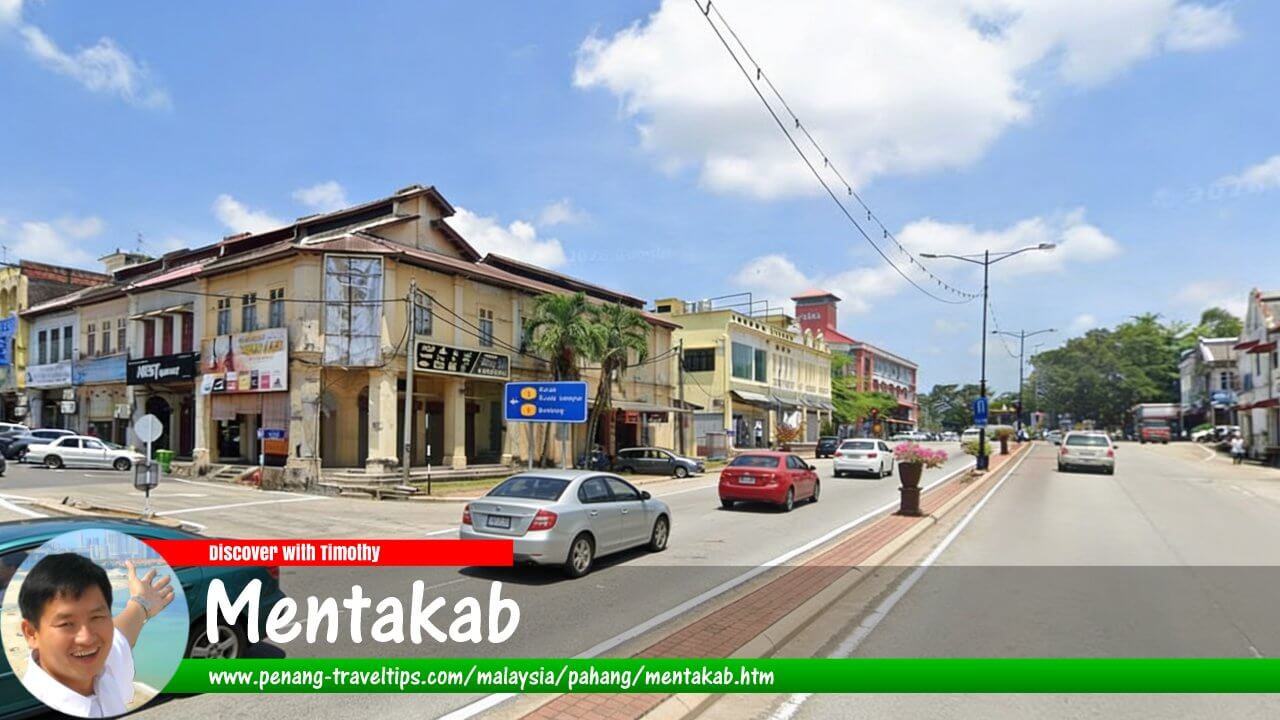
The most straightforward way to experience Mentakab is simply to explore the town centre. The older commercial streets contain two-storey shophouses, small businesses, restaurants, coffee shops and other establishments serving the local population.
Visitors should not expect a large concentration of formal monuments. Mentakab's attraction is more subtle: it is a working Malaysian town where older commercial architecture exists alongside modern shops and everyday urban activity.
A morning or late-afternoon walk is particularly suitable. The heat can be considerable during the middle of the day, so early morning and evening are generally more comfortable for exploring on foot.
Visit Mentakab Railway Station
Mentakab Railway Station is one of the town's most interesting landmarks. The station is served by KTM Intercity trains operating along the East Coast Line, making it possible to reach Mentakab without driving.6
The station is also useful for understanding Mentakab's historical importance. The railway was instrumental in connecting the interior of Pahang with the national transport network, and the station remains part of that railway corridor today.
Train services can change according to the current timetable, so visitors intending to use the railway should check the latest KTM schedule before planning their journey.
Chatin Lake Recreation Forest
Chatin Lake Recreation Forest is one of the principal recreational areas in Mentakab. The site retains a relatively natural forest environment with tall trees providing shade and a lake that supports freshwater fish and other aspects of the local ecosystem.9
The recreation area has facilities including a children's playground, exercise equipment, food stalls and toilets. It is therefore more suitable for a relaxed family outing than for a demanding wilderness excursion.
The forest is particularly useful for visitors who want a break from the town without travelling a long distance. It can be included in a short Mentakab itinerary alongside the town centre and local food stops.
Explore nearby Temerloh
Because Mentakab is only about 9 kilometres from Temerloh, visitors should consider the two towns as part of the same travel area. Temerloh offers attractions that complement Mentakab's urban and railway character, particularly its riverfront and food culture.1
The Pahang River is one of Temerloh's defining features. The riverfront area provides a place for residents to relax and exercise, particularly during the evening, while the wider district is known for freshwater fish and riverside activities.2
Other attractions within the wider Temerloh area include Kubang Gajah Waterpark, Esplanade Park, Patin Square, Gunung Senyum, Deerland Park and the Kuala Gandah Elephant Conservation Centre.10
Explore rural Pahang
Mentakab is also a useful starting point for exploring the villages and countryside of central Pahang. A drive outside the town reveals a landscape of kampung settlements, agricultural land and tropical vegetation.
Travellers who prefer slow tourism can make the journey itself part of the experience, stopping at small food stalls, local shops and village attractions rather than concentrating only on formal tourist sites.
Food in Mentakab
Mentakab is a good destination for visitors who enjoy everyday Malaysian food. The town has a mixture of Malay eateries, Chinese restaurants, coffee shops, food stalls and casual restaurants serving the local population.
As Mentakab is part of the wider Temerloh food region, visitors should also look for ikan patin, one of central Pahang's best-known foods. The freshwater catfish is associated particularly strongly with Temerloh and the Pahang River, and it is commonly prepared in dishes such as patin tempoyak.11
Patin tempoyak combines freshwater catfish with a fermented durian-based gravy. Its strong flavour makes it a dish that some visitors immediately enjoy and others may need time to appreciate. For travellers interested in regional Malaysian cuisine, however, it is one of the most distinctive dishes to try in the Temerloh-Mentakab area.
Visitors should also explore the local coffee-shop culture. A simple breakfast of noodles, rice, bread or other local dishes accompanied by coffee or tea can provide a more authentic experience of daily life than eating exclusively at restaurants designed for tourists.
Markets and Shopping
Mentakab has a number of everyday shopping areas, shops and markets serving residents from the town and surrounding villages. These are more useful for experiencing local life and buying ordinary Malaysian products than for finding major tourist souvenirs.
The town's markets can be particularly interesting in the morning, when fresh produce and prepared food are available. Visitors should arrive early if they want to see the greatest level of activity.
For a larger traditional market experience, the nearby Temerloh area is worth visiting. Temerloh is known for its Pekan Sehari, a long-established Sunday market where local produce and food are traded.12
Where to Stay in Mentakab
Mentakab has a selection of modest hotels, guesthouses and other accommodation suitable for short stays. The choice is smaller than in major Malaysian cities, but there are sufficient options for travellers making an overnight stop or using the town as a base for exploring central Pahang.
Staying in Mentakab is particularly convenient for travellers arriving by train because the railway station is located within the town. It is also practical for motorists who want to break a longer journey between Kuala Lumpur and destinations farther east.
Travellers looking for a wider selection of hotels, restaurants and services can also stay in nearby Temerloh. The short distance between the two towns means that choosing one over the other does not significantly restrict access to the attractions of the surrounding area.
During weekends, school holidays and public holidays, it is sensible to reserve accommodation in advance, particularly if Mentakab or Temerloh forms part of a larger road-trip itinerary.
How to Get to Mentakab
By car from Kuala Lumpur
Mentakab is approximately 82 kilometres from Kuala Lumpur and can be reached by road in around one and a half to two hours under normal conditions, depending on the starting point and traffic.1
The most convenient modern route from Kuala Lumpur is generally through the Kuala Lumpur–Karak Expressway and East Coast Expressway, followed by the appropriate exit towards Temerloh and Mentakab. The exact route depends on traffic conditions and the traveller's starting point.
Drivers should allow additional time during Friday afternoons, weekends, public holidays and festive periods, when traffic between Kuala Lumpur and the east coast can become considerably heavier.
From Temerloh
Mentakab is only about 9 kilometres from Temerloh, making the journey between the two towns quick and straightforward. The two towns are connected by the local road network and can easily be combined in a single day of sightseeing.1
By train
For visitors who enjoy railway travel, KTM Intercity provides one of the most interesting ways to reach Mentakab. The town's railway station lies on the East Coast Line, which runs through Pahang towards Kelantan and also connects southwards with Gemas.6
The current KTM Intercity network includes Mentakab among the stations on the East Coast Line, together with destinations such as Triang, Kuala Krau, Jerantut, Kuala Lipis, Gua Musang and Tumpat.13
Travellers should check the current KTMB timetable before travelling because train frequencies and stopping patterns may change.
By bus
Bus services connect Mentakab with surrounding towns and larger transport centres. However, visitors coming from Kuala Lumpur may find a combination of express bus services to the Temerloh area and local road transport more convenient than relying entirely on local buses.
For travellers who do not intend to explore far beyond the town, public transport can be adequate. Those planning to visit several rural attractions should consider renting a car or arranging private transport.
Getting Around Mentakab
A private car is the most convenient form of transport for exploring Mentakab and its surrounding area. The town itself is relatively compact, and some parts of the commercial centre can be explored on foot, but attractions outside the town are more easily reached by car.
Taxis and e-hailing services may be available, but coverage and availability can be less predictable than in Kuala Lumpur or other major cities. Visitors relying on these services should arrange return transport in advance if travelling to a rural attraction.
Those arriving by train can use the railway station as the starting point for a short exploration of the town. For a wider itinerary covering Mentakab, Temerloh and rural attractions, however, having a vehicle provides considerably greater flexibility.
When to Visit Mentakab
Mentakab can be visited throughout the year. Because most activities are town-based or involve short road journeys, there is no single season that is essential for a visit.
The dry and relatively settled periods are more convenient for road trips and outdoor recreation, while the wetter months can produce lush vegetation and fuller rivers. Heavy rain, however, can affect outdoor activities and cause temporary difficulties on rural roads.
Visitors travelling during public holidays should expect more traffic on the main roads between Kuala Lumpur, Mentakab, Temerloh and the east coast. Accommodation should also be booked in advance during busy periods.
How Long to Spend in Mentakab
A half-day is enough for visitors who simply want to explore the town centre, visit the railway station and have a meal.
A full day allows a more relaxed visit, combining the town with Chatin Lake Recreation Forest and a longer meal stop. If the trip includes Temerloh, a full day becomes more worthwhile because the two towns are so close together.
A two-day stay is preferable for travellers using Mentakab as a base for exploring the wider district. This provides enough time to combine local food, markets, riverside attractions and selected nature destinations without making the trip feel rushed.
Suggested Mentakab Itineraries
Half-day Mentakab visit
- Morning: Arrive in Mentakab and explore the town centre.
- Late morning: Visit Mentakab Railway Station and surrounding streets.
- Lunch: Enjoy local noodles, rice dishes or other Malaysian food.
- Afternoon: Continue your journey or travel to nearby Temerloh.
One-day Mentakab and Temerloh trip
- Morning: Explore Mentakab's old commercial area and railway station.
- Late morning: Visit Chatin Lake Recreation Forest.
- Lunch: Try local food, including patin if available.
- Afternoon: Travel to Temerloh and visit the riverside area.
- Evening: Explore local food stalls or return to Mentakab for the night.
Two-day central Pahang trip
- Day 1: Explore Mentakab, its railway heritage, town centre and food scene.
- Day 1 evening: Stay overnight in Mentakab or Temerloh.
- Day 2 morning: Explore Temerloh and its riverside attractions.
- Day 2 afternoon: Choose a nearby nature or rural attraction.
- Day 2 evening: Continue towards Kuala Lumpur or another destination in Pahang.
Practical Travel Tips
- Check train schedules: KTM Intercity services are useful but should be planned around the current timetable.
- Use a car for rural exploration: A vehicle gives much greater flexibility outside the town.
- Try local food: The Mentakab-Temerloh area is particularly suitable for experiencing freshwater fish and everyday Pahang cuisine.
- Start early: Morning is generally the most comfortable time to explore markets and outdoor areas.
- Carry cash: Smaller food stalls and traditional businesses may not accept cards.
- Allow extra driving time: Traffic can increase considerably during weekends and public holidays.
- Check weather conditions: Heavy rain may affect outdoor activities and rural roads.
- Combine Mentakab with Temerloh: The towns are close enough to visit together rather than treating them as separate destinations.
Mentakab as a Travel Destination
Mentakab is not a destination that depends on grand monuments or major resort attractions. Its appeal comes from the character of a historic Malaysian town, its railway heritage, its position within central Pahang and its proximity to the rivers, food and natural attractions of the Temerloh area.
Its history makes the town particularly interesting. Mentakab was once considered as a possible capital of Pahang, later became an important railway town and subsequently developed into a commercial and industrial centre. These layers of history can still be understood through its location, railway station and townscape.
For Malaysian travellers, Mentakab makes a practical stop on a road trip between Kuala Lumpur and central or eastern Pahang. For international visitors, it offers a chance to experience a smaller inland Malaysian town rather than limiting a Pahang itinerary to the state's better-known beaches, highlands and national parks.
The town is also best experienced together with its surroundings. A visit to Mentakab can easily be combined with Temerloh, the Pahang River, Chatin Lake Recreation Forest and other attractions in the wider district. This makes it particularly suitable for travellers who enjoy slow travel, local food, railway journeys and exploring places beyond the main tourist routes.
Ultimately, Mentakab is a useful gateway to central Pahang. Its modest appearance should not obscure its historical importance or its practical location. Whether arriving by train, stopping during a road trip or using the town as a base for exploring Temerloh, Mentakab provides a convenient introduction to this part of Pahang.
References
- Tourism Pahang – Temerloh: Centre of the Peninsular.
- Tourism Pahang – Temerloh and the Pahang River.
- Universiti Teknologi MARA – Study on Mentakab.
- Majlis Perbandaran Temerloh – Temerloh Background.
- Portal Rasmi Kerajaan Negeri Pahang – Sejarah Pentadbiran Pahang.
- KTM Intercity – East Coast Line.
- Mentakab KTM Railway Station.
- Malaysian Timber Industry – Wood Processing and Timber Industry.
- Majlis Perbandaran Temerloh – Chatin Lake Recreation Forest.
- Majlis Perbandaran Temerloh – Places of Interest.
- Tourism Pahang – Temerloh Food and Local Attractions.
- Tourism Pahang – Pekan Sehari and Temerloh.
- Keretapi Tanah Melayu – Integrated Ticketing System.
Page Details
This page was created on 10 September 2026. Hi, my name is Timothy and created it from my research, for my own entertainment, knowledge and to satisfy my curiosity. I am providing the information to you in good faith and hope it is useful. I try to get the details as accurate as possible. I also try to update the page whenever I stumble on new details. So this and all my other pages are perpetual work in progress. If you discover any error, please politely inform me, pointing out where the error lies, and I will correct it as soon as possible. Your helpfulness will keep this page accurate, relevant and helpful to those who need the information.Buy Me A Coffee
If you enjoy the information I provide and want to support the work I do, please buy me a coffee! I appreciate it immensely, thank you so much!
