
Gopeng Travel Guide
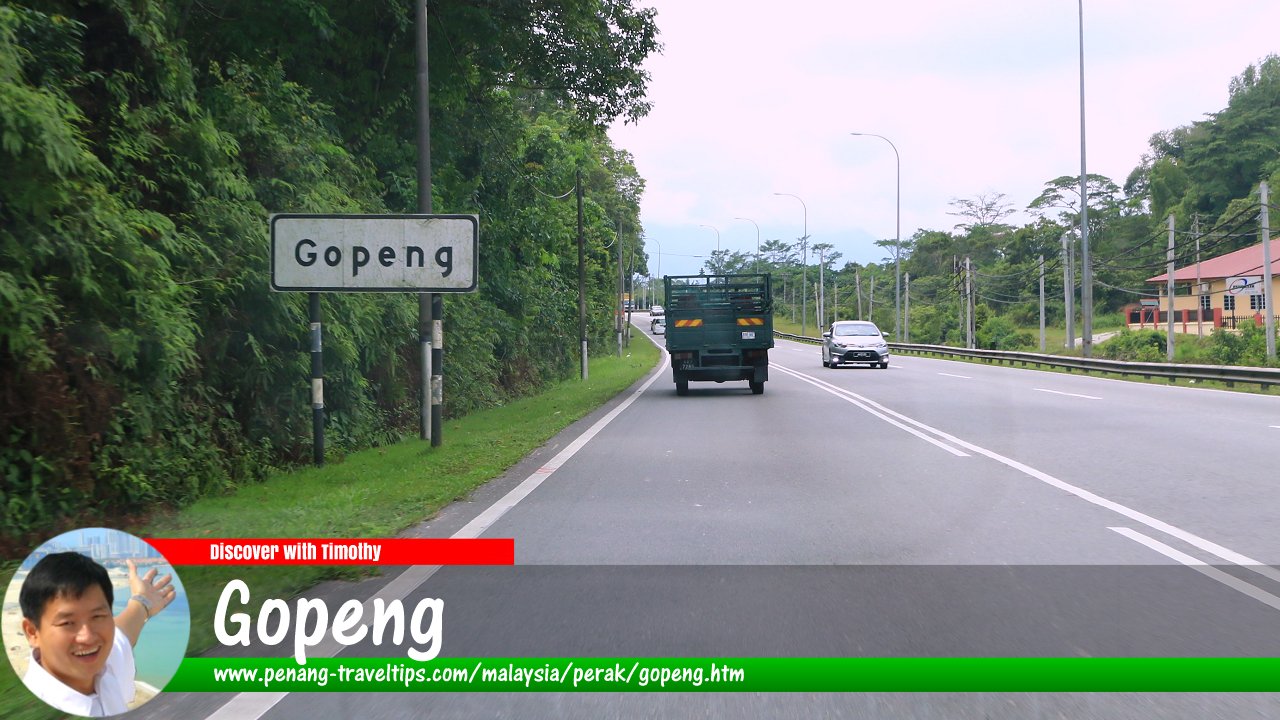 Gopeng signboard on the road into town (12 August 2017)
Also available: Panduan Melawat Gopeng
Gopeng is a small town in Kampar District, Perak, with a history closely connected to the rise of the Kinta Valley's tin-mining industry. Once one of the most important mining towns in Perak, Gopeng today is better known as a destination for heritage, caves, rivers, rainforest and outdoor adventure. It lies about 20 kilometres south of Ipoh and is easily accessible from the North-South Expressway.
The town itself retains old shophouses and other reminders of its mining past, while the surrounding countryside provides access to Gua Tempurung, the Kampar River, Gaharu Tea Valley, rainforest trails, waterfalls and adventure activities. This combination makes Gopeng suitable both for travellers interested in the history of Perak and for visitors looking for outdoor experiences.
Quick Facts
Location: Gopeng, Kampar District, Perak, Malaysia
Coordinates: 4.47143, 101.16648
Distance from Ipoh: About 20 km south
District: Kampar
Local authority: Majlis Daerah Kampar
Historical importance: Former major tin-mining centre of the Kinta Valley
Best known for: Gua Tempurung, heritage buildings, white-water rafting, caving, rainforest activities and Gaharu Tea Valley
Nearest railway stations: Batu Gajah and Kampar
Main road access: Federal Route 1 and the North-South Expressway
Where is Gopeng?
Gopeng is in the southern part of the Kinta Valley, in the present-day Kampar District of Perak. The town is situated on Federal Route 1 between Ipoh and Kampar, while the North-South Expressway runs nearby. The Gopeng interchange provides convenient access from the expressway.
To the east are the foothills and forested mountains of the Main Range, while limestone hills and former mining landscapes characterise much of the surrounding area. The countryside around Gopeng includes villages such as Sungai Itek, Pintu Padang, Jelintoh and Geruntum.
Gopeng is particularly convenient for visitors coming from Ipoh. It can also be incorporated into a longer journey between Kuala Lumpur and northern Perak.
A Brief History of Gopeng
Gopeng developed as a mining settlement during the nineteenth-century expansion of tin mining in the Kinta Valley. The town is older than Ipoh and became one of the valley's principal mining centres.
By the late nineteenth century, Gopeng had attracted Chinese, Malay, Indian, European and other communities involved in mining, commerce, administration and agriculture. Chinese miners included large numbers of Cantonese and Hakka immigrants, while Malay, Rawa, Mandailing and Orang Asli communities were also part of the wider Gopeng area.
The town grew rapidly during the 1880s and 1890s. A major fire in April 1887 destroyed many buildings, after which Gopeng was rebuilt. By the late nineteenth century it had developed government facilities, shops, a market, police facilities and other urban amenities. European mining companies, including the Straits Trading Company and Gopeng Tin Mining Company, subsequently became important participants in the local mining industry.
Gopeng's importance declined as Ipoh emerged as the principal urban centre of the Kinta Valley and mining activity shifted elsewhere. The depletion of tin deposits and changes in the mining industry further reduced the town's economic importance. Some of its historic buildings survived, however, and these now form part of Gopeng's heritage landscape.
The town's mining history can still be seen in its old streets, former mining areas, heritage buildings and museums. Gopeng's history is therefore closely linked to the wider story of how tin mining transformed Perak in the nineteenth and twentieth centuries.
Gopeng's Heritage
One of the most interesting aspects of Gopeng is that it remains a relatively small town despite its former importance. Walking through the older part of town provides a glimpse of the commercial landscape that developed during the mining era.
Eu Kong Street is particularly significant. Historic shophouses associated with the Eu family remain along the street. The family became closely associated with mining and commerce in Perak, and Eu Tong Sen later became one of the most prominent businessmen in British Malaya.
Some of the older buildings contain decorative architectural details that reflect the prosperity of the mining period. The surviving streetscape is considerably more modest than that of George Town or Ipoh, but this is part of Gopeng's appeal: the town offers a more intimate view of a former mining settlement.
Muzium Gopeng
Muzium Gopeng, also known as the Gopeng Heritage House, documents the history and development of the town. It was established as a community-based initiative to preserve Gopeng's heritage and has collected old photographs, household objects, mining equipment and other artefacts.
The museum is now located at 47, 49, 51 and 53 Jalan Eu Kong, in buildings that were formerly associated with a horse stable belonging to Eu Tong Sen. The museum's collection illustrates the lives of earlier residents as well as the importance of tin mining, rubber and other economic activities.
As of 2026, the Kampar District Council lists the museum as operating by appointment. Travellers should therefore contact the museum before making a special journey to visit it.
The museum also serves as a starting point and coordination centre for heritage walks around Gopeng, which can provide a more detailed understanding of the town's historic buildings and streets.
Gua Tempurung
Gua Tempurung is Gopeng's best-known natural attraction and one of the largest limestone caves in Peninsular Malaysia. The cave system is about 4.5 kilometres long, although approximately 1.9 kilometres are accessible to visitors. An underground river flows through part of the cave.
The cave consists of five major domes, each with different limestone formations, temperatures and water conditions. Stalactites, stalagmites, flowstone and other formations can be seen along the cave routes.
Different cave tours are available, ranging from relatively straightforward sightseeing and walking routes to more demanding wet-caving experiences. The more adventurous routes involve walking, climbing, crawling and moving through water, so visitors should choose a route appropriate to their physical ability.
Gua Tempurung is approximately 400 million years old and forms part of the limestone landscape of the Kinta Valley. The name Tempurung means coconut shell in Malay, referring to the shape of the cave's domed chambers.
Because cave conditions can be affected by rainfall, travellers should check the latest operating conditions and tour arrangements before visiting.
White-Water Rafting on the Kampar River
The Kampar River, also known locally in parts of the Gopeng area as Sungai Itek or Gopeng River, is one of the main centres for white-water rafting in Perak.
Rafting trips generally take visitors through a series of rapids surrounded by tropical vegetation and former mining landscapes. Operators offer guided trips with safety equipment, making the activity accessible to visitors who do not have previous rafting experience, although participants should be reasonably fit and comfortable in moving water.
Rafting is normally organised as a scheduled activity rather than something undertaken independently. Visitors should book with an established operator and follow the guide's safety instructions.
Caving and Other Adventure Activities
Gopeng has developed into one of Perak's principal outdoor-adventure destinations. Besides Gua Tempurung, several operators offer access to Gua Kandu and other limestone and rainforest environments.
Other activities available in the wider Gopeng area include:
- White-water rafting
- River tubing
- Caving
- Jungle trekking
- Waterfall trekking
- Waterfall abseiling
- Hiking
- Rafflesia trekking, when suitable flowers are present
- ATV activities
- Night walks
- Paintball and other group activities
Adventure activities should generally be arranged through an operator because many of the sites are in forested or mountainous terrain. Conditions can change rapidly during the rainy season.
Gaharu Tea Valley
HOGA Gaharu Tea Valley is an agro-tourism attraction in the Sungai Itek area of Gopeng. Despite its name, the plantation is primarily associated with gaharu, or agarwood, rather than conventional tea.
The plantation covers a large area and contains more than 200,000 agarwood trees. Visitors can join a guided vehicle tour through the plantation and stop at viewpoints and other areas of interest. The attraction combines agriculture, landscape and information about the cultivation and uses of agarwood.
HOGA currently lists guided van experiences for visitors. Its published operating information states that it is generally open from morning until early evening, with Tuesdays normally closed except during public and school holidays. Visitors should check the latest schedule before travelling.
Taman Herba Negeri Perak
Taman Herba Negeri Perak is a large herb garden located near Kampung Kepayang, close to the Gopeng area. The garden covers about 22 hectares and contains hundreds of species of medicinal and useful plants.
The site has facilities including a tram, camping areas, a surau and a briefing hall. It provides an opportunity to learn about plants used in traditional medicine, aromatherapy, cosmetics, cooking and other applications.
The Kampar District Council lists visiting hours as 8:30am to 5:00pm on weekdays and 9:00am to 3:00pm on weekends. Admission has been listed at RM2 for adults and RM1 for students and children, although travellers should verify current arrangements before visiting.
Waterfalls and the Rainforest
The hills east of Gopeng contain streams, waterfalls and rainforest landscapes. The Ulu Geruntum and Ulu Kampar areas are particularly associated with outdoor recreation, including trekking and waterfall activities.
Ulu Geruntum is also one of the areas used for waterfall abseiling. This is a specialised activity requiring appropriate equipment and a trained guide. Visitors should not attempt waterfall abseiling independently.
The surrounding rainforest is also habitat for a variety of plants and animals. Rafflesia trekking is offered by some local operators when flowering specimens are available, but sightings cannot be guaranteed because the flowers bloom for only a limited period.
Gopeng's Villages
Travellers who have time should explore the villages surrounding the town rather than concentrating only on the main road. Sungai Itek, Pintu Padang, Jelintoh and Geruntum provide a transition from the historic town to the forested foothills.
Traditional Malay houses, fruit trees, streams and small agricultural plots can be found in these rural areas. Several accommodation and adventure operators are also based in the villages, making them convenient places to stay for visitors whose main purpose is outdoor recreation.
Food in Gopeng
Gopeng is a small town, so its food scene is more modest than that of Ipoh. Nevertheless, the old town has coffee shops, Chinese eateries, Malay restaurants, stalls and small local businesses serving everyday meals.
Visitors can look for local Perak and Malaysian favourites such as noodles, rice dishes, chicken and fish dishes, snacks, kuih and drinks such as traditional coffee and tea.
For a more extensive choice of restaurants, supermarkets and modern food outlets, travellers can also travel to nearby Kampar, Batu Gajah or Ipoh.
Food for Muslim Travellers
Muslim travellers should look for restaurants displaying a halal certification or clear Muslim-owned status where this is important to them. Gopeng has a Malay-Muslim community and several mosques, but not every food establishment in the old town is necessarily halal-certified.
For visitors who require strict halal assurance, it is advisable to ask the restaurant about its ingredients and food preparation or choose an establishment with recognised halal certification.
Mosques in Gopeng
Gopeng has long had a Muslim community, and mosques are found in and around the town.
Masjid Jamek Lama Gopeng is located on Jalan Majlis in the old town. The mosque remains one of the local places of worship serving the town's Muslim community.
Masjid Jamek Baru Gopeng is located along the main Ipoh–Kampar road. The present mosque was built to replace an older mosque that had become too small and deteriorated. It provides facilities including ablution areas, prayer facilities, parking and other amenities useful to travellers.
Muslim visitors can therefore arrange daily prayers while exploring Gopeng, although Friday prayer times and other arrangements should be checked locally.
Accommodation in Gopeng
Accommodation in Gopeng ranges from simple hotels and guesthouses in or near the town to homestays, traditional Malay houses, campsites and rainforest resorts.
Travellers visiting for adventure activities may find it more convenient to stay in the rural areas around Sungai Itek, Geruntum or Pintu Padang, where several outdoor operators and rainforest accommodation providers are located.
For visitors who prefer conventional hotels and a wider choice of restaurants and services, Ipoh and Kampar provide additional options.
During weekends, school holidays and public holidays, accommodation associated with Gua Tempurung and outdoor activities can become busy. Advance booking is advisable when travelling during these periods.
Getting to Gopeng
By Car
Driving is the easiest way to explore Gopeng and its surrounding attractions.
From Kuala Lumpur, take the North-South Expressway (E1) northwards and exit at the Gopeng interchange. From the interchange, follow the local road towards Gopeng and Federal Route 1.
From Ipoh, travel south along Federal Route 1 or use the North-South Expressway. The journey from central Ipoh to Gopeng is relatively short, making Gopeng suitable for a day trip.
Having a car is particularly useful because many attractions are scattered across rural roads and cannot easily be reached by public transport.
By Train
Gopeng does not have a railway station in the town centre. Travellers using KTM ETS can consider alighting at Batu Gajah or Kampar, then continuing by taxi or e-hailing service.
Because local transport to rural attractions can be limited, visitors arriving by train should arrange their onward transport in advance.
By Bus
Gopeng has local bus services and a bus station, but long-distance travellers will generally find Ipoh or Kampar more convenient as transport hubs. From there, a taxi or e-hailing service can be used to reach Gopeng.
Getting Around Gopeng
The old town is compact enough to explore on foot. Walking is particularly suitable for visitors interested in the shophouses, market area, streets and local food.
A car or motorcycle is much more useful for exploring attractions outside the town centre. Gua Tempurung, Gaharu Tea Valley, Taman Herba Negeri Perak and the rainforest adventure areas are spread across different locations.
E-hailing availability may be more limited in rural areas than in Ipoh, especially when returning from an attraction in the evening. Travellers should not assume that a car will always be immediately available for the return journey.
Gopeng for Local Travellers
For travellers from Penang, Perak and the Klang Valley, Gopeng is suitable for a weekend trip or even a day excursion. The short driving distance from Ipoh makes it particularly easy to combine with other attractions in the Kinta Valley.
Families can choose easier cave tours, the herb garden or an agro-tourism visit, while more adventurous groups can arrange rafting, caving, trekking and waterfall activities.
Gopeng is also an interesting destination for visitors who want to explore a less commercialised former mining town rather than spending the entire trip in a major city.
Gopeng for Foreign Travellers
Foreign visitors will find Gopeng especially interesting as an introduction to the landscape and history of inland Perak. The town demonstrates how the tin-mining industry shaped settlement patterns, migration and economic development in the Kinta Valley.
Gua Tempurung and the surrounding limestone hills provide a natural counterpoint to the historic town. The area also offers outdoor activities that can be arranged with local guides and operators.
Visitors arriving from Kuala Lumpur can reach Gopeng by road in roughly two hours under normal traffic conditions. From Ipoh, Gopeng can be visited as a half-day or full-day excursion, although an overnight stay is preferable for travellers planning several outdoor activities.
Suggested One-Day Gopeng Itinerary
- Morning: Start with breakfast in Gopeng town and explore the old streets and heritage shophouses.
- Late morning: Visit Muzium Gopeng, provided a visit has been arranged in advance.
- Lunch: Have lunch in Gopeng or along the road towards the countryside.
- Afternoon: Visit Gua Tempurung for a cave tour, or choose Gaharu Tea Valley for a less physically demanding experience.
- Late afternoon: Return to Gopeng town or explore one of the surrounding villages.
- Evening: Continue to Ipoh or stay overnight in Gopeng.
Suggested Two-Day Itinerary
Day 1 – Heritage and Nature
- Breakfast in Gopeng.
- Explore the old town and historic shophouses.
- Visit Muzium Gopeng by prior appointment.
- Have lunch in town.
- Visit Gaharu Tea Valley or Taman Herba Negeri Perak.
- Stay overnight in Gopeng or the surrounding villages.
Day 2 – Adventure
- Start early with a guided Gua Tempurung tour or white-water rafting.
- Have lunch after the activity.
- Continue with a shorter jungle, waterfall or village activity if time permits.
- Return to Gopeng town before travelling onward.
Visitors who want to combine rafting and caving should allow sufficient time for both activities and make reservations in advance.
Best Time to Visit Gopeng
Gopeng can be visited throughout the year, but weather is an important consideration because many of its attractions are outdoors.
The drier periods are generally more comfortable for walking, sightseeing and outdoor activities. Heavy rain can affect river conditions, cave tours, hiking trails and waterfall activities. At the same time, rainfall is an important part of the rainforest environment and can make waterfalls and streams more impressive.
For adventure activities, always follow the operator's advice regarding weather and river conditions rather than relying solely on a general weather forecast.
How Long Should You Stay?
A day trip is sufficient for visitors who want to see the old town and one major attraction such as Gua Tempurung.
A two-day, one-night stay is more suitable for travellers who want to combine heritage sightseeing with rafting, caving or rainforest activities.
Adventure enthusiasts can easily spend several days in the area by combining different activities, particularly when staying in the villages east of Gopeng.
Practical Tips
- Wear comfortable footwear for exploring the town and countryside.
- For cave and jungle activities, follow the clothing and equipment requirements of the operator.
- Bring a change of clothes if participating in rafting, river tubing or wet caving.
- Protect electronic equipment from water during outdoor activities.
- Check cave and river conditions after periods of heavy rain.
- Book adventure activities and specialist tours in advance, particularly during weekends and school holidays.
- Contact Muzium Gopeng before visiting because the museum currently operates by appointment.
- Bring sufficient cash when visiting small-town businesses or rural areas, as not every establishment accepts cards.
- Foreign visitors should keep their passport and travel documents secure and comply with Malaysian immigration requirements.
- Muslim travellers can use the local mosques, but should check prayer times and Friday arrangements locally.
Nearby Destinations
Gopeng is well positioned for exploring several other destinations in central Perak.
- Ipoh: About 20 km to the north, with extensive food, heritage, shopping and accommodation options.
- Batu Gajah: A former administrative and mining town west of Ipoh, known for attractions including Kellie's Castle.
- Kampar: A former tin-mining town south of Gopeng and an education centre associated with Universiti Tunku Abdul Rahman.
- Kinta Valley National Geopark: A landscape of limestone hills, caves and former mining areas extending across central Perak.
- Kellie's Castle: The unfinished historic mansion near Batu Gajah, associated with Scottish planter William Kellie Smith.
- Tanjung Tualang: A former tin-mining area known for its mining heritage.
- Simpang Pulai: A settlement north-east of Gopeng at the southern approach to the Ipoh highlands.
Gopeng as a Former Tin Town
Perhaps the most important reason to visit Gopeng is to understand what a nineteenth-century mining town looked like away from the major cities. Its story is part of the larger transformation of Perak caused by the tin industry.
The wealth generated by tin mining brought migrants, merchants, engineers, European companies, government institutions and new transport links into the Kinta Valley. Gopeng was once at the centre of this process. Although its mining importance declined, the town's historic streets and surviving buildings provide evidence of that earlier period.
Today, Gopeng's identity is being reshaped around heritage and nature tourism. Its old mining town, limestone caves, rainforest, rivers and agricultural attractions complement one another, giving the town a character quite different from the larger urban centres of Perak.
Conclusion
Gopeng is one of the most interesting small towns in Perak for travellers who want to combine history with outdoor activities. Its past as a major tin-mining centre is reflected in its old streets, shophouses and museum, while the surrounding landscape provides some of the state's best-known opportunities for caving, rafting, trekking and rainforest exploration.
Gua Tempurung is the principal attraction, but visitors who spend more time in Gopeng can also discover Gaharu Tea Valley, Taman Herba Negeri Perak, the villages around Sungai Itek and Geruntum, and the historic town centre itself.
For travellers from Malaysia, Gopeng makes an easy weekend destination. For foreign visitors, it offers a useful combination of Perak's mining history, multicultural heritage, limestone geology and tropical rainforest in a relatively compact area.
Map of Gopeng, Perak
Sights in Gopeng
- Agro Mall (GPS: 4.49469, 101.15365)

- Chang Lung Association (GPS: 4.47499, 101.16669)

- Gaharu Tea Valley Gopeng (GPS: 4.45915, 101.19297)

- Gopeng Rainforest Resort (GPS: 4.4562, 101.21047)

- Gua Kandu (GPS: 4.44893, 101.17355)

- Heritage House of Muzium Gopeng (GPS: 4.47396, 101.16766)

- Makam Raja Bendahara Alang Iskandar (GPS: 4.37879, 101.07891)

- Masjid Lama Gopeng (GPS: 4.47373, 101.16592)

- Muzium Gopeng (GPS: 4.47393, 101.16661)

- Surau Darul Amaniah (GPS: 4.44754, 101.16632)

- Taman Herba Negeri Perak (GPS: 4.50106, 101.13842)

Streets in Gopeng
Gopeng is  on the Map of towns in Perak
References
- Majlis Daerah Kampar, Muzium Gopeng
- Majlis Daerah Kampar, Heritage House Gopeng
- Tourism Perak Malaysia, Gua Tempurung
- Tourism Perak Malaysia, Kampar
- Malaysia Truly Asia, Tempurung Cave
- Malaysia Truly Asia, HOGA Experience Van Tour
- HOGA Gaharu Tea Valley, About
- Majlis Daerah Kampar, Taman Herba Negeri Perak
- PlanMalaysia, Malaysian Townplan: Gopeng, Perak
- Tourism Perak, The History of Gopeng
- Gopeng Berhad, The Company
- Jabatan Agama Islam Perak, Masjid Jamek Baru Gopeng
Page Details
This page was created on 15 September 2026. Hi, my name is Timothy and created it from my research, for my own entertainment, knowledge and to satisfy my curiosity. I am providing the information to you in good faith and hope it is useful. I try to get the details as accurate as possible. I also try to update the page whenever I stumble on new details. So this and all my other pages are perpetual work in progress. If you discover any error, please politely inform me, pointing out where the error lies, and I will correct it as soon as possible. Your helpfulness will keep this page accurate, relevant and helpful to those who need the information.Buy Me A Coffee
If you enjoy the information I provide and want to support the work I do, please buy me a coffee! I appreciate it immensely, thank you so much!
