
Taiping Travel Guide
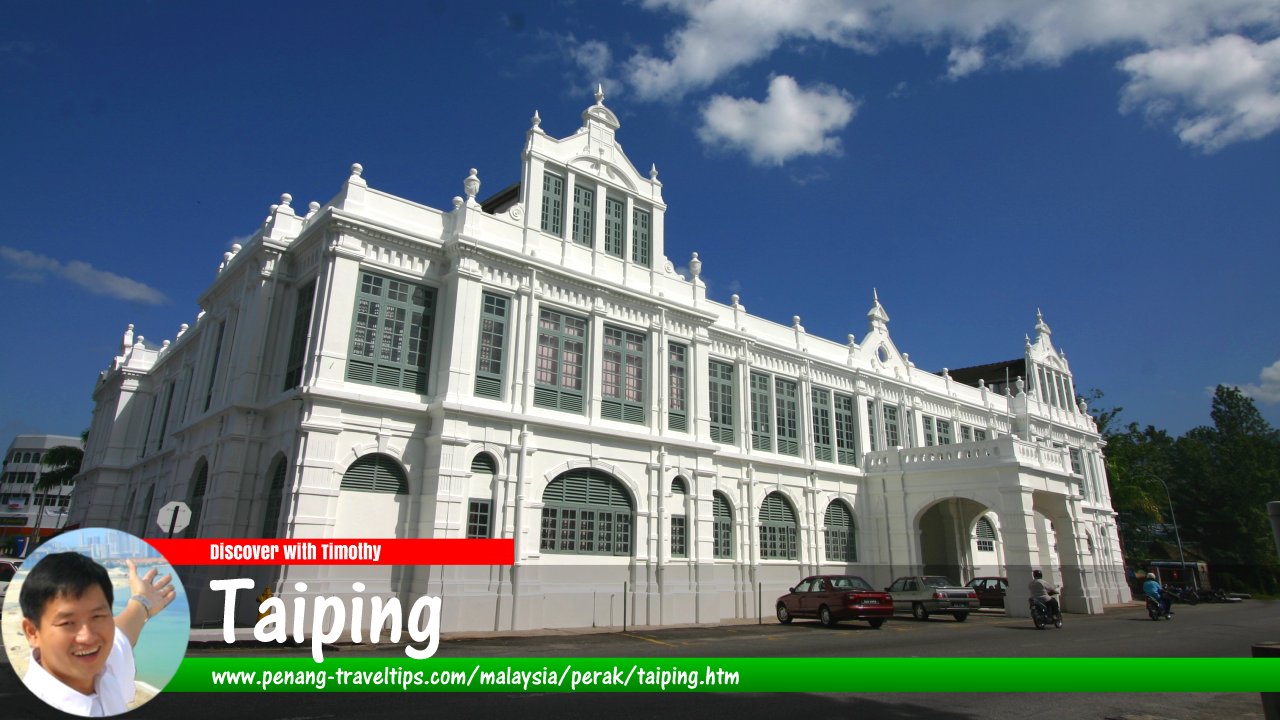 Taiping Travel Guide (4 February 2006)
Also available: Panduan Melawat Taiping
Taiping is one of Perak's most historically significant towns, located at the foot of Bukit Larut (Maxwell Hill) in the Larut, Matang and Selama District. Developed from the 19th-century tin-mining settlement of Klian Pauh, Taiping became an important administrative and commercial centre during the early years of British involvement in Perak. Today, it is known for its historic buildings, old town streets, museums, gardens, lakes, wildlife attractions and exceptionally green surroundings.
Taiping is particularly suitable for travellers interested in history, heritage, nature, architecture and local food. Many of its principal attractions are concentrated around the old town and Lake Gardens, making the town relatively easy to explore. Beyond the town centre, Bukit Larut, Kuala Sepetang, Matang and the surrounding countryside provide opportunities for visitors to explore the natural and historical landscapes of northern Perak.
Quick Facts
- Town: Taiping
- Former name: Klian Pauh
- State: Perak
- District: Larut, Matang and Selama
- Known for: Heritage buildings, Taiping Lake Gardens, Bukit Larut, Taiping Zoo and Perak Museum
- Historical economy: Tin mining
- Meaning of Taiping: Commonly translated from the Chinese Tai-Peng as "everlasting peace"
- Main transport: Car, KTM/ETS train, bus and e-hailing services
Where is Taiping?
Taiping is in northern Perak, roughly between Ipoh and Penang. The town lies on the western side of Bukit Larut, with the hills rising immediately to the east. To the west are the lowlands of Matang and the coastal areas around Kuala Sepetang.
The town is the administrative centre of the Larut, Matang and Selama District. The surrounding district includes places such as Kamunting, Simpang, Kuala Sepetang, Trong, Batu Kurau and other settlements.
Taiping's location has contributed greatly to its character. The town developed from a mining settlement, while the nearby hills provided a cooler and heavily forested environment. Its proximity to the Matang mangrove forests and Kuala Sepetang also connected the inland mining economy with the coast.
History of Taiping
Klian Pauh and the tin-mining industry
The settlement that developed into Taiping was originally known as Klian Pauh. The word klian refers to a mine, while pauh refers to a type of small mango. The name reflects the area's origins as a tin-mining settlement.
Tin mining expanded rapidly in the Larut area during the 19th century. Chinese miners migrated into Perak in large numbers, and competing Chinese secret societies became involved in the mining industry. Rivalries between the Ghee Hin and Hai San groups contributed to a series of conflicts known collectively as the Larut Wars.
The conflicts eventually became intertwined with political disputes within the Perak royal succession. The instability provided one of the circumstances that enabled the British to intervene more directly in Perak.
The Pangkor Engagement
The Pangkor Engagement was concluded on 20 January 1874. The agreement marked an important turning point in the political history of Perak and paved the way for greater British involvement in the state's administration.
Following the agreement, Captain Speedy became an important British administrative figure in Larut. Taiping subsequently developed as the principal administrative centre of the area.
From Klian Pauh to Taiping
The name Taiping is derived from the Chinese term Tai-Peng, generally translated as "everlasting peace". The name symbolised the hoped-for end of the conflicts that had affected the Larut mining districts.
Taiping subsequently expanded from a mining settlement into a town with government offices, commercial buildings, schools, religious institutions, roads and other public facilities. Its development was closely associated with the growing importance of Perak's tin-mining economy.
Taiping as the early capital of Perak
Taiping became the principal administrative centre of Perak during the early period of British administration and served as the state's capital before the role was transferred to Ipoh in 1937. The growth of Ipoh further south, in the heart of the Kinta Valley tin-mining region, eventually made it a more suitable administrative centre.
Although Taiping lost its position as the state capital, its historic role is still visible in its concentration of early government buildings and public institutions. The town retains an unusually rich collection of structures associated with the formative period of modern Perak.
Why is Taiping Important in Malaysian History?
Taiping is significant because a number of important developments in the history of British Malaya occurred here. The town was one of the earliest major centres of the tin-mining industry, an early centre of British administration, and the location of several pioneering public institutions.
The Perak Museum, established in 1883, was the first museum in Malaya. The railway linking Taiping with Port Weld, now Kuala Sepetang, opened in 1885 and is generally regarded as the first railway line in Malaya. Bukit Larut was also developed as an early hill station, while Taiping Lake Gardens emerged from former mining land.
These developments make Taiping particularly valuable to travellers who want to understand how mining, transportation, administration and urban development interacted during the late 19th century.
Taiping Heritage
Taiping's heritage is concentrated mainly around the old town and the area between the town centre and Taiping Lake Gardens. Historic buildings include government offices, religious buildings, schools, commercial premises and transport infrastructure.
The town's heritage is not confined to individual buildings. Its importance also lies in the relationship between the old town, former mining areas, Lake Gardens, Bukit Larut and the route to Kuala Sepetang. Together, these places illustrate the historical development of Taiping from a mining settlement into an established town.
Places to Visit in Taiping
1. Taiping Lake Gardens
Taiping Lake Gardens is one of the town's best-known landmarks. The extensive landscaped park contains several lakes, mature trees, walking paths and open areas, with Bukit Larut forming a dramatic backdrop to the east.
The Lake Gardens is particularly interesting because of its connection with Taiping's mining history. The lakes were formed in an area that had previously been associated with mining. The former mining landscape was subsequently transformed into a public recreational area.
The gardens are pleasant in the early morning and late afternoon, when temperatures are generally more comfortable. They are also a good place to appreciate the unusually green character of Taiping.
2. Taiping Zoo and Night Safari
Taiping Zoo and Night Safari occupies an area beside the Lake Gardens. Established in 1961, it is the oldest zoo in Malaysia and has become one of Taiping's major visitor attractions.
The zoo houses a variety of animals and has educational and conservation functions in addition to recreation. Its Night Safari allows visitors to observe nocturnal animals in an environment designed for after-dark viewing.
Because of its location beside the Lake Gardens, the zoo can easily be combined with a visit to the park.
3. Perak Museum
Perak Museum is one of the most important historical institutions in Taiping. Established in 1883, it was the first museum established in Malaya.
The museum's collections cover natural history, ethnology, archaeology and other subjects. Its displays provide useful background for understanding the peoples, environment and history of Perak.
The museum building itself is also significant. Its architecture incorporates several European architectural influences and forms part of Taiping's historic institutional landscape.
Visitors should check the museum's current opening arrangements before travelling, as opening hours and admission arrangements may change.
4. Bukit Larut
Bukit Larut, also known as Maxwell Hill, rises immediately to the east of Taiping. It was developed as a hill station during the colonial period and is one of the oldest hill stations in Malaysia.
The mountain has a markedly cooler and wetter environment than the lowlands. Its forests support a variety of plants and wildlife, while its elevation provides views towards Taiping and the surrounding lowlands when weather conditions are favourable.
Bukit Larut is suitable for visitors interested in hiking, forest environments, birdlife and the history of Malaysia's colonial hill stations. Access arrangements can change, so visitors should check the current regulations and transport arrangements before making the trip.
5. Taiping Railway Station
Taiping Railway Station is associated with one of the most important developments in the history of transportation in Malaya. The railway from Taiping to Port Weld was completed in 1885, linking the inland mining centre with its coastal port.
The original line no longer operates as a railway to Kuala Sepetang, but the history of the route remains an important part of Taiping's heritage.
The present railway station serves KTM and ETS services. Its location makes Taiping particularly convenient for travellers arriving by train.
6. Taiping Clock Tower
The Taiping Clock Tower is one of the town's historic landmarks. An earlier timber clock tower was erected in 1881, while the present masonry structure dates from the late 19th century.
The clock tower stands in the historic commercial area and can be incorporated into a walking tour of Taiping's old town.
7. All Saints' Church
All Saints' Church is one of Taiping's historic Christian buildings. The church was established in 1886 and reflects the presence of the European and Christian communities that developed in the town during the colonial period.
The surrounding grounds and historic cemetery add to the site's heritage value.
8. Taiping Market
Taiping Market is associated with the town's long commercial history. Markets were essential to the growth of Taiping as a mining and administrative centre, serving both the local population and the large number of people drawn to the Larut mining districts.
The market area is most interesting in the morning, when it provides an opportunity to observe everyday commerce rather than simply the town's formal heritage attractions.
9. Taiping War Cemetery
The Taiping War Cemetery commemorates members of the armed forces who died during the Second World War and other wartime circumstances. Located near the foothills of Bukit Larut, the cemetery is a quiet historical site away from the busier parts of the town.
It provides another perspective on Taiping's history, particularly the town's experience during the Japanese occupation and the wider events of the Second World War.
Food in Taiping
Taiping has a long-established food culture influenced by the town's Malay, Chinese and Indian communities. Its food scene includes traditional coffee shops, hawker stalls, restaurants and local dessert shops.
Mi Goreng Doli
Mi Goreng Doli is one of the dishes associated with Taiping. The fried noodles are a popular local meal and are worth trying when exploring the town's food scene.
Yong Tau Foo
Yong tau foo is another common choice in Taiping. Various vegetables and tofu products, often stuffed with fish paste, are served with soup or sauce.
Cendol
Cendol is a popular Malaysian dessert made with shaved ice, coconut milk, palm sugar and green rice-flour jelly. Taiping has several long-established cendol stalls and shops that are popular with local residents.
Coffee-shop food
Traditional coffee shops remain an important part of Taiping's food culture. Visitors can find noodles, rice dishes, toast, eggs, drinks and other inexpensive local meals in the old commercial areas.
Rather than concentrating exclusively on restaurants aimed at tourists, visitors interested in local food may find that the older coffee shops and market areas provide a better impression of everyday Taiping.
Where to Stay in Taiping
Accommodation in Taiping is concentrated around the town centre, Lake Gardens and the Kamunting area. The best location depends on the purpose of the visit.
Town centre
Staying in the town centre is convenient for visitors interested in heritage buildings, local food, shops and the old commercial district. It is also practical for travellers arriving by train.
Lake Gardens
Accommodation around the Lake Gardens provides convenient access to the park, Zoo Taiping and the lower slopes of Bukit Larut. This area is particularly suitable for visitors interested in nature and outdoor activities.
Kamunting
Kamunting, north of central Taiping, offers additional accommodation and has convenient road connections, making it a practical base for visitors travelling by car.
How to Get to Taiping
By car
Taiping is conveniently reached from the North-South Expressway. The highway passes through the wider Taiping and Kamunting area, with roads connecting the expressway to the town centre.
By road, Taiping is approximately two to three hours from Kuala Lumpur depending on traffic and route, while the journey from George Town is considerably shorter. The exact travel time varies according to traffic conditions.
By train
The ETS is one of the most convenient ways to travel to Taiping from Kuala Lumpur and other towns along the West Coast railway corridor. Services also connect Taiping with destinations in northern Perak and Penang.
The railway station is relatively close to the town centre, making train travel particularly attractive for visitors who do not want to drive.
By bus
Long-distance and local bus services connect Taiping with other towns in Perak and neighbouring states. Bus travel can be economical, although journey times vary according to the route and traffic conditions.
Getting Around Taiping
A car is useful if you intend to visit attractions outside the town centre, particularly Bukit Larut, Kuala Sepetang, Matang and other rural areas.
Several attractions in the historic centre can be combined in a walking itinerary. The clock tower, market, historic commercial buildings, Perak Museum and Lake Gardens can form part of a heritage-oriented visit.
E-hailing services provide another practical option for travelling between the railway station, accommodation and attractions that are too far to reach comfortably on foot.
A Hop-On Hop-Off service was also introduced in Taiping in 2025, providing a tourism-oriented way of connecting several attractions in the town.
How Long Should You Spend in Taiping?
One day is sufficient for a brief introduction to Taiping. A possible itinerary would include the Perak Museum, old town, Lake Gardens and Zoo Taiping.
Two days is a better option if you want to explore at a slower pace. The first day can focus on the town's history and heritage, while the second can be devoted to Bukit Larut, the zoo and other attractions.
With three days or more, Taiping can be used as a base for exploring Kuala Sepetang, Matang, Bukit Gantang, Batu Kurau and other parts of the Larut, Matang and Selama District.
Suggested Two-Day Taiping Itinerary
Day 1 – History and heritage
- Have breakfast at a traditional coffee shop in the town centre.
- Begin with the Taiping Clock Tower and historic commercial district.
- Explore the market and old town streets.
- Visit the Perak Museum.
- Continue to the historic churches and other heritage buildings.
- Spend the late afternoon at Taiping Lake Gardens.
- Have dinner in the town centre.
Day 2 – Nature and wildlife
- Have breakfast in town.
- Visit Bukit Larut, subject to current access and weather conditions.
- Return to Taiping and spend some time at the Lake Gardens.
- Visit Zoo Taiping during the afternoon.
- Explore the local food scene in the evening.
- Consider the Night Safari if operating on the day of your visit.
Taiping and Kuala Sepetang
A trip to Taiping can easily be combined with Kuala Sepetang, the coastal settlement formerly known as Port Weld. Kuala Sepetang played an important role in the development of Taiping because it provided a maritime outlet for the Larut mining district.
The historical railway connecting Taiping to Port Weld was completed in 1885. The line carried people and goods between the inland mining centre and its coastal port, making it an important part of the early economic infrastructure of Perak.
Kuala Sepetang is now associated with its mangrove forests, Matang Mangrove Forest Reserve, charcoal industry and ecotourism. Combining Taiping with Kuala Sepetang therefore provides a useful way to experience both sides of the historic mining economy: the inland town and its coastal outlet.
Taiping's Natural Environment
One of the most distinctive characteristics of Taiping is its greenery. The town sits between the lowlands and the heavily forested slopes of Bukit Larut, while the Lake Gardens provides a large area of mature trees and water within the urban environment.
Taiping is also famous for its high rainfall. The wet climate helps explain the lush vegetation around the town and contributes to its popular nickname, the "Rain Town".
Travellers should therefore expect rain at any time of year. An umbrella or lightweight rain jacket is useful, particularly when planning outdoor activities.
Best Time to Visit Taiping
Taiping can be visited throughout the year. There is no single dry season that guarantees rain-free conditions, and the town's wet climate is part of its geographical character.
For outdoor sightseeing, morning is generally a good time to visit the Lake Gardens, walk around the old town or explore Bukit Larut. Visitors should keep some flexibility in their schedule in case heavy rain affects outdoor activities.
The rainy conditions are not necessarily a disadvantage. After rainfall, the gardens and surrounding hills can be particularly green, while the cooler atmosphere can make Taiping pleasant for walking.
Practical Travel Tips
- Bring rain protection. Taiping is one of the wetter towns in Peninsular Malaysia.
- Wear comfortable shoes. A heritage walk can involve considerable walking.
- Start outdoor activities early. Morning conditions are often more comfortable.
- Check attraction opening times. Museums, zoos and other attractions may change their operating hours.
- Allow extra time for Bukit Larut. Weather and access arrangements can affect the visit.
- Consider travelling by ETS. Taiping's railway station provides a convenient connection with the West Coast railway network.
- Combine Taiping with Kuala Sepetang. The two places have a close historical relationship and complement each other as destinations.
- Explore the old town on foot. Walking provides a better opportunity to appreciate the relationship between Taiping's historic buildings and its commercial streets.
Taiping as a Heritage Destination
Taiping's importance as a heritage destination comes from the combination of its different historical layers. It began as a mining settlement, became a major centre of the Larut tin-mining industry, developed into an early British administrative centre and subsequently evolved into a modern Perak town.
Many of these stages remain visible today. The old commercial district reflects the growth of the mining economy; the government buildings reflect the colonial administration; the railway station recalls the development of modern transport; and the Lake Gardens and Bukit Larut demonstrate the town's long association with recreation and the natural environment.
Unlike a heritage destination consisting of only a few isolated monuments, Taiping offers a broader historic urban landscape. Its streets, buildings, gardens, hills and surrounding settlements all contribute to an understanding of the town's past.
Why Visit Taiping?
Taiping is a good destination for travellers who want to combine history and nature. The town offers museums and colonial-era buildings, while its lakes, gardens and mountains provide an unusually green setting.
Its relatively compact historic centre also makes it suitable for a slower style of travel. Rather than moving rapidly from one attraction to another, visitors can spend time walking through the old town, stopping at a coffee shop, visiting the museum and then relaxing beside the lake.
For travellers exploring northern Perak, Taiping is also strategically located. A visit can be combined with Kuala Sepetang and the Matang mangrove forests, while the wider district provides access to places such as Bukit Gantang and Batu Kurau.
Most importantly, Taiping provides a way to understand the relationship between tin mining, migration, colonial administration, transportation and urban development in the history of Perak. This historical importance, combined with its gardens and mountain setting, makes Taiping one of the most distinctive towns in Malaysia.
Map of Taiping, Perak
Places of Interest in Taiping
- Antong Coffee Factory (GPS: 4.85509, 100.73292)

- Aun Tong House (GPS: 4.85482, 100.73276)

- Burmese Pool (GPS: 4.85435, 100.76054)

- Chung Keng Kwee Townhouse (GPS: 4.85426, 100.74144)

- Dataran Warisan Taiping (GPS: 4.85424, 100.74333)

- Guan Hin Chan (GPS: 4.85225, 100.74289)

- Gurdwara Sahib Taiping (GPS: 4.02525, 101.02229)

- Kompleks Majlis Perbandaran Taiping (GPS: 4.85491, 100.74387)

- Larut Matang District Office (GPS: 4.85377, 100.74362)

- Larut Matang District Office (GPS: 4.86051, 100.75997)

- Ling Nam Ku Miew (GPS: 4.8621, 100.74708)

- New Clock Tower (GPS: 4.85208, 100.73957)

- Ng Boo Fee Fountain (GPS: 4.8562, 100.74745)

- Old House Museum (GPS: 4.852, 100.73935)

- Pejabat Orang Besar Jajahan Larut Matang dan Selama (GPS: 4.8474, 100.73499)

- Perak Museum (GPS: 4.86005, 100.74549)

- Spritzer EcoPark (GPS: 4.82074, 100.75203)

- Shun Te Hui Kuan (GPS: 4.85321, 100.74303)

- Taiping Cenotaph (GPS: 4.85655, 100.74564)

- Taiping Clocktower (GPS: 4.85212, 100.74203)

- Taiping Hokkien Association (GPS: 4.84805, 100.73523)

- Taiping Lake Gardens (GPS: 4.84886, 100.7482)

- Taiping Market (GPS: 4.85145, 100.73999)

- Taiping Prison (GPS: 4.8605, 100.74656)

- Taiping War Cemetery (GPS: 4.85889, 100.75737)

- Taiping Zoo (GPS: 4.85483, 100.75133)

- Temple of the Immortal Girl (GPS: 4.85316, 100.74401)

- The Residency (GPS: 4.85886, 100.74892)
- Wat Phodhiyaram (GPS: 4.85755, 100.72926)

Streets in Taiping
- Jalan Barrack
- Jalan Chin Ah Yam
- Jalan Chung Thye Phin
- Jalan Esplanade
- Jalan Kelab Lama
- Jalan Kota
- Jalan Maharajalela
- Jalan Manecksha
- Jalan Masjid
- Jalan Ong Saik
- Jalan Panggung Wayang
- Jalan Pekeliling
- Jalan Samanea Saman
- Jalan Stesen
- Jalan Sultan Abdullah
- Jalan Sultan Mansor
- Jalan Taming Sari
- Jalan Tasik Lestari
- Jalan Tupai
Hotels in Taiping
- Hotel Taiping Perdana (GPS: 4.8433, 100.7402)

Eateries in Taiping
- Larut Matang Hawker Centre (GPS: 4.86631, 100.73022)

Shopping in Taiping
- AEON Mall Taiping (GPS: 4.87256, 100.72882)

- Centrepoint Taiping (GPS: 4.86508, 100.73011)

- Giant Hypermarket, Taiping (GPS: 4.86336, 100.70782)

- Taiping Mall (GPS: 4.85886, 100.74892)

- Taiping Sentral Mall (GPS: 4.86571, 100.73143)

- Tesco Taiping (GPS: 4.86631, 100.73022)

- The Store Taiping (GPS: 4.86631, 100.73022)

Mosques in Taiping
- Indian Muslim Mosque (GPS: 4.84751, 100.73434)

- Masjid Hanafi (GPS: 4.84954, 100.7373)

- Old Kota Mosque (GPS: 4.84954, 100.7373)

Churches in Taiping
- All Saints Church (GPS: 6.435766, 100.190755)

- Chinese Methodist Church, Pokok Assam (GPS: 4.83218, 100.73969)
- St Louis Church (GPS: 4.84619, 100.73603)

- Taiping Chinese Gospel Hall (GPS: 4.84843, 100.73658)

- Taiping Chinese Methodist Church (GPS: 4.84843, 100.73658)

- Taiping Gospel Hall (GPS: 4.84846, 100.73461)

- Wesley Methodist Church, Taiping (GPS: 4.85995, 100.74198)

Transport Hubs in Taiping
- Taiping Bus Hub (GPS: 4.85017, 100.73971)

- Taiping Bus Terminal (GPS: 4.85287, 100.73236)

- Taiping Railway Station (GPS: 4.85287, 100.73236)
Sports and Country Clubs in Taiping
- New Club (GPS: 4.85709, 100.74585)

- Chinese Recreation Club (GPS: 4.85709, 100.74585)

Medial Attention in Taiping
- Taiping Hospital (GPS: 4.85089, 100.73747)

Categories of sights in Taiping
- Bakeries in Taiping
- Cemeteries in Taiping
- Chinese temples in Taiping
- Churches in Taiping
- Clan associations in Taiping
- Hawker Centres in Taiping
- Hindu Temples in Taiping
- Historic Buildings in Taiping
- Hospitals in Taiping
- Hotels in Taiping
- Markets in Taiping
- Monuments in Taiping
- Mosques in Taiping
- Mountains in Taiping
- Museums in Taiping
- Parks in Taiping
- Recreation Clubs in Taiping
- Schools in Taiping
- Shopping Malls in Taiping
- Swimming Pools in Taiping
- Streets in Taiping
- Thai Temples in Taiping
- Tourist Attractions in Taiping
References
- Pejabat Daerah dan Tanah Larut, Matang dan Selama – Sejarah Daerah
- PLANMalaysia – Taiping: Life and Soul
- Tourism Perak – Architectural Heritages
- Tourism Perak – Perak Tourism Map
- Tourism Perak – Taiping Zoo
- Tourism Perak – Zoo Taiping & Night Safari
- Jabatan Muzium Malaysia – Perak Museum
- Jabatan Muzium Malaysia – Perak Museum Background
- Tourism Perak – Taiping Railway Station
- Tourism Perak – Taiping Clock Tower
Page Details
This page was created on 12 September 2026. Hi, my name is Timothy and created it from my research, for my own entertainment, knowledge and to satisfy my curiosity. I am providing the information to you in good faith and hope it is useful. I try to get the details as accurate as possible. I also try to update the page whenever I stumble on new details. So this and all my other pages are perpetual work in progress. If you discover any error, please politely inform me, pointing out where the error lies, and I will correct it as soon as possible. Your helpfulness will keep this page accurate, relevant and helpful to those who need the information.Buy Me A Coffee
If you enjoy the information I provide and want to support the work I do, please buy me a coffee! I appreciate it immensely, thank you so much!
