
Tanjung Piandang Travel Guide
 Tanjung Piandang Travel Guide (AI generated on 10 September 2026)
Also available: Panduan Melawat Tanjung Piandang
Tanjung Piandang Travel Guide provides practical information about this coastal town and mukim in the Kerian district of Perak. Tanjung Piandang is a traditional fishing community on the northwestern coast of the state, where fishing and paddy cultivation remain important parts of local life.
The town is particularly known for its seafood, fishing-village atmosphere and Ban Pecah, a coastal recreation area nearby. Tanjung Piandang is also a useful base for exploring other parts of coastal Kerian, including Kuala Gula, Kuala Kurau and the wider Ban Pecah coastline.
Quick Facts
- Name: Tanjung Piandang
- District: Kerian
- State: Perak
- Type: Small town, mukim and fishing community
- Location: Northwestern coastal Perak
- Main industries: Fishing, seafood-related activities and paddy farming
- Main attraction: Ban Pecah
- Other interests: Fishing village, salted fish production, seafood and local temples
- Nearest major town: Parit Buntar
- Nearby destinations: Kuala Kurau, Kuala Gula, Ban Pecah and Bukit Merah
- Nearest major airport: Penang International Airport
Where Is Tanjung Piandang?
Tanjung Piandang is a small town and mukim in the Kerian district of northwestern Perak. The mukim occupies part of the coastal plain between the mainland agricultural areas and the Straits of Malacca.
The town lies close to the Perak–Penang–Kedah region, making it accessible from several parts of northern Peninsular Malaysia. Its nearest major urban centre is Parit Buntar, the administrative centre of Kerian.
The coastal location has strongly influenced the character of Tanjung Piandang. Fishing, seafood processing, paddy farming and village life are all visible in and around the town.
What Is Tanjung Piandang Known For?
Tanjung Piandang is best known as a fishing town and for the seafood available in the area. The surrounding mukim also contains extensive agricultural land, particularly paddy fields.
Visitors will find a landscape quite different from the larger towns of Perak. The approach to Tanjung Piandang passes through villages and agricultural areas before reaching the coastal settlement.
The town is also a convenient stopping point for visitors exploring the coastal side of Kerian. A trip can be combined with Kuala Gula, Kuala Kurau and Ban Pecah to form a full-day coastal itinerary.
History of Tanjung Piandang
Tanjung Piandang has a much older history than its present-day appearance might suggest. Historical records from the 19th century describe a fishing settlement here, while a 2022 study by historian Miau Ing Tan examines the town's earlier history and its relationship with British colonial attempts to impose greater control over the area.
Tanjung Piandang appeared in the writings of John Anderson in 1824. At that time, it was associated with maritime activity and was described as a place frequented by pirates.
During the 19th century, the settlement developed into a Chinese fishing community. Historical records describe Teochew fishermen living in the village and depending heavily on fishing and prawns.
The settlement also experienced conflict with the British colonial authorities. Historical accounts describe the village being destroyed by fire during the colonial period following disturbances, after which residents rebuilt it.
This history is significant because it shows that Tanjung Piandang was not simply a recently established fishing village. It was already a recognised coastal settlement during the 19th century.
A Historic Fishing Village
The fishing heritage of Tanjung Piandang is one of its defining characteristics. A late-19th-century account recorded a fishing village at Tanjung Piandang with several dozen fishermen, most of whom were Teochew.
The same historical source indicates that fishing methods included the use of nets and that prawns were an important catch. The abundance of prawns was already an economic concern at the time, demonstrating how closely the community's livelihood depended on the coastal environment.
Today, fishing remains part of the identity of the town. Visitors may see fishing boats, equipment and seafood-related activities while travelling through the settlement.
Fishing and Seafood
Fishing is one of the main economic activities in the Tanjung Piandang area. The town's coastal location gives it access to the waters and estuaries of the northern Perak coast.
Seafood is consequently an important part of the local food culture. Restaurants and food businesses in the area serve various types of fish and other seafood.
For visitors, the best way to experience this aspect of Tanjung Piandang is to eat at a local establishment and observe the fishing-related activities around the town.
Salted Fish
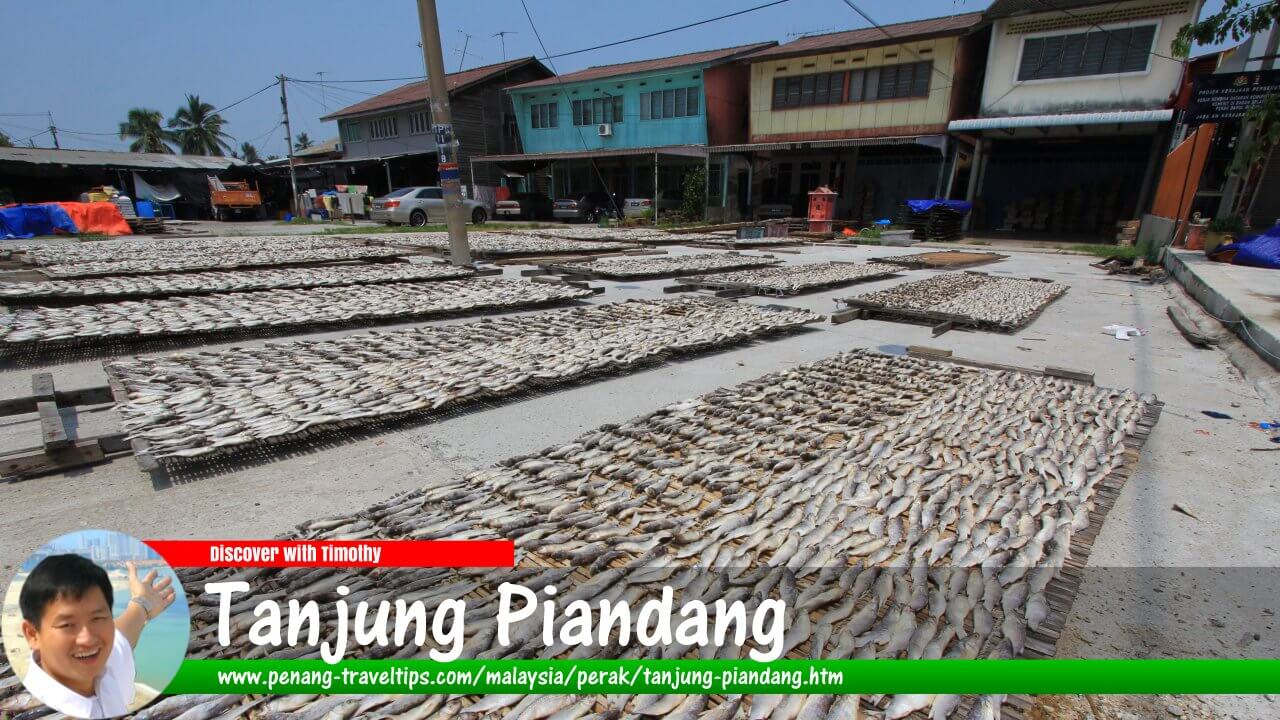
One of the more distinctive sights associated with Tanjung Piandang is the preparation of salted fish. Fish can be seen being processed and dried in the open air in parts of the village.
Salted fish is a traditional method of preserving fish in many coastal communities throughout Malaysia. In a fishing town such as Tanjung Piandang, it also reflects the close relationship between the fishing industry and local food production.
Visitors should not enter private processing areas without permission. If photographing the production process, ask the operator first.
Ban Pecah
Ban Pecah is the principal recreational attraction associated with Tanjung Piandang. It is a coastal area facing the Straits of Malacca and is known for its sea views, rocky shoreline and wave-break structures.
The area is particularly popular for relaxing, photography, fishing and watching the sunset. Unlike a conventional sandy beach, Ban Pecah has a distinctive rocky and engineered coastal landscape.
The name Ban Pecah is associated with the coastal embankment or bund in the area. The coastline is exposed to the sea, and the structures along the shore help protect the land from wave action.
Sunset at Ban Pecah
Late afternoon is a popular time to visit Ban Pecah. The open western horizon provides views of the setting sun over the Straits of Malacca, weather permitting.
Visitors should remain behind designated barriers and away from unstable edges. Rocks near the water can become slippery, particularly after rain or when waves are strong.
Fishing at Ban Pecah
Ban Pecah is also associated with recreational fishing. Anglers should be aware that the rocky shoreline and strong waves can create hazardous conditions.
Visitors should not fish from exposed rocks during rough weather. Children should also be supervised closely around the shoreline.
The Tanjung Piandang Coast
The coast around Tanjung Piandang is characterised by a mixture of fishing settlements, agricultural land, waterways and coastal protection structures.
Rather than being a conventional beach-resort destination, the area provides an opportunity to see how a rural coastal community lives alongside the sea.
This makes Tanjung Piandang particularly interesting to travellers who prefer local landscapes and everyday life to commercial tourist attractions.
Paddy Farming
Fishing is not the only important economic activity in Tanjung Piandang. The mukim also has extensive areas of paddy cultivation.
The combination of fishing and agriculture gives the area two distinct landscapes: coastal villages near the sea and broad agricultural fields further inland.
Visitors travelling around the mukim can therefore experience both aspects of rural Kerian in a relatively short journey.
Local Culture
Tanjung Piandang has a multicultural history, with the fishing settlement historically associated with the Teochew Chinese community. The town today also forms part of the wider multicultural society of Kerian.
The presence of Chinese temples and other places of worship reflects the long history of different communities living in the area.
At the same time, the surrounding villages have a strong Malay rural character, particularly in areas associated with paddy cultivation and agriculture.
Places of Worship
Visitors will find places of worship representing different religious communities in and around Tanjung Piandang. These include Chinese temples and Hindu places of worship, as well as mosques and surau serving the Muslim population.
Muslim travellers should check the location of the nearest mosque before setting out for Ban Pecah or other coastal areas, particularly if planning to remain there around prayer times.
When visiting a place of worship that is not part of your own faith tradition, observe the rules displayed at the entrance and dress respectfully.
Food in Tanjung Piandang
Seafood is the food speciality most closely associated with Tanjung Piandang. Local establishments may offer fish, prawns, crabs and other seafood depending on the day's supply.
The town also has ordinary Malaysian dishes and local snacks, making it possible to combine a seafood meal with other familiar foods.
Food for Muslim Travellers
Muslim travellers should check the halal status of individual restaurants. Tanjung Piandang has a mixed population, and not every seafood restaurant is necessarily halal simply because its main ingredients are fish or other seafood.
Restaurants operated by Muslims or establishments with clear halal indications are the simplest choices. If the status of a restaurant is unclear, ask the operator about the ingredients, cooking oil, sauces and preparation methods.
Travellers who are particularly strict about halal certification may prefer to plan their main meals at established halal restaurants in Parit Buntar or other larger towns.
Nearby Kuala Kurau
Kuala Kurau is one of the most useful destinations to combine with Tanjung Piandang. It is another traditional fishing settlement in Kerian, centred around the mouth of Sungai Kurau.
Kuala Kurau offers a different but related coastal experience, with fishing boats, aquaculture, river scenery, seafood and traditional village landscapes.
A Tanjung Piandang–Ban Pecah–Kuala Kurau route is suitable for a relaxed one-day excursion.
Kuala Gula
Kuala Gula lies further along the Kerian coast and is particularly famous for its bird sanctuary and mangrove environment.
The Kuala Gula Bird Sanctuary is an important habitat for resident and migratory birds. Travellers interested in nature can combine Tanjung Piandang with Kuala Gula for a broader exploration of the coastal ecosystems of Kerian.
Bukit Merah
Bukit Merah is located inland from the coastal settlements. It provides a contrasting environment centred around the freshwater lake and recreational attractions.
The Bukit Merah area includes the Bukit Merah Orang Utan Island Foundation and Bukit Merah Laketown Resort and Waterpark.
Families who want a mixture of coastal scenery and organised recreational activities can therefore combine Tanjung Piandang with Bukit Merah.
Parit Buntar
Parit Buntar is the administrative centre of Kerian and the nearest major urban centre to Tanjung Piandang.
It has a wider selection of accommodation, restaurants, shops, banks and other services. Travellers who prefer to stay in a town rather than a rural village may use Parit Buntar as their base.
Parit Buntar is also connected to the railway network, making it useful for visitors arriving by train.
How to Get to Tanjung Piandang
By Car
Driving is the easiest way to reach and explore Tanjung Piandang. The town is connected to the surrounding parts of Kerian by local roads.
Jalan Pantai (Route A190) is an important road serving the coastal settlements in this part of Kerian. It provides access through the coastal villages and towards Kuala Kurau.
From Parit Buntar, travellers can drive towards the coastal side of Kerian. From Penang, the journey can be made through Seberang Perai and onward into Perak.
Travellers coming from Ipoh or southern Perak can use the North–South Expressway and continue into Kerian through the appropriate local-road connections.
By Train
The most practical railway connection is Parit Buntar railway station. From the station, travellers can continue to Tanjung Piandang by taxi, e-hailing service or private vehicle.
Visitors relying on public transport should arrange the final leg of the journey before arriving, particularly if travelling outside normal daytime hours.
From Penang International Airport
For foreign travellers arriving by air, Penang International Airport is a practical gateway to Tanjung Piandang. The journey continues through mainland Penang and towards the Kerian district.
A rental car is useful for visitors who intend to explore Tanjung Piandang together with Kuala Gula, Kuala Kurau, Ban Pecah and Bukit Merah.
Getting Around
Tanjung Piandang is a small town, and there is no extensive urban public transport system. A private vehicle or rental car is therefore the most convenient way to explore the surrounding area.
Cycling can also be an enjoyable way to experience the village and agricultural landscape, although visitors should be prepared for hot weather and should exercise caution on roads shared with vehicles.
Walking is suitable for exploring parts of the town centre, but a vehicle is needed to reach the wider coastal attractions conveniently.
Suggested One-Day Itinerary
Morning: Arrive in Tanjung Piandang and explore the town and fishing-village area. Look for fishing boats and local seafood-related activities.
Late morning: Observe the traditional preparation of salted fish where available, while respecting private property and asking permission before taking photographs.
Lunch: Have a seafood meal at a suitable local restaurant. Muslim travellers should confirm that the establishment is halal.
Afternoon: Drive towards Ban Pecah and spend time along the coast. Fishing enthusiasts can explore the area where conditions permit.
Late afternoon: Stay at Ban Pecah for the coastal scenery and sunset.
Evening: Return to Tanjung Piandang or continue towards Kuala Kurau or Parit Buntar for dinner and accommodation.
Suggested Two-Day Itinerary
For a more leisurely trip, spend the first day exploring Tanjung Piandang and Ban Pecah. On the second day, travel north along the coast towards Kuala Kurau and Kuala Gula.
Another option is to spend the second day inland at Bukit Merah, particularly for families interested in recreational attractions and the Orang Utan Island.
For Families
Tanjung Piandang is suitable for families interested in a quieter rural experience. Children can see fishing boats, learn about seafood and observe how paddy farming and fishing coexist in the same district.
Ban Pecah can be a pleasant place for families to enjoy the coastal scenery, but it is not a conventional swimming beach. Strong waves, rocks and coastal structures mean that children should be supervised closely.
Families should also avoid allowing children to climb onto wave-break structures or unstable rocks.
For Photographers
Tanjung Piandang provides a variety of subjects for photographers, particularly those interested in documentary and rural photography.
- Fishing boats and jetties
- Salted fish being dried
- Village houses and lanes
- Paddy fields
- Seafood and fishing activities
- Chinese temples and other places of worship
- Ban Pecah coastline
- Sunset over the Straits of Malacca
The early morning is suitable for village and fishing scenes, while late afternoon is preferable for Ban Pecah and sunset photography.
Always seek permission when photographing people closely or documenting private commercial activities.
For Foreign Travellers
Tanjung Piandang offers foreign visitors an opportunity to experience a part of Malaysia that is less developed for mass tourism. The town is more closely connected to fishing, farming and local commerce than to conventional tourist attractions.
Visitors interested in Malaysian food culture may find the seafood and salted-fish traditions particularly interesting. The town also illustrates the multicultural character of the northern Perak coast.
English may be understood in some businesses, but Malay is the main language used in everyday communication. Keeping the name and address of your accommodation or destination written in Malay can be helpful when using local transport.
For Muslim Travellers
Muslim travellers can visit Tanjung Piandang comfortably by planning around prayer times and choosing suitable food establishments.
- Identify a nearby mosque or surau before heading to Ban Pecah.
- Do not assume that all seafood restaurants are halal.
- Ask about cooking ingredients if a restaurant's halal status is unclear.
- Carry personal prayer items if travelling to rural areas for several hours.
- Plan around Zuhur, Asar and Maghrib when spending the afternoon at the coast.
- Dress modestly when visiting villages and places of worship.
- Respect religious and cultural practices at temples and mosques.
Best Time to Visit
Tanjung Piandang can be visited throughout the year, although outdoor activities are more enjoyable during periods of good weather.
Early morning and late afternoon are generally the most comfortable times for exploring the village. Late afternoon is particularly suitable for Ban Pecah and sunset photography.
Visitors should be cautious during periods of heavy rain or rough sea conditions. Fishing and coastal activities should be postponed when conditions become unsafe.
Practical Tips
- Bring drinking water, sunscreen and a hat when exploring the coast.
- Wear comfortable footwear for village roads and coastal areas.
- Carry some cash because small businesses may not accept cashless payments.
- Check restaurant opening hours before travelling specifically for a meal.
- Ask permission before photographing fishermen or private businesses.
- Do not enter fishing jetties, workshops or private property without permission.
- Take care on rocks and wave-break structures at Ban Pecah.
- Do not swim at exposed coastal areas unless the location is specifically designated and conditions are safe.
- Check the weather before planning a sunset or fishing trip.
Responsible Tourism
Tanjung Piandang is a working community rather than a theme park. Visitors should therefore treat local people, businesses and places of worship with respect.
- Keep the village and coastline clean.
- Do not disturb fishing activities.
- Ask permission before photographing people or private property.
- Do not remove fishing equipment or other objects from jetties.
- Dispose of fishing lines, plastic and other waste responsibly.
- Respect religious sites regardless of your own religious background.
- Support local restaurants and small businesses where appropriate.
Conclusion
Tanjung Piandang is a coastal town where fishing, seafood, paddy farming and village life remain central to its identity. Its history as a long-established fishing settlement gives it an additional dimension beyond its present-day role as a quiet town in Kerian.
The most distinctive experience is not a single large tourist attraction, but the combination of the fishing village, seafood culture, salted-fish production, agricultural landscape and the nearby Ban Pecah coastline.
For local travellers, Tanjung Piandang makes a suitable day trip from Penang, Kedah or other parts of Perak. Foreign travellers can use it to experience a less commercial side of Malaysia, particularly when combining it with Kuala Gula, Kuala Kurau and other destinations in Kerian.
Map of Tanjung Piandang
What to eat at Tanjung Piandang
- Seafood at Makanan Laut Fifty Heng Kee (GPS: 5.070053, 100.385441) was recommended by Alice S G Seah on 16 September, 2019
Categories of sights in Tanjung Piandang
Other sights in Tanjung Piandang
- Bagan Tiang (GPS: 5.10169, 100.40658)

- Bagan Utara (GPS: 5.07791, 100.37743)

- Bagan Selatan (GPS: 5.07531, 100.37563)

Tanjung Piandang is  on the Map of towns in Perak
References
- Tourism Perak – Kerian
- Majlis Daerah Kerian – Destinasi Menarik
- Majlis Daerah Kerian – Garis Panduan Aktiviti Air dan Peta Pelancongan Kerian
- Universiti Malaya – The “Unruly” Space: Tanjong Piandang, a Pirates’ Haven to a Fishing Village
- Universiti Malaya – Research Publications: The “Unruly” Space
- Journal of the Straits Branch of the Royal Asiatic Society – Fishing Industry of Krian and Kurau, Perak
- Penang Travel Tips – Tanjung Piandang, Perak
- Profil Mukim Tanjung Piandang
- Discover Perak – Ban Pecah, Tanjung Piandang
Page Details
This page was created on 15 September 2026. Hi, my name is Timothy and created it from my research, for my own entertainment, knowledge and to satisfy my curiosity. I am providing the information to you in good faith and hope it is useful. I try to get the details as accurate as possible. I also try to update the page whenever I stumble on new details. So this and all my other pages are perpetual work in progress. If you discover any error, please politely inform me, pointing out where the error lies, and I will correct it as soon as possible. Your helpfulness will keep this page accurate, relevant and helpful to those who need the information.Buy Me A Coffee
If you enjoy the information I provide and want to support the work I do, please buy me a coffee! I appreciate it immensely, thank you so much!
