
Kerteh Travel Guide
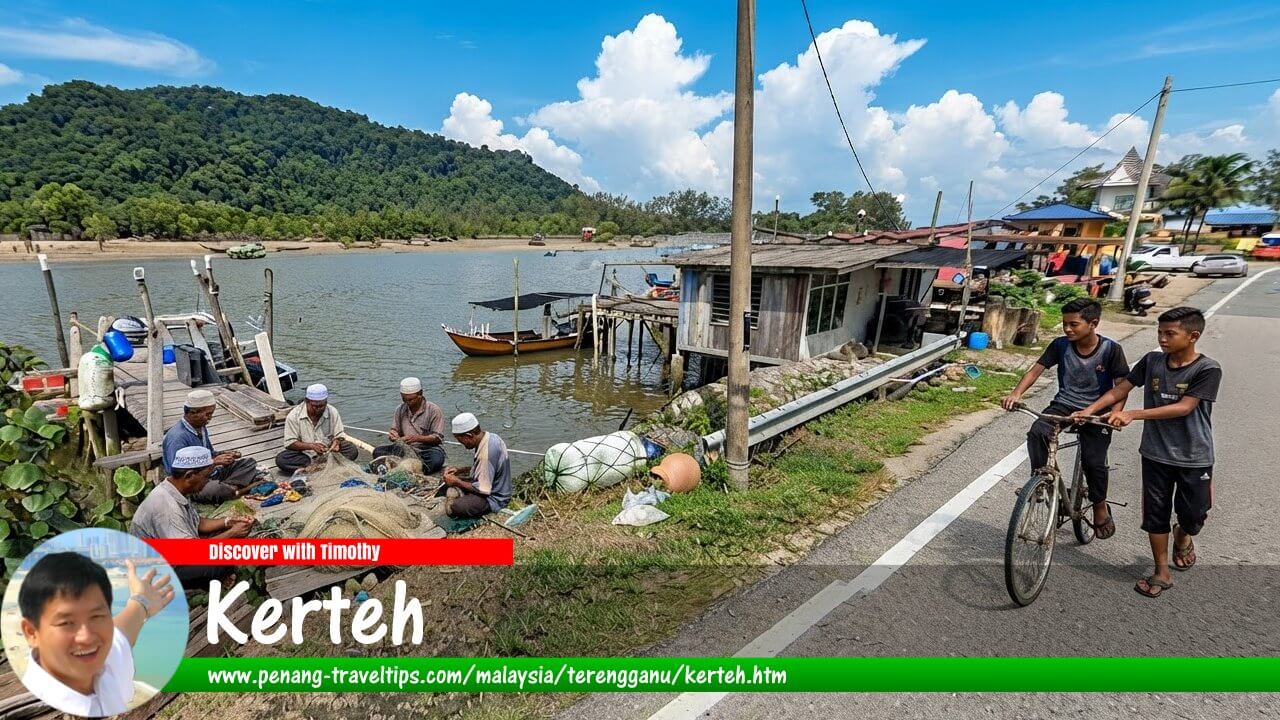 Kerteh Travel Guide: Scene along Sungai Kerteh (AI generated on 10 September 2026)
Also available: Panduan Melawat Kerteh
Kerteh, also commonly spelled Kertih, is a town and mukim in Kemaman District, Terengganu, on the east coast of Peninsular Malaysia. Once a small coastal settlement, Kerteh was transformed in the second half of the 20th century by the discovery and development of offshore petroleum and natural gas. It subsequently became one of Malaysia's most important centres for oil and gas processing and petrochemical manufacturing. Today, Kerteh combines a working industrial landscape with traditional villages, coastal scenery, local food and convenient access to beaches and attractions in southern Terengganu.
Quick Facts
- Name: Kerteh, also commonly written as Kertih
- State: Terengganu
- District: Kemaman
- Region: Southern Terengganu, on the east coast of Peninsular Malaysia
- Postal code: 24300
- Geographical setting: Coastal lowland beside the South China Sea
- Main river: Sungai Kerteh
- Best known for: Petroleum, natural gas, petrochemical and energy industries
- Major industrial landmark: Kerteh Integrated Petrochemical Complex
- Airport: Kerteh Airport (KTE), principally serving industrial and offshore aviation
- Nearby attractions: Kemasik Beach, Mesra Mall, Paka, Kijal, Rantau Abang and Ma' Daerah
- Popular local food: nasi dagang, nasi kerabu, keropok lekor, sata, laksam and seafood
- Best way to explore: Private or rental car
Introducing Kerteh
Kerteh is unusual among Malaysian towns because its modern identity is closely tied to the development of the country's petroleum industry. The town is the home of a major industrial complex operated by companies within the PETRONAS group and associated businesses. Natural gas from offshore fields is processed here, while the surrounding industrial area contains refineries, petrochemical plants, utilities and supporting facilities.
Despite its industrial importance, Kerteh is not simply an industrial estate. The town and its surrounding mukim include traditional Malay villages, residential areas, shops, schools, places of worship and stretches of coastline. The contrast between village life and large-scale industrial infrastructure is one of the defining characteristics of Kerteh.
For travellers, Kerteh is best understood as a working town and a convenient base for exploring the southern Terengganu coast. It is not a conventional resort destination, but it offers practical accommodation, restaurants, shopping facilities and road connections to beaches and attractions between Dungun and Kemaman.
Geography of Kerteh
Kerteh is located in Kemaman District, in the southern part of Terengganu. The district stretches along the South China Sea and borders Dungun District to the north and Pahang to the south and west. The coastal part of Kemaman consists largely of low-lying terrain, while the interior becomes more hilly.1
The town lies close to the coast, with the South China Sea forming the eastern edge of the wider area. Sungai Kerteh and smaller waterways drain the surrounding lowlands towards the sea. Historically, these waterways were closely connected with settlement and fishing activities before the area's economy became dominated by petroleum and industrial development.
Kerteh's location is also strategically important because it lies roughly midway between the larger towns of Dungun and Chukai. Paka is immediately to the south, while Kemasik and Kijal are further south towards Kemaman. This makes Kerteh a useful stopping point for travellers driving along the Terengganu coast.
History of Kerteh
Before the petroleum era
Before the development of the oil and gas industry, Kerteh was a relatively small coastal settlement. Local communities depended primarily on traditional occupations such as fishing, farming and small-scale handicrafts. The population was concentrated in villages rather than in a modern urban centre.
The coastline and river systems provided the geographical basis for the early settlement. Fishing was conducted on a modest scale, with small boats used by local fishermen. Agriculture and village-based activities supplemented fishing as sources of livelihood.
This older landscape has not disappeared completely. Travellers passing through Kerteh can still see kampung settlements and traditional houses alongside modern residential areas and industrial infrastructure. These surviving elements provide a reminder that Kerteh existed as a community long before petroleum transformed the region.
The discovery of petroleum and natural gas
The decisive change came with the discovery of offshore petroleum and natural gas deposits in the waters off Terengganu. PETRONAS describes Kertih as having developed from a quiet coastal settlement into what became an important centre of Malaysia's petroleum industry. The discovery of the Duyong gas field was followed by the discovery of the Dulang oil field in 1982, located about 130 kilometres offshore.2
The availability of offshore hydrocarbons created the basis for an entirely new industrial economy. Rather than simply exporting raw petroleum and gas, Malaysia developed processing and downstream industries at Kerteh. This helped establish the town as a major energy centre and encouraged the construction of roads, housing, an airport, port facilities and other supporting infrastructure.
Development of the petrochemical complex
The Kerteh Integrated Petrochemical Complex became the centrepiece of the industrial transformation. PETRONAS Chemicals records the commencement of ethylene and polyethylene production at the complex in the 1990s, followed by additional petrochemical production including benzene, paraxylene, ammonia, vinyl chloride monomer, polyvinyl chloride and acetic acid.3
PETRONAS Gas also developed gas-processing facilities in Kerteh. The company's Peninsular Gas Utilisation network began with the Kertih–Teluk Kalong pipeline, which entered service in 1983, connecting the Kerteh gas-processing area with the wider national gas network.4
The result was an integrated industrial ecosystem in which natural gas and petroleum feedstocks could be processed into fuels, chemicals and other products. Kerteh consequently became an important link in Malaysia's downstream petroleum and petrochemical industry rather than simply a location for offshore oil and gas operations.
The Oil and Gas Industry Today
Petroleum remains central to Kerteh's identity. The wider industrial area includes gas-processing plants, petrochemical facilities, refining operations, storage facilities, utilities and marine infrastructure. PETRONAS describes the Kerteh complex as an integrated manufacturing centre, with its various facilities connected to supporting infrastructure and one another.5
The industrial development has also influenced the wider economy of Kemaman. Recent demographic information from the Department of Statistics Malaysia identifies the rapid development of the oil and gas industry in Kerteh, together with heavy industry at Teluk Kalong, as an important factor attracting workers to the district.1
For visitors, much of this industrial area is not open for casual sightseeing. Security restrictions apply around petroleum installations, pipelines and processing plants. Travellers should not attempt to enter restricted areas or photograph sensitive facilities without permission.
Nevertheless, the industrial landscape is an important part of Kerteh's character. The large-scale facilities, pipelines, storage tanks and associated infrastructure illustrate how a small coastal settlement became an industrial centre of national significance.
How Did Kerteh Get Its Name?
The origin of the name Kerteh is not completely certain. Several local explanations have circulated, and they should be treated as traditions rather than established historical fact.
One commonly repeated explanation connects the name with the old physical landscape of the area. According to this tradition, parts of the area were once swampy or waterlogged. As the land dried, the condition was described using a Terengganu dialect expression associated with something becoming dry. Over time, the expression was said to have evolved through forms such as Kerotey and Kretay before becoming Kerteh.6
Another popular story attributes the name to a person or family associated with someone called Cik Teh, with the name supposedly emerging from a conversation involving a monkey, or kera. This story is part of local folklore rather than a documented etymology.6
It is therefore preferable to present these stories as local explanations for the name rather than state that one of them is definitively correct. The spelling Kertih is also commonly encountered, including in the names of PETRONAS facilities, while Kerteh is widely used for the town and airport.
Things to See and Do in Kerteh
Kerteh town
The town itself is best explored at a relaxed pace. Visitors can walk or drive around the commercial areas, visit local food outlets and observe the mixture of older kampung settlements and newer development. Kerteh is not a heritage town with a concentration of colonial buildings, so its interest lies more in its everyday character and industrial history.
A visit is particularly worthwhile for travellers interested in the relationship between small-town Malaysia and the petroleum economy. The transition is visible in the scale of housing developments, roads and industrial infrastructure surrounding the original settlement.
Kerteh Airport
Kerteh Airport (KTE) is one of the most distinctive pieces of infrastructure associated with the town. The airport is only a few kilometres from Kerteh town and has long served the petroleum industry, particularly flights associated with offshore operations.
Current Civil Aviation Authority of Malaysia information continues to list Kerteh Airport as an operational aerodrome. Its published procedures include dedicated helicopter arrival routes associated with offshore oil installations, illustrating the airport's continuing role in the energy sector.7
However, travellers should not assume that Kerteh Airport functions like a normal scheduled passenger airport. Its principal role is associated with industrial and offshore aviation, and prior approval requirements apply to certain non-scheduled operations. Travellers arriving in Kerteh should therefore plan primarily around road transport unless they have a confirmed flight arrangement.
Mesra Mall
Mesra Mall is the main modern shopping and entertainment centre serving the Kerteh area. It provides supermarkets, shops, restaurants and entertainment facilities, making it useful for travellers who need to stock up on supplies or want a more conventional shopping environment.
For visitors staying several nights, Mesra Mall can also be useful during rainy weather or when a break from outdoor activities is needed. It is located within the wider Kerteh area and is easily reached by car.
Kemasik Beach
Kemasik Beach is one of the most attractive coastal destinations near Kerteh. It lies to the south of Kerteh, between Kerteh and Kijal, and is particularly known for its unusual rock formations near the shore.
The beach is popular with local visitors, especially in the late afternoon and on weekends. Food stalls in the area offer local snacks and seafood, including keropok lekor. The combination of sand, rock formations and the open South China Sea makes Kemasik a worthwhile short excursion from Kerteh.
Paka and its surroundings
To the north, Paka is close enough to be explored as part of the same journey. Paka has its own coastal and riverine character, centred on Sungai Paka and the South China Sea. It is a useful stop for travellers interested in seeing how the older fishing settlements of southern Terengganu coexist with the modern petroleum economy.
Rantau Abang
Travellers heading north from Kerteh can continue towards Rantau Abang, one of Terengganu's best-known turtle conservation areas. Rantau Abang has a long association with sea turtles, particularly the leatherback turtle, although visitor opportunities today are focused on conservation rather than guaranteed turtle sightings.
The turtle season and conservation arrangements can change, so visitors should check with the relevant authorities before planning a trip specifically to see turtles.
Ma' Daerah Turtle Sanctuary
Travellers going south from Kerteh towards Kemaman can visit the wider coastal area around Ma' Daerah, another important turtle conservation site. It is particularly relevant to visitors interested in Terengganu's marine environment and conservation programmes.
What to Eat in Kerteh
Kerteh's food scene reflects southern Terengganu rather than being defined by a particular dish unique to the town. Local restaurants, warung and food stalls serve familiar Terengganu dishes alongside seafood and Malaysian favourites.
Some foods worth seeking out include:
- Nasi dagang – steamed rice cooked with coconut milk and traditionally served with fish curry.
- Nasi kerabu – rice served with herbs, vegetables, fish or meat and various accompaniments.
- Keropok lekor – a fish-based snack made with fish paste and sago flour, usually boiled or fried.
- Sata – seasoned fish mixed with coconut and spices, wrapped in leaves and grilled.
- Laksam – thick rolls of rice noodles served with a rich fish-based coconut gravy.
- Ketupat sotong – squid filled with glutinous rice and cooked in a coconut-based gravy.
- Fresh seafood – fish, squid, prawns and other seafood are natural choices in this coastal part of Terengganu.
For breakfast, look for local shops serving nasi dagang, nasi kerabu, laksam and traditional kuih. For lunch and dinner, seafood restaurants and Malay eateries are practical choices.
Travellers should also try keropok lekor from a local producer or roadside stall when possible. Terengganu is particularly associated with this fish-based snack, and freshly fried keropok lekor is noticeably different from packaged versions.
Where to Stay in Kerteh
Kerteh has a range of accommodation suitable for business travellers, families and independent travellers. Because the town serves a major industrial area, much of its accommodation caters to people working in or visiting the petroleum and petrochemical sector.
Kertih Damansara Inn is one of the accommodation options close to Kerteh Airport and the town. Other hotels and inns include properties such as Singgah Kertih, Hotel Az-Zahra Kerteh and budget-oriented establishments in the town area. Current accommodation listings show a variety of hotels, inns and homestays in and around Kerteh.8
For visitors who prefer a beach resort, Resorts World Kijal lies further south towards Kijal. Another option is The Qamar Paka, north of Kerteh, which provides a resort-style alternative beside the sea. These are more suitable for travellers who want accommodation to be part of the holiday experience rather than simply a convenient place to sleep.
When choosing accommodation in Kerteh, consider whether you want to stay near the commercial centre, airport, industrial area or beach. The distances between these areas are manageable by car, but the town is spread out enough that location can make a difference.
How to Get to Kerteh
By car
Driving is the easiest way to reach and explore Kerteh. The town is situated on the main east-coast road between Kuala Terengganu and Kuantan, and it can also be reached from the East Coast Expressway via the Kerteh interchange.
From Kuala Terengganu, the journey south follows the coastal road through places such as Marang and Dungun before reaching Paka and Kerteh. From Kuantan, travellers drive north through Pahang and enter Terengganu near the Kemaman area before continuing towards Kijal and Kerteh.
Driving times depend on traffic, roadworks, weather and the exact starting point. For a relaxed trip, allow additional time for stops at beaches, food stalls and viewpoints along the coast.
By bus
Kerteh is served by long-distance and regional bus services, although schedules vary according to the operator and season. Travellers from Kuala Lumpur, Kuantan, Kuala Terengganu and other towns should check the current destination list before purchasing a ticket.
For international visitors who are unfamiliar with Malaysian bus travel, it is worth checking whether the bus terminates in Kerteh itself or at another nearby town such as Paka, Dungun or Kemaman. A short taxi or e-hailing journey may then be required.
By air
Kerteh Airport is physically close to the town, but it should not be confused with a conventional regional airport serving large numbers of holidaymakers. Its continuing importance is primarily connected with the petroleum industry and offshore helicopter operations.7
For ordinary leisure travellers, Sultan Mahmud Airport in Kuala Terengganu is generally the more straightforward airport to consider when planning a trip to the northern part of Terengganu, followed by a road journey south. Depending on the itinerary, Kuantan Airport may also be practical for visitors approaching from the south.
Getting Around Kerteh
A private or rental car is the most convenient way to get around Kerteh and the surrounding coast. This is particularly important if you want to visit Kemasik Beach, Kijal, Paka, Rantau Abang or other places outside the town centre.
Taxis and e-hailing services may be available, but coverage can be less predictable than in major Malaysian cities. Visitors should not assume that an e-hailing car will always be readily available for a return journey from a quiet beach or rural attraction.
Walking is practical for short journeys within a particular commercial or residential area, but Kerteh is not a compact tourist town designed around pedestrian sightseeing. The tropical heat and distance between attractions also make a car considerably more comfortable.
Best Time to Visit Kerteh
Kerteh can be visited throughout the year, but the weather should be considered when planning a coastal trip. The east coast of Peninsular Malaysia is strongly influenced by the Northeast Monsoon, which normally brings wetter conditions and rougher seas towards the end of the year and into the beginning of the following year.
The drier months are generally more convenient for beach visits and road trips along the coast. Even during the wetter season, however, rain does not necessarily occur continuously throughout the day, so short visits can still be possible when weather conditions permit.
Beach activities should be approached with caution during rough seas. Avoid swimming in areas with strong currents or during periods when local authorities have issued warnings. The sea can change quickly during monsoon conditions.
A Suggested Kerteh Itinerary
One-day Kerteh visit
- Begin with breakfast at a local restaurant and try nasi dagang or another Terengganu specialty.
- Explore the town centre and observe the contrast between traditional settlements and modern development.
- Visit the Kerteh area and learn about its petroleum and petrochemical heritage from outside publicly accessible areas.
- Have lunch at a local Malay or seafood restaurant.
- Drive south to Kemasik Beach for the afternoon.
- Stop for keropok lekor or another local snack before returning to Kerteh.
- Have dinner in Kerteh or continue south towards Kijal or Kemaman.
Two-day Kerteh and southern Terengganu trip
- Day 1: Arrive in Kerteh and check into your accommodation.
- Explore Kerteh town and the surrounding residential and commercial areas.
- Visit Mesra Mall for shopping, food or entertainment.
- Enjoy a local dinner featuring Terengganu dishes or seafood.
- Day 2: Drive to Kemasik Beach and continue towards Kijal.
- Depending on your interests, continue south towards Ma' Daerah or Kemaman.
- Alternatively, travel north towards Paka and Rantau Abang before continuing towards Dungun or Kuala Terengganu.
Kerteh for Different Types of Travellers
For first-time visitors to Terengganu
Kerteh is useful for visitors who want to understand a less tourist-oriented side of Terengganu. Instead of focusing entirely on beaches and resorts, the town provides an opportunity to see how petroleum development has shaped a Malaysian community.
For road-trippers
Kerteh makes a convenient stop on a coastal road trip. Its position between Dungun and Kemaman means that travellers can easily combine it with beaches, villages, food stops and other attractions along the Terengganu coast.
For families
Families can use Kerteh as a practical base because accommodation, restaurants, shops and supermarkets are readily available. Mesra Mall provides an indoor alternative when the weather is unsuitable for outdoor activities, while nearby beaches provide opportunities for family outings in good weather.
For industrial and heritage enthusiasts
Kerteh is particularly interesting for anyone fascinated by industrial history. The town illustrates the dramatic transformation that petroleum can bring to a previously small rural settlement. Its story connects offshore exploration, natural-gas processing, petrochemicals, electricity, pipelines, ports and international trade.
Practical Tips for Visiting Kerteh
- Bring sun protection: The coastal climate can be hot and humid, particularly around midday.
- Carry cash: Smaller food stalls and village businesses may not accept cards or digital payments.
- Use a car where possible: This makes it much easier to explore beaches and nearby towns.
- Respect industrial security: Do not enter restricted petroleum facilities or photograph sensitive installations without permission.
- Check weather conditions: Coastal conditions can deteriorate during the Northeast Monsoon.
- Plan fuel stops: Fuel stations are available around Kerteh and along the main road, but it is still sensible to refuel before heading into less developed coastal or rural areas.
- Check accommodation location: A hotel described as being in Kerteh may actually be several kilometres from the town centre.
Kerteh as a Travel Destination
Kerteh is not a destination that depends on a long list of conventional tourist attractions. Its importance lies elsewhere. It is a place where the history of a small Terengganu coastal settlement intersects with the development of one of Malaysia's most important industrial sectors.
The town's transformation began with offshore petroleum and natural gas discoveries and accelerated as PETRONAS developed gas processing, refining and petrochemical facilities. The resulting industrial complex helped create new infrastructure, employment and economic activity across southern Terengganu.23
At the same time, Kerteh remains part of the traditional coastal landscape of Terengganu. Villages, local food, beaches and fishing communities remain close to the industrial zone. Nearby destinations such as Kemasik, Kijal, Paka and Rantau Abang provide opportunities to experience the coast beyond the petroleum industry.
For travellers exploring the east coast of Peninsular Malaysia by road, Kerteh is therefore worth more than a brief roadside stop. A short stay provides an opportunity to understand an important chapter in Malaysia's economic history while enjoying the food, coastline and everyday life of southern Terengganu.
References
- Department of Statistics Malaysia, Kemaman: Facts and Figures. https://www.statistics.gov.my/portal-main/downloads-log?id=9942&type=download_pdf
- PETRONAS, Terengganu's Tipping Point, discussing the development of Kertih and Malaysia's petroleum industry. https://www.petronas.com/flow/sites/default/files/assets/2021-01/flow-issue-2-2017.pdf
- PETRONAS Chemicals Group Berhad, Our Company – Our Milestones. https://www.petronas.com/pcg/bm/node/1791
- PETRONAS Gas Berhad, Our Presence, information on the Peninsular Gas Utilisation pipeline and Kertih gas-processing facilities. https://www.petronas.com/pgb/about-us/our-presence
- PETRONAS, information on the integrated facilities at Kertih Integrated Petrochemical Complex. https://www.petronas.com/sites/default/files/uploads/content/2022/Sustainability-Report-2010.pdf
- Civitasbook, Kerteh – Asal-usul nama, recording local explanations of the origin of the name Kerteh. https://civitasbook.com/singo.php?_i=ensiklopedia&cb=non&id=90980&id1=aaaaaaaatamu&id2=
- Civil Aviation Authority of Malaysia, AIP Malaysia – Kerteh Airport (WMKE). https://aip.caam.gov.my/aip/eAIP/2026-08-11/html/eAIP/WM-AD-2.WMKE-en-MS.html
- Traveloka, current accommodation listings in Kerteh and around Kerteh Airport. https://www.traveloka.com/en-my/hotel/malaysia/area/kerteh-108041
- Malaysia Airports, Kerteh Airport. https://www.malaysiaairports.com.my/airports/kerteh-airport/flight-information
Page Details
This page was created on 11 September 2026. Hi, my name is Timothy and created it from my research, for my own entertainment, knowledge and to satisfy my curiosity. I am providing the information to you in good faith and hope it is useful. I try to get the details as accurate as possible. I also try to update the page whenever I stumble on new details. So this and all my other pages are perpetual work in progress. If you discover any error, please politely inform me, pointing out where the error lies, and I will correct it as soon as possible. Your helpfulness will keep this page accurate, relevant and helpful to those who need the information.Buy Me A Coffee
If you enjoy the information I provide and want to support the work I do, please buy me a coffee! I appreciate it immensely, thank you so much!
