
Kuala Berang Travel Guide
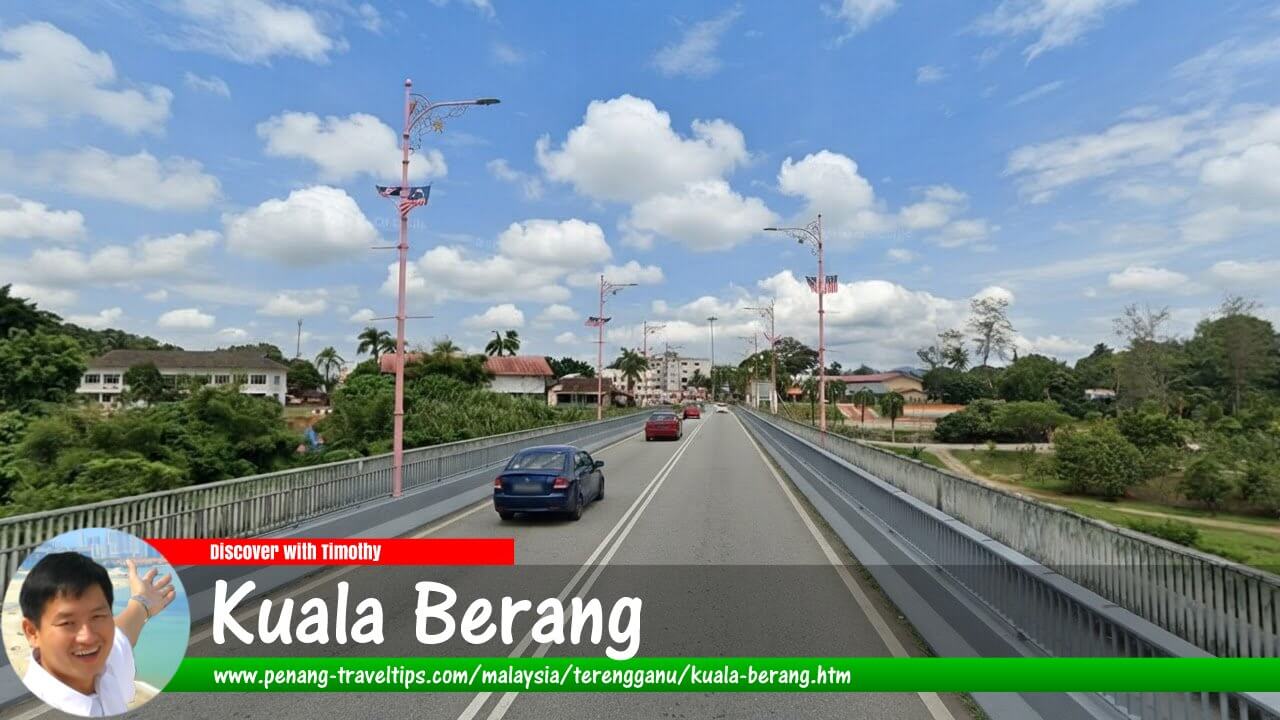 Kuala Berang Travel Guide (AI generated on 10 September 2026)
Also available: Panduan Melawat Kuala Berang
Kuala Berang is the principal town and administrative centre of Hulu Terengganu District in Terengganu, Malaysia. Located inland, about 40 km from Kuala Terengganu, the town occupies an important position at the meeting of the Berang and Terengganu river systems and serves as a gateway to the interior of Terengganu, including Tasik Kenyir.1 Kuala Berang is also one of the state's historically significant towns. The discovery of the Batu Bersurat Terengganu at nearby Kampung Buluh in the late 19th century placed the area prominently in the history of Islam, Jawi writing and Malay civilisation in Southeast Asia.2
Quick Facts
- Location: Hulu Terengganu District, Terengganu, Malaysia
- Role: Administrative and commercial centre of Hulu Terengganu
- District council: Majlis Daerah Hulu Terengganu
- Distance from Kuala Terengganu: About 40 km by road
- Geographical setting: Inland Terengganu, around the confluence of the Berang and Terengganu rivers
- Historical importance: Associated with the early history of the Terengganu Sultanate and the discovery of the Batu Bersurat Terengganu
- Historic artefact: Batu Bersurat Terengganu, dated to 702 Hijrah (1303 AD) according to the commonly accepted reading
- UNESCO recognition: Batu Bersurat Terengganu was inscribed on the Memory of the World Register in 2009
- Major nearby attraction: Tasik Kenyir
- Other nature attraction: Hutan Lipur Sekayu / Air Terjun Sekayu
- Public transport: BAS.MY route T22 connects Kuala Terengganu with Kuala Berang
- Nearest airport: Sultan Mahmud Airport (TGG), Kuala Terengganu
- Best suited for: History, river landscapes, rural culture, nature excursions and as a base for exploring Hulu Terengganu
Where is Kuala Berang?
Kuala Berang is situated in Hulu Terengganu, the large inland district occupying much of the western interior of Terengganu. The district covers more than 3,800 square kilometres and includes extensive forested areas, agricultural land and the enormous Tasik Kenyir development area.1
The town is approximately 40 km west of central Kuala Terengganu by road. It is therefore considerably closer to the state capital than its inland setting might suggest. Kuala Berang is connected to Ajil and Kuala Terengganu by the main road network, while other roads lead deeper into Hulu Terengganu and towards the Kelantan and Pahang hinterlands.
Unlike Kuala Terengganu, which developed around the mouth of the Terengganu River and the South China Sea, Kuala Berang developed further upstream. Its location gave it an important relationship with the river system and with the interior of the Malay Peninsula. Historical sources indicate that the Terengganu River was an important route for traders travelling inland towards Kuala Berang.3
Geography and natural environment
Hulu Terengganu is one of the most forested and environmentally sensitive parts of Terengganu. The district borders Kelantan and Pahang and forms part of the broader Central Forest Spine of Peninsular Malaysia. The district council describes about 99 percent of the district as environmentally sensitive and unsuitable for development.1
The landscape around Kuala Berang is dominated by the valleys of the Sungai Berang and Sungai Terengganu. The surrounding lowlands provide fertile agricultural areas, while the terrain becomes increasingly forested and mountainous farther west. This contrast between river valleys, villages, farms and forest is one of the defining characteristics of Hulu Terengganu.
Tasik Kenyir occupies a huge area to the northwest of Kuala Berang. Created by the Kenyir hydroelectric development, the lake consists of extensive stretches of water dotted with islands, forested hills and river valleys. Today it is an important ecotourism destination, with activities including boat trips, fishing, jungle trekking and visits to waterfalls and caves.4
The location of Kuala Berang also makes it a convenient starting point for exploring natural attractions that are closer to town. Hutan Lipur Sekayu, for example, is about 16 km from Kuala Berang and contains a series of waterfalls within the Hulu Terengganu forest environment.5
History of Kuala Berang
Kuala Berang has a history considerably older than its present appearance as a small inland administrative town suggests. The Hulu Terengganu area was part of an early network of settlements and trading routes associated with the Terengganu River. Historical and geographical sources identify Kuala Berang as an important inland centre, while the river provided a natural connection with the coast.3
The area is also associated with the early history of the Terengganu Sultanate. Historical accounts recorded by the Malaysian National Library indicate that Tun Zainal Abidin, who became Sultan Zainal Abidin I, established his centre of government at Tanjung Baru in Kuala Berang before the political centre was subsequently established at Kuala Terengganu.6
Kuala Berang consequently occupies an important place in the early political history of Terengganu. The town was later superseded in importance by Kuala Terengganu, whose position at the mouth of the river provided better access to maritime trade and eventually made it the state's principal administrative and royal centre. The Kuala Terengganu City Council's historical account specifically describes Kuala Terengganu as having become the state capital after Kuala Berang and other districts.7
The Batu Bersurat and Kuala Berang's historical importance
The most important historical association of Kuala Berang is the Batu Bersurat Terengganu, or Inscribed Stone of Terengganu. The granite stone was discovered at Kampung Buluh in the Kuala Berang area in the late 19th century. Its inscription is written in Jawi and provides an important record of the development of Islam, law and Malay literacy in the region.2
The inscription is commonly dated to 702 Hijrah, corresponding to 1303 AD, although the damaged portion of the date has led to historical discussion concerning its precise reading. The earlier date of 1303 is the date generally associated with the stone today and is the basis for its importance in the history of Islam and Jawi writing in the Malay world.
UNESCO describes the Batu Bersurat as the earliest evidence of Jawi writing in the Malay Muslim world of Southeast Asia. It was inscribed on the Memory of the World Register in 2009.2
The inscription also provides evidence of a society in which Islamic religious principles were becoming established alongside existing cultural practices. The Department of National Heritage notes that the stone refers to regional trade and the movement of people during the process of Islamisation, while retaining terms associated with the region's earlier Hindu cultural heritage.8
The stone itself is now preserved by the Terengganu State Museum. Nevertheless, the discovery site near Kuala Berang remains significant because it demonstrates that the interior of Terengganu was connected to the wider commercial and cultural networks of the Malay world more than seven centuries ago.
How did Kuala Berang get its name?
The name Kuala Berang can be understood from its geographical setting. In Malay geographical terminology, kuala refers to the mouth of a river, an estuary or a place where waterways meet. Kuala Berang is situated at the meeting of the Berang River and the Terengganu River system, giving the first part of the name a straightforward geographical meaning.
The second part, Berang, refers to the Sungai Berang, the river that flows through the area. Local accounts describe Kuala Berang as deriving its name from the meeting of Sungai Berang with Sungai Terengganu. The river itself runs through several settlements before reaching the Kuala Berang area.9
The name therefore follows a common pattern in Malay place names, in which a geographical term such as kuala is combined with the name of a river or other local feature. It is more useful to understand Kuala Berang in this geographical sense than to attribute the name to a speculative personal or legendary origin.
Things to see and do around Kuala Berang
Batu Bersurat heritage
For visitors interested in history, the Batu Bersurat is the principal reason to explore Kuala Berang and the surrounding villages. Although the original stone is not displayed in the town itself, the heritage of its discovery is closely connected with the Kuala Berang area. The Jalan Memorial Batu Bersurat and related local place names reflect this historical association.10
A visit to the area can be combined with a broader exploration of Hulu Terengganu's historical landscape, particularly the villages along the Terengganu and Tersat river systems.
Hutan Lipur Sekayu and Air Terjun Sekayu
Hutan Lipur Sekayu, also known as Air Terjun Sekayu, is one of the easiest nature excursions from Kuala Berang. It is situated approximately 16 km from the town and 56 km from Kuala Terengganu, within the Hulu Terengganu Additional Forest Reserve.5
The recreation forest is known for its waterfalls, streams and forest surroundings. It is suitable for visitors looking for a relatively accessible introduction to the natural environment of Hulu Terengganu. The site can be reached by road from the Ajil area and is practical for a half-day excursion from Kuala Berang.
Lata Belukar Bukit
Lata Belukar Bukit is another local recreation area, situated about 20 km south of Kuala Berang. The site is described by the Hulu Terengganu District Council as a picnic and camping area, with its natural surroundings, cool water and peaceful atmosphere forming its principal attractions.11
It is a particularly suitable option for visitors who want a simple riverside outing without travelling as far into the interior as Tasik Kenyir.
Tasik Kenyir
Tasik Kenyir is the major natural and recreational attraction associated with Kuala Berang. The lake extends across a vast area of Hulu Terengganu and is characterised by hundreds of islands, forested shorelines, waterfalls and waterways. Pengkalan Gawi is the principal gateway for visitors travelling into the lake area from the Kuala Berang side.4
Activities at Tasik Kenyir include boat excursions, fishing, jungle trekking, visiting waterfalls and exploring the lake's islands. Houseboats are also an important part of the lake's tourism industry, allowing visitors to spend several days exploring the waterways rather than returning to the mainland each day.
Tasik Kenyir Orchid Garden
The Tasik Kenyir Orchid Garden is another attraction within the lake area. The garden displays more than 300 species of orchids, including locally occurring and exotic species. Visitors normally reach the garden by travelling from Kuala Berang towards Tasik Kenyir and continuing by boat or ferry from one of the lake's jetties.12
Because the attraction is located within the lake environment, a visit requires more planning than a simple road excursion. It is best combined with a boat trip or other Tasik Kenyir activities.
Food in Kuala Berang
Food in Kuala Berang reflects the everyday cooking traditions of inland Terengganu. The town has ordinary restaurants and coffee shops, but visitors who want to experience local cuisine should look for masakan kampung, especially dishes using freshwater fish and locally available ingredients.
Freshwater fish such as ikan baung, ikan keli and ikan lampam are associated with the rivers and inland waters of Hulu Terengganu. They may be prepared as gulai tempoyak, fried dishes, singgang or other traditional preparations. Ulam, budu and vegetable dishes are common accompaniments to a traditional rice meal.
Other familiar Terengganu dishes worth seeking include nasi dagang, nasi kerabu, laksam, laksa Terengganu, keropok lekor and traditional kuih. Food availability varies between individual establishments and meal times, so it is useful to explore the town rather than rely on a particular restaurant.
Local food reporting has also highlighted the presence of traditional kampung cuisine around Kuala Berang, including food prepared using traditional cooking methods and wood fires.13 Visitors travelling towards Tasik Kenyir may also encounter small roadside eateries and food stalls serving simple meals.
Where to stay in Kuala Berang
Kuala Berang has a modest but useful range of accommodation. The Hulu Terengganu District Council's current licensed accommodation list includes guesthouses and budget accommodation in the town, as well as larger resort-style properties around Tasik Kenyir.14
Options in the town include small hotels, guesthouses and homestays. Among the establishments listed by the district council are Aj Hotel, Selesa Inn, The Serai Cottage, Bella Hotel and several guesthouse operators. The council's list is useful as an indication of the local accommodation structure, although visitors should confirm current availability before travelling.14
Visitors whose main purpose is to explore Tasik Kenyir have a different choice: they can stay at a lake resort or arrange a houseboat. The lake resorts provide a more nature-oriented experience, while staying in Kuala Berang itself is more convenient for visitors who want access to shops, restaurants and ordinary town facilities.
How to get to Kuala Berang
By car
Driving is the most convenient way to reach Kuala Berang, particularly if the itinerary includes Tasik Kenyir, Sekayu, Lata Belukar Bukit or other rural attractions. From Kuala Terengganu, the road distance is approximately 40 km, and the journey can take around 35–45 minutes under normal conditions.15
Travellers approaching from the south can use the East Coast Expressway Phase 2 (LPT2) and leave the expressway around Ajil before continuing towards Kuala Berang. Ajil is an important road junction for Hulu Terengganu and provides access from the expressway network to the district.
From Kuantan, the road journey to Kuala Berang is roughly 190 km. The route can be useful for travellers crossing between Pahang and inland Terengganu, although the exact journey time depends on the route, traffic and weather conditions.16
By bus
Kuala Berang is served by local bus services from Kuala Terengganu. The current BAS.MY Kuala Terengganu network includes route T22, connecting Kuala Terengganu with Kuala Berang.17
The Hulu Terengganu District Council also identifies the Kuala Berang bus terminal as a local transport facility and lists express bus services, local buses, taxis and passenger vans among the transport options available in the town.18
Express bus services have also historically connected Kuala Berang directly with Kuala Lumpur. Travellers using buses should check the latest schedules before departure, as routes and frequencies can change.
By air
The nearest commercial airport is Sultan Mahmud Airport (TGG) in Kuala Terengganu. The airport is roughly 45–55 km from Kuala Berang depending on the exact starting point and route. A taxi, private transfer or rental car is therefore the most straightforward way to continue from the airport.
For international visitors, Kuala Lumpur is likely to offer a wider choice of international flights. From Kuala Lumpur, travellers can either take a domestic flight to Kuala Terengganu and continue by road, or travel overland to Terengganu.
Getting around Kuala Berang
The central part of Kuala Berang is relatively compact and can be explored on foot for basic shopping, food and town activities. However, the wider Hulu Terengganu area is extensive, and the most interesting natural attractions are scattered across a large area.
A private or rental car is strongly recommended for visitors who intend to explore beyond the town centre. This is particularly true for trips combining Kuala Berang with Sekayu, Lata Belukar Bukit, Pengkalan Gawi and other parts of Hulu Terengganu.
Taxis are available for journeys between Kuala Berang and Kuala Terengganu, while passenger vans provide services to some inland communities. The district council notes that public transport is limited in the more remote interior areas.18
For Tasik Kenyir, road transport only takes visitors as far as the lake's access points. Once at Pengkalan Gawi or another appropriate jetty, boats are required to travel around the lake and reach many of its attractions.
How long should you stay?
A traveller primarily interested in Kuala Berang can see the town in one day, especially if the visit focuses on its historical associations, local food and town centre.
A stay of two or three days is more suitable for visitors who want to use Kuala Berang as a base for Hulu Terengganu. This allows time for a nature excursion to Sekayu or Lata Belukar Bukit, while leaving a full day or more for Tasik Kenyir.
Those planning a multi-day houseboat trip on Tasik Kenyir should regard Kuala Berang as the mainland gateway rather than as the principal destination itself.
Suggested two-day itinerary
- Day 1 morning: Arrive in Kuala Berang, explore the town centre and learn about its historical connection with Hulu Terengganu.
- Day 1 lunch: Have a traditional Terengganu meal, looking out for freshwater fish and other kampung dishes.
- Day 1 afternoon: Visit Hutan Lipur Sekayu or Lata Belukar Bukit.
- Day 1 evening: Return to Kuala Berang for dinner and stay overnight in town.
- Day 2 morning: Drive towards Pengkalan Gawi and Tasik Kenyir.
- Day 2: Take a boat excursion on Tasik Kenyir, visit a waterfall or island attraction, or arrange a longer houseboat experience.
- Day 2 evening: Return to Kuala Berang or stay overnight at a lake resort or houseboat, depending on the itinerary.
Best time to visit Kuala Berang
Kuala Berang can be visited throughout the year, but the weather should be considered carefully when planning outdoor activities. The east coast of Peninsular Malaysia experiences the Northeast Monsoon, normally from around November to February, when rainfall can be heavy and rivers and waterfalls may become unsafe.
The relatively drier months are generally more convenient for visiting Tasik Kenyir, hiking and exploring waterfalls. Nevertheless, heavy rain can occur outside the monsoon season as well, so visitors should check weather conditions before setting out for forest and river activities.
For Tasik Kenyir, weather conditions also affect boat travel. Visitors arranging houseboats or lake excursions should confirm the operating conditions with their accommodation or boat operator before travelling.
Practical travel tips
- Use a car if possible: Kuala Berang itself is manageable, but the surrounding attractions are widely dispersed.
- Plan Tasik Kenyir separately: A lake excursion requires a boat and cannot be treated simply as a road trip.
- Bring suitable footwear: Sandals or shoes suitable for wet surfaces are useful for waterfall and riverside activities.
- Check the weather: Heavy rain can make waterfalls and rivers dangerous and may affect boat operations.
- Carry cash: Smaller food stalls and rural businesses may not accept cards or electronic payments.
- Do not assume every attraction is open daily: Recreation areas and private facilities can have different operating arrangements.
- Refuel before travelling into the interior: Petrol stations become less frequent away from the main town.
- Respect local communities: Many attractions are situated near villages, religious sites and environmentally sensitive areas.
- Allow extra time: Road travel in rural Hulu Terengganu can take longer than a map estimate, particularly during rain.
Kuala Berang as a destination
Kuala Berang is not primarily a destination for conventional urban sightseeing. Its appeal lies in the combination of history, rivers, rural culture and access to the natural environment of Hulu Terengganu. The town is particularly important because of its association with the Batu Bersurat, one of the most significant surviving records of early Jawi writing and Islam in Southeast Asia.
Its geographical position gives the town another important role. Kuala Berang sits between the more developed coastal zone of Terengganu and the extensive forests and waterways of the interior. From here, visitors can travel towards Sekayu, Lata Belukar Bukit and, most importantly, Tasik Kenyir.
For travellers interested in understanding Terengganu beyond its beaches, Kuala Berang offers a different perspective. It is a place where the history of the early Terengganu state, the river-based economy of the past and the forested landscape of modern Hulu Terengganu come together. A visit is therefore best planned not simply as a stop in a town, but as an introduction to the wider inland region of Terengganu.
References
- Majlis Daerah Hulu Terengganu — Info Hulu Terengganu
- UNESCO — Batu Bersurat Terengganu (Inscribed Stone of Terengganu)
- Majlis Bandaraya Kuala Terengganu — Kuala Terengganu Historical Information
- Kementerian Kemajuan Desa dan Wilayah — Tasik Kenyir, Hulu Terengganu
- Majlis Daerah Hulu Terengganu — Rekreasi
- Dewan Bahasa dan Pustaka — Sejarah dan Arkeologi Terengganu
- Majlis Bandaraya Kuala Terengganu — Sejarah Kuala Terengganu dan Terengganu
- Jabatan Warisan Negara — Batu Bersurat Terengganu
- Pusat Internet Kuala Berang — Sejarah Kuala Berang
- Majlis Daerah Hulu Terengganu — Senarai Sekolah Kuala Berang
- Majlis Daerah Hulu Terengganu — Recreation
- K-Tourism / KETENGAH — Taman Orkid Tasik Kenyir
- Free Malaysia Today — Authentic kampung food in a quiet Terengganu town
- Majlis Daerah Hulu Terengganu — Penginapan
- Rome2Rio — Kuala Berang to Kuala Terengganu
- Rome2Rio — Kuala Berang to Kuantan
- BAS.MY — Kuala Terengganu Bus Network
- Majlis Daerah Hulu Terengganu — Pengangkutan
Page Details
This page was created on 11 September 2026. Hi, my name is Timothy and created it from my research, for my own entertainment, knowledge and to satisfy my curiosity. I am providing the information to you in good faith and hope it is useful. I try to get the details as accurate as possible. I also try to update the page whenever I stumble on new details. So this and all my other pages are perpetual work in progress. If you discover any error, please politely inform me, pointing out where the error lies, and I will correct it as soon as possible. Your helpfulness will keep this page accurate, relevant and helpful to those who need the information.Buy Me A Coffee
If you enjoy the information I provide and want to support the work I do, please buy me a coffee! I appreciate it immensely, thank you so much!
