
Kuala Terengganu Travel Guide
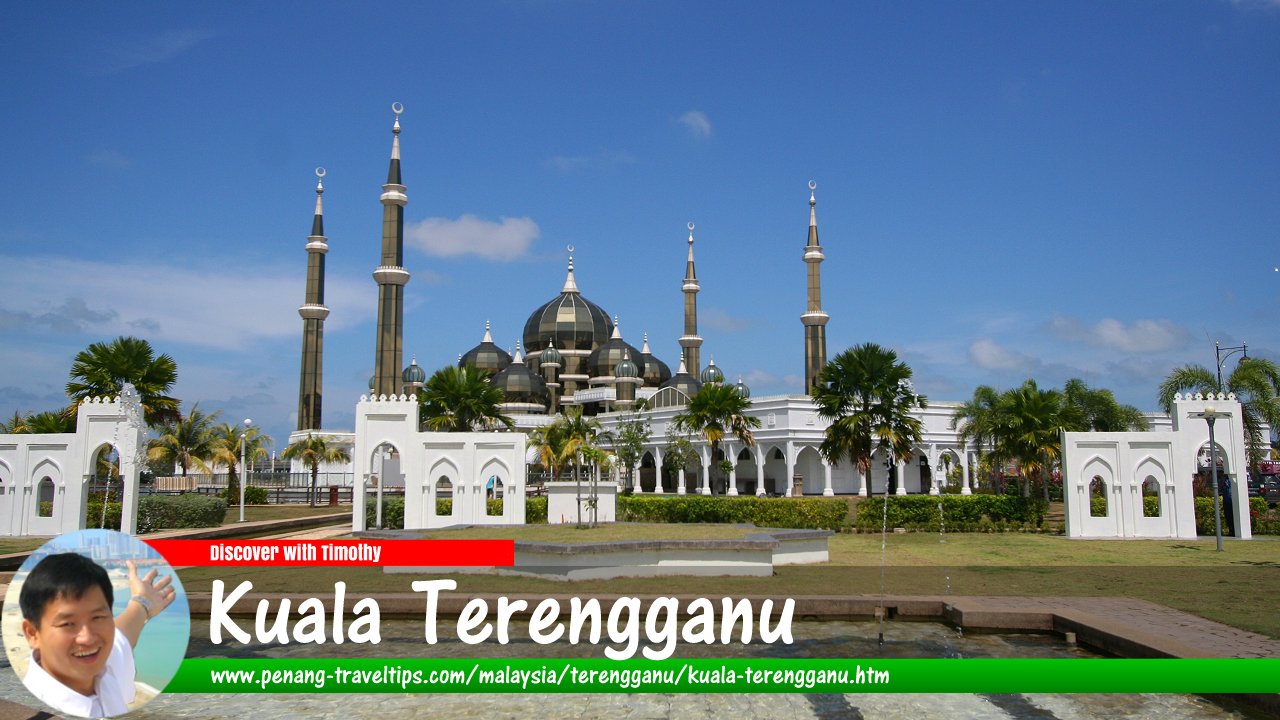 Kuala Terengganu Travel Guide (AI generated on 10 September 2026)
Also available: Panduan Melawat Kuala Terengganu
Kuala Terengganu is the capital of Terengganu and the state's principal urban centre. Situated at the broad estuary of the Terengganu River on the South China Sea, the city developed historically as a trading port, fishing centre and centre of Islamic scholarship and administration. Today, it combines a traditional waterfront cityscape with modern commercial districts, beaches, museums, mosques, markets and heritage neighbourhoods.
Quick Facts
- Country: Malaysia
- State: Terengganu
- Role: State capital and district capital
- Municipal authority: Kuala Terengganu City Council (MBKT)
- City status: Granted on 1 January 2008
- Location: At the mouth of the Terengganu River on the South China Sea
- Main river: Terengganu River
- Known for: Kampung Cina, Pasar Payang, traditional crafts, beaches, museums, Islamic heritage and riverfront scenery
- Nearest airport: Sultan Mahmud Airport
- Major road connection: East Coast Expressway and the coastal Federal Route 3
- Rail: East Coast Rail Link station planned for Kuala Terengganu; passenger operations are scheduled to begin in 2027
- Recommended stay: 2–3 days for the city and its principal attractions
About Kuala Terengganu
Kuala Terengganu is both the political capital and the historic heart of Terengganu. Although it has developed into a modern city, much of its identity remains connected to the river, the sea and the traditional economy of the east coast. Fishing, boat building, maritime trade and handicrafts have played important roles in its development, while Islam and the Terengganu royal tradition have strongly influenced its architecture and culture.1
The city occupies a strategic position between the Terengganu River and the South China Sea. The river once provided the principal inland route for traders travelling between the coast and settlements farther upstream, while the sea connected Terengganu with other parts of the Malay Peninsula and the wider region. The result is a city whose traditional character is distinctly maritime.
For visitors, Kuala Terengganu is best understood not simply as a place to pass through on the way to the islands, but as a destination in its own right. Its historic market, Chinese quarter, royal buildings, museums, mosques, craft centres, beaches and food culture provide a useful introduction to Terengganu before travelling farther along the coast.
Geography and Setting
Kuala Terengganu lies on the east coast of Peninsular Malaysia, facing the South China Sea. The city is centred around the wide estuary of the Terengganu River, one of the most important waterways in the state. The river divides and surrounds several parts of the urban area before reaching the sea, creating a landscape of river islands, low-lying coastal land and waterways.
Among the islands within the urban river environment are Pulau Duyung, Pulau Wan Man, Pulau Sekati and Pulau Duyung Kecil. Pulau Duyung in particular is associated with traditional boat building and maritime culture. The geography of the city therefore helps explain why boats, fishing and river transport have been so important to its history.1
The wider Kuala Terengganu district extends beyond the compact central city. Its eastern side faces the South China Sea, while inland areas contain villages, agricultural land and the upper reaches of the river system. The coastal environment also places the city within easy reach of some of Terengganu's best-known beaches and offshore islands.
History of Kuala Terengganu
An Early Trading Centre
Kuala Terengganu has a history that extends back many centuries. Chinese historical writings from the 12th and 13th centuries contain names such as Teng-ya-nu and Teng-ya-nung, which are generally associated with Terengganu. Chinese records also describe trading activity on the east coast of the Malay Peninsula, while later historical interpretations have identified the Terengganu River as an important route into the interior.1
The river was particularly important because goods could be moved from the coast towards settlements farther inland, including Kuala Berang. Historical accounts describe the exchange of forest products and other commodities for gold and silver. Kuala Terengganu's location at the river mouth therefore gave it an important commercial advantage.
The Terengganu Sultanate
The modern political history of Terengganu is closely associated with the establishment of the Terengganu Sultanate in the early 18th century. Sultan Zainal Abidin I, traditionally regarded as the first Sultan of Terengganu, was installed in 1725. Under the Terengganu sultanate, Kuala Terengganu developed as the principal seat of government and increasingly became the political and cultural centre of the state.2
Development accelerated during the 19th century. During the reign of Sultan Omar, who ruled from 1839 to 1876, roads and other infrastructure were developed in Kuala Terengganu. The city also became increasingly important as population, trade and government administration expanded.
The reign of Sultan Zainal Abidin III later became particularly significant in the history of Terengganu. The period was associated with administrative development, economic activity and the strengthening of Islamic institutions. Kuala Terengganu remained the principal political centre of the sultanate.
The Inscribed Stone
One of the most important historical objects associated with the region is the Batu Bersurat Terengganu, or Inscribed Stone of Terengganu. The stone bears an inscription dated to 1303 CE, corresponding to 702 Hijrah, and contains an early Malay-language Islamic inscription written in Jawi. It is regarded as a major piece of evidence for the early spread of Islam in the Malay world.
The stone was discovered at Kampung Buluh near Kuala Berang rather than in Kuala Terengganu itself, but its importance is central to understanding the state's history. The Batu Bersurat Terengganu was inscribed on UNESCO's Memory of the World Register in 2009.3
From Town to City
The administration of Kuala Terengganu developed through several stages during the 20th century. A local authority known as the Kuala Terengganu Town Board was eventually followed by the Kuala Terengganu Municipal Council, established in 1979. The local authority subsequently expanded its administrative responsibilities.
On 1 January 2008, Kuala Terengganu received city status and the local authority became the Kuala Terengganu City Council, or MBKT. The city is officially associated with the description Bandaraya Warisan Pesisir Air, reflecting its identity as a waterfront heritage city.4
How Kuala Terengganu Got Its Name
The word kuala in Malay refers to a river mouth, estuary or confluence. Kuala Terengganu therefore describes the settlement at the mouth or estuary of the Terengganu River.
The origin of the word Terengganu, however, is less certain. Several explanations have been proposed. One popular interpretation connects it with terang ganu, sometimes translated as "bright rainbow". Another traditional story associates the name with the phrase taring anu, meaning roughly "the fang of something". According to the story, hunters from Pahang found a large animal fang in the area and used the expression when asked where they had obtained their hunting spoils. The expression was subsequently said to have evolved into the name Terengganu.
The latter is a traditional origin story rather than a proven historical explanation. It is best treated as part of Terengganu's oral tradition rather than as an established linguistic fact.
Things to See and Do in Kuala Terengganu
Kampung Cina
Kampung Cina, or Chinatown, is one of Kuala Terengganu's most distinctive historic neighbourhoods. The settlement developed around the Chinese trading community and contains rows of old shophouses, temples, clan buildings, restaurants and narrow lanes.
The area is particularly interesting because Chinese and Malay cultural influences have existed side by side here for generations. Many of the old buildings have been adapted for modern businesses while retaining their traditional façades. Tourism Malaysia describes the area as an old Chinese settlement with historic shophouses and Peranakan cultural influences.5
Kampung Cina is best explored on foot. Allow time to wander beyond the main street and look at the smaller lanes, traditional houses, places of worship, cafés and street art.
Pasar Payang
Pasar Payang is Kuala Terengganu's best-known traditional market and one of the city's most useful places for understanding local commerce. The market sells fresh produce alongside textiles, handicrafts, food products and souvenirs.
Among the products associated with the market are batik, songket, traditional snacks and keropok lekor. The market is therefore both a shopping destination and a place where visitors can see the everyday commercial culture of Terengganu.6
Bukit Puteri
Bukit Puteri is a small historic hill overlooking the central part of Kuala Terengganu and the river. Its elevated position made it useful as a defensive and strategic site during the city's earlier history. The hill also provides views across the surrounding urban area and river.
Its location close to other historic landmarks makes Bukit Puteri convenient to combine with a walk around the city centre, particularly the area around Pasar Payang and Istana Maziah.
Istana Maziah
Istana Maziah is the principal royal palace associated with Kuala Terengganu. Located near Bukit Puteri, the palace is an important part of the city's royal landscape. Visitors should distinguish between seeing the palace from outside and entering a tourist attraction, as access to royal premises may be restricted.
Terengganu State Museum Complex
The Terengganu State Museum Complex is one of the most important museums in the state. The complex presents Terengganu's history, royal heritage, Islamic traditions, crafts and maritime culture. Tourism Malaysia describes it as a large museum complex comprising several main buildings, with the Maritime Museum located nearby.7
A visit here is particularly useful before exploring the rest of Kuala Terengganu because it provides context for the state's distinctive material culture, including traditional textiles, weapons, boats and other objects.
Islamic Heritage Park and Crystal Mosque
Islamic Heritage Park, also known as Taman Tamadun Islam, is located on Pulau Wan Man. Its most recognisable landmark is the Crystal Mosque, a striking modern mosque constructed principally with steel and glass.
The Islamic Heritage Park was developed as a major cultural and educational attraction. The park includes architectural replicas representing important Islamic buildings from different parts of the world, while the Crystal Mosque has become one of Kuala Terengganu's most recognisable modern landmarks.8
Terengganu River and Waterfront
The Terengganu River is central to the identity of Kuala Terengganu. Walking along the waterfront provides a different perspective of the city, particularly around the central market, river islands and the newer waterfront developments.
River cruises and boat excursions may also be available depending on the operator and season. A boat trip can be worthwhile because it reveals how closely the city's development is tied to the river and its islands.
Terengganu Drawbridge
The Terengganu Drawbridge is one of the city's most prominent modern landmarks. The cable-stayed bridge crosses the Terengganu River near its mouth and forms part of the newer waterfront landscape. Its distinctive towers are particularly noticeable from the river and surrounding coastal areas.
The bridge represents the contrast between old and new Kuala Terengganu: traditional markets, fishing boats and historic neighbourhoods exist alongside contemporary infrastructure and waterfront development.
Batu Buruk Beach
Batu Buruk Beach is the city's principal urban beach. It is located close to the central city and is a popular place for walking, enjoying the sea breeze, watching the sunset and experiencing the coastal atmosphere.
Swimming in the South China Sea should always be approached with caution because sea conditions and currents can change. Visitors should follow any local warnings and avoid entering the water during rough conditions.
Tengku Tengah Zaharah Mosque
The Tengku Tengah Zaharah Mosque, commonly known as the Floating Mosque, is situated near the mouth of Sungai Ibai, south of the central city. Its design combines modern and Moorish architectural elements, while its position on a partially submerged platform creates the appearance of floating when viewed during suitable water conditions.7
Pulau Duyung
Pulau Duyung is associated with Terengganu's traditional boat-building industry. The island is historically important because skilled craftsmen have built wooden boats using techniques passed down through generations.
Boat building is an especially useful part of the Kuala Terengganu story because it demonstrates how the city's maritime environment influenced local craftsmanship. Visitors should respect private boatyards and workshop areas and visit only places that are open to the public.
Traditional Arts and Crafts
Kuala Terengganu is one of the best places in Malaysia to encounter Terengganu's traditional crafts. The most prominent include batik, songket, copperware, traditional boat building and wood carving. The city's cultural traditions also include performing arts and traditional games such as silat, gamelan, ulik mayang and kite flying.4
For visitors interested in craft production, the Noor Arfa Craft Complex in Chendering is one of the better-known places associated with batik. Traditional crafts are also sold at Pasar Payang and other commercial areas around the city.
What to Eat in Kuala Terengganu
Food is an important part of the Kuala Terengganu experience. Terengganu cuisine is strongly influenced by the state's coastal location, with fish and other seafood featuring prominently in many dishes. Rice remains the staple food, while coconut, herbs and spices are commonly used in local cooking.9
Nasi Dagang
Nasi dagang is one of Terengganu's best-known dishes. The rice is prepared with coconut milk and is commonly served with a rich fish-based curry and accompaniments. It is particularly associated with breakfast but can be eaten at other times of day.
Keropok Lekor
Keropok lekor is perhaps the most recognisable Terengganu snack. It is made principally from fish and sago flour, formed into elongated pieces and either boiled or fried. The fried version is especially popular as a snack and is normally served with chilli sauce.
Satar
Satar consists of seasoned fish paste wrapped in banana leaves and grilled over charcoal. It has a smoky flavour and is another example of how Terengganu's coastal food traditions make extensive use of fish.
Other Local Foods
Visitors can also look for dishes such as nasi kerabu, laksam, pulut lepa, local kuih and a variety of seafood dishes. Food stalls, traditional restaurants and markets are generally better places to look for everyday local cooking than restaurants aimed primarily at tourists.
Where to Stay in Kuala Terengganu
Kuala Terengganu has accommodation ranging from simple guesthouses and budget hotels to larger city hotels and resorts. For a first visit, the most useful areas depend on what you want to do.
- City centre: Convenient for Pasar Payang, Kampung Cina, Bukit Puteri, Istana Maziah and other heritage attractions.
- Waterfront: Suitable for visitors who want to be near the river, city centre and newer commercial developments.
- Batu Buruk: Convenient for visitors who prefer to stay near the beach and seaside recreational areas.
- Chendering and southern Kuala Terengganu: Useful for visitors interested in craft centres and attractions south of the city.
- Near Sultan Mahmud Airport: Practical for very early or late flights, although less convenient for exploring the historic city centre on foot.
For most visitors spending two or three nights in Kuala Terengganu, staying in or near the central city is the most convenient choice. It reduces the need for repeated car or e-hailing journeys to the historic core.
How to Get to Kuala Terengganu
By Air
Sultan Mahmud Airport is the main airport serving Kuala Terengganu. It is located north of the city and provides the quickest option for travellers arriving from Kuala Lumpur and other Malaysian destinations when suitable flights are available.
Flight schedules can change, so travellers should check the current timetable before planning an itinerary around a particular flight. From the airport, visitors can continue into the city by taxi, e-hailing service or private vehicle.
By Car
Driving is one of the most practical ways to reach Kuala Terengganu, particularly for visitors who intend to explore other parts of Terengganu. From the Klang Valley, the main approach is via the East Coast Expressway, followed by connecting roads towards Kuala Terengganu.
The coastal Federal Route 3 is particularly useful for travellers approaching from other parts of the east coast. It follows much of the east coast of Peninsular Malaysia and provides access to towns and coastal attractions north and south of Kuala Terengganu.
Driving also gives visitors greater flexibility for reaching places such as Batu Buruk, Chendering, Pulau Duyung and the museum complex, as well as for making day trips beyond the city.
By Bus
Long-distance express buses connect Kuala Terengganu with Kuala Lumpur, Kota Bharu, Kuantan and other Malaysian cities. The main bus terminal is useful for travellers arriving without a car and is connected to the city's local transport network.
Bus travel is generally cheaper than flying and can be practical for travellers from nearby east-coast towns. Journey times are considerably longer than flying, however, and may vary with traffic and holiday-season congestion.
By Rail: A Future Option
As of 2026, Kuala Terengganu does not yet have an operating intercity passenger railway. This is expected to change with the East Coast Rail Link (ECRL).
Malaysia Rail Link has identified Kuala Terengganu as one of the six ECRL stations in Terengganu. The first operational phase, connecting Kota Bharu with the Gombak Integrated Terminal, is scheduled to begin passenger services in January 2027. The ECRL project was reported at 92.62% overall construction progress as of February 2026.10
This will eventually provide a new overland travel option for visitors travelling between the east coast and the Klang Valley. Travellers should check the latest operating information before relying on the ECRL for a trip, particularly during its initial period of service.
Getting Around Kuala Terengganu
A private car is the most flexible way to explore Kuala Terengganu and the surrounding district. This is especially true if your itinerary includes attractions spread across the city and southern or northern suburbs.
E-hailing services are useful for individual journeys, particularly between hotels, restaurants, markets and major attractions. Availability is generally better in the urban area than in more rural parts of the district.
The city also has local bus services. MBKT describes its Bas Bandar as a city service linking several tourist attractions, including Pasar Payang, Bukit Puteri, Istana Maziah, the State Museum and the Tengku Tengah Zaharah Mosque. Traditional-style buses have been used as part of the city's public transport identity.11
Trishaws, or beca, can still be found around the central city and can be an enjoyable option for short sightseeing journeys. They are most suitable for short distances rather than as the main form of transport for a full-day itinerary.
The historic centre is also relatively pleasant to explore on foot. Walking is particularly worthwhile around Kampung Cina, Pasar Payang, Bukit Puteri and the nearby waterfront, where several attractions are located within a manageable distance of one another.
How Long to Stay
A two-day visit is sufficient for a first introduction to Kuala Terengganu. A three-day stay gives a more relaxed experience and allows time for attractions outside the immediate city centre.
One-Day Visit
- Pasar Payang
- Kampung Cina
- Bukit Puteri
- Istana Maziah area
- Terengganu River waterfront
- Batu Buruk Beach
Two-Day Visit
On the second day, add the Terengganu State Museum Complex, Pulau Duyung, Islamic Heritage Park and Crystal Mosque, together with a craft centre such as Noor Arfa.
Three-Day Visit
A third day can be used for a slower exploration of the city, additional food stops, nearby beaches or a day excursion outside Kuala Terengganu. This is also a better option for travellers who want to experience the city without rushing between attractions.
Suggested Kuala Terengganu Itinerary
Day 1: Historic Kuala Terengganu
- Begin at Pasar Payang.
- Walk through Kampung Cina and explore its historic lanes.
- Visit Bukit Puteri and view the surrounding river landscape.
- See Istana Maziah from the surrounding public area.
- Explore the waterfront and Terengganu River.
- End the day at Batu Buruk Beach.
Day 2: Heritage, Islam and Maritime Culture
- Visit the Terengganu State Museum Complex.
- Explore Pulau Duyung and learn about traditional boat building where public access permits.
- Visit Islamic Heritage Park and the Crystal Mosque.
- Continue to the Tengku Tengah Zaharah Mosque.
- Return to the city for a local dinner.
Day 3: Crafts and a Slower City Experience
- Visit a batik or handicraft centre.
- Explore additional markets and shops around the city.
- Try local dishes such as nasi dagang, keropok lekor and satar.
- Spend time along the waterfront or beach.
- Use the evening for a relaxed meal or city walk.
When to Visit Kuala Terengganu
Kuala Terengganu has a tropical climate and can be visited throughout the year. Temperatures are generally warm and humid, with rainfall occurring during different periods of the year.
The northeast monsoon is particularly important when planning coastal activities. Rougher seas and heavier rain can affect beaches, boat trips and access to offshore islands. If your itinerary includes island excursions, always check the marine and weather conditions before travelling.
For a city-focused holiday, however, the weather is less restrictive because many attractions are on land and several major museums, markets and heritage sites can still be visited when it rains.
Shopping and Souvenirs
Kuala Terengganu is a good place to buy products that reflect Terengganu's traditional culture. The most characteristic purchases include batik, songket, woven textiles, traditional snacks, handicrafts and small copper or brass objects.
Pasar Payang is the obvious starting point for visitors who want to browse a broad range of products in one location. Craft centres such as Noor Arfa provide another option, particularly for visitors interested in seeing how batik is produced.
Food products also make practical souvenirs. Packaged keropok lekor and other shelf-stable Terengganu snacks can be easier to transport than fresh food, particularly for travellers flying home.
Practical Travel Tips
- Dress appropriately: Kuala Terengganu is a predominantly Malay Muslim city. Modest clothing is appropriate, especially when visiting mosques, museums and religious sites.
- Visit markets early: Morning is often the most interesting time to experience traditional markets and food stalls.
- Carry cash: Although cards and electronic payments are widely accepted in modern businesses, smaller stalls and traditional vendors may still prefer cash.
- Allow for rain: Tropical showers can be sudden. Carrying a compact umbrella is useful.
- Protect yourself from the sun: Beaches and waterfront areas can be hot, particularly around midday.
- Check mosque access: Non-Muslim visitors may have restrictions on entering certain prayer areas. Follow the instructions of the mosque staff.
- Plan island trips separately: Boat schedules and sea conditions can affect journeys to islands such as Redang and Bidong.
- Use the city as a base: Kuala Terengganu is well positioned for exploring other parts of the Terengganu coast.
Kuala Terengganu as a Base for Exploring Terengganu
Kuala Terengganu works particularly well as a starting point for a wider Terengganu journey. Travellers can head south towards Marang and Dungun or north towards Setiu and Besut. The state's long coastal route includes numerous beaches, fishing settlements and smaller towns.
The city's location also makes it a useful gateway to Terengganu's offshore islands. Depending on the destination and current transport arrangements, visitors may travel from different jetties along the coast rather than directly from Kuala Terengganu itself. It is therefore important to confirm the departure point when booking an island trip.
For visitors interested in inland landscapes, the city can also serve as a base for travelling towards Hulu Terengganu and Lake Kenyir, although these destinations are better treated as separate excursions because of the distances involved.
What Makes Kuala Terengganu Worth Visiting?
Kuala Terengganu's appeal lies in the combination of several layers of history. It is simultaneously a royal capital, an old trading port, a fishing and boat-building centre, an important Islamic centre and a modern state capital.
Its heritage is not confined to a single monument. It can be seen in the layout of the riverfront, the old shophouses of Kampung Cina, the products sold at Pasar Payang, the royal buildings around Bukit Puteri, traditional boats on the river and the continuing production of batik and songket.
At the same time, modern landmarks such as the Crystal Mosque and Terengganu Drawbridge show how the city continues to change. This mixture of old and new is what makes Kuala Terengganu different from a purely resort-oriented destination.
Conclusion
Kuala Terengganu is one of the most historically significant cities on Malaysia's east coast and provides a useful introduction to the culture and history of Terengganu. Its position at the mouth of the Terengganu River explains much of its development, from an early trading settlement to the royal and administrative centre of the state.
For first-time visitors, the best approach is to combine the historic city centre with the riverfront, Kampung Cina, Pasar Payang, the State Museum, the city's mosques and a visit to Batu Buruk Beach. Those with additional time can explore the city's craft traditions, maritime heritage and surrounding coastal areas.
Although Kuala Terengganu is often treated as a gateway to Terengganu's famous islands, the city itself deserves time. Its markets, food, river, traditional crafts and historic neighbourhoods provide a more complete picture of the state than an island holiday alone.
Map of Kuala Terengganu
Places in Kuala Terengganu
- Bukit Puteri (GPS: 5.33633, 103.137)

- Chinatown (GPS: 5.33302, 103.13271)

Places of interest in Kuala Terengganu
- Crescent Moon Bridge (GPS: 5.33601, 103.13454)

- Dataran Shahbandar (GPS: 5.33826, 103.13928)

- Istana Maziah (GPS: 5.33585, 103.13738)

- Kuala Terengganu Waterfront (GPS: 5.33519, 103.13329)

- Noor Arfa Craft Complex (GPS: 5.27634, 103.16763)

- Pulau Duyong (GPS: 5.32985, 103.12274)

- Taman Tamadun Islam (GPS: 5.32267, 103.1131)

Categories of Sights in Kuala Terengganu
- Beaches in Kuala Terengganu
- Bridges in Kuala Terengganu
- Bus Terminals in Kuala Terengganu
- Chinese Temples in Kuala Terengganu
- Handicraft Centres in Kuala Terengganu
- Hills in Kuala Terengganu
- Historic Buildings in Kuala Terengganu
- Historic Sites in Kuala Terengganu
- Homestays in Kuala Terengganu
- Hotels in Kuala Terengganu
- Islands in Kuala Terengganu
- Markets in Kuala Terengganu
- Mosques in Kuala Terengganu
- Museums in Kuala Terengganu
- Palaces in Kuala Terengganu
- Parks in Kuala Terengganu
- Restaurants in Kuala Terengganu
- Stadiums in Kuala Terengganu
- Waterfront Promenades in Kuala Terengganu
Homestays in Kuala Terengganu
- Homestay Teluk Ketapang (GPS: 5.37281, 103.11453)

Public Amenities in Kuala Terengganu
- Kuala Terengganu Airport (GPS: 5.37916, 103.10541)

- Stadium Tertutup Terengganu (GPS: 5.3346, 103.13788)

- Sultan Mahmud Bridge (GPS: 5.33215, 103.11857)

- Sultan Mizan Zainal Abidin Stadium (GPS: 5.36979, 103.10556)

- Town Bus Terminal
Sights at Taman Tamadun Islam
- Bbeteng Restaurant & Food Court: Food establishment offering local and international dishes.
- Crystal Mosque: Landmark glass mosque within Taman Tamadun Islam.
- Taman Tamadun Islam Monument Park: A park with replicas of 22 Islamic monuments.
- Tok Ku Paloh Jetty: Jetty for river cruises.
- Taman Tamadun Islam Convention Centre: Biggest convention centre in the East Coast of Peninsula Malaysia.
References
- Kuala Terengganu Info — Kuala Terengganu City Council (MBKT)
- Info Kuala Terengganu: History and development — MBKT
- Batu Bersurat Terengganu — UNESCO Memory of the World
- Background of Kuala Terengganu City Council — MBKT
- 7 Unforgettable Stops to Make in Kuala Terengganu — Tourism Malaysia
- Malaysia Travel Guide: Terengganu — Tourism Malaysia
- Malaysia Travel Guide: Terengganu — Tourism Malaysia
- Islamic Civilisation Park, Kuala Terengganu — Tourism Malaysia
- Essential Information and Terengganu Cuisine — Tourism Malaysia
- ECRL Project Hits 92.6% Completion, On Track for 2027 Launch — Malaysia Rail Link
- Transportation in Kuala Terengganu — MBKT
Page Details
This page was created on 10 September 2026. Hi, my name is Timothy and created it from my research, for my own entertainment, knowledge and to satisfy my curiosity. I am providing the information to you in good faith and hope it is useful. I try to get the details as accurate as possible. I also try to update the page whenever I stumble on new details. So this and all my other pages are perpetual work in progress. If you discover any error, please politely inform me, pointing out where the error lies, and I will correct it as soon as possible. Your helpfulness will keep this page accurate, relevant and helpful to those who need the information.Buy Me A Coffee
If you enjoy the information I provide and want to support the work I do, please buy me a coffee! I appreciate it immensely, thank you so much!
