
Anamalai Avenue, Singapore
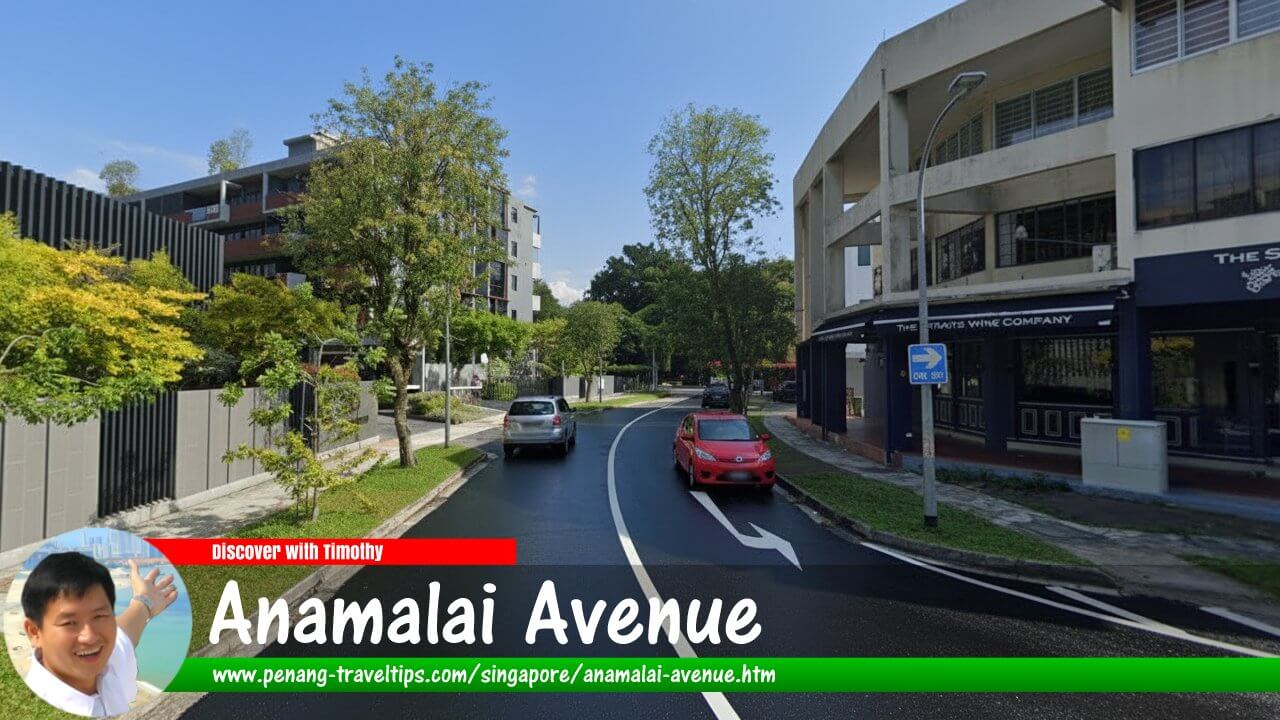 Anamalai Avenue, Singapore (AI-edited photograph on 4 May 2026)
Anamalai Avenue is a short residential road located in Singapore, within the Bukit Timah Planning Area. Measuring approximately 206 metres in length, it connects Bukit Timah Road in the north to Sixth Avenue in the south. Despite its modest scale, the avenue is situated in one of Singapore’s most prestigious residential districts, known for its greenery, landed properties, and proximity to key educational institutions and lifestyle amenities.
Quick Facts
- Road Name: Anamalai Avenue
- Length: 206 metres
- Postal District: 10
- Planning Area: Bukit Timah
- Road Type: Residential avenue
- Connections: Bukit Timah Road (north), Sixth Avenue (south)
- Nearest MRT Station: Sixth Avenue (DT7)
History and Development
The Bukit Timah area, where Anamalai Avenue is located, has a long history of development that dates back to the 19th century. Initially characterised by plantations and rural settlements, Bukit Timah gradually evolved into a desirable residential district during the colonial period. Its higher elevation, relative distance from the congested town centre, and cooler environment made it attractive to affluent residents.
Anamalai Avenue likely emerged in the early to mid-20th century, when land subdivision and residential planning intensified in Bukit Timah. The construction of Bukit Timah Road as a major arterial route facilitated access to the area, encouraging the development of side streets such as Anamalai Avenue. These smaller roads were designed to serve low-density housing, particularly landed homes and bungalows.
Over the decades, the character of the area has remained largely residential, although modern redevelopment has introduced new housing typologies such as semi-detached houses and low-rise condominiums. Despite these changes, Anamalai Avenue has retained its quiet and exclusive atmosphere, reflecting the enduring appeal of Bukit Timah as a prime residential enclave.
Name Origin
Anamalai Avenue was named after Annamalai R. Chettiar, a prominent figure within the Natukottai Chettiar community in Singapore. He established the Natukottai Chettiar’s Trade Association in Tank Road in the 1920s, playing a key role in organising and supporting the community’s commercial and social activities.1
Originally from Ramachandrapuram in Tamil Nadu, India, Annamalai R. Chettiar was known for his proficiency in English and his philanthropic contributions. The Chettiars were an influential mercantile community in Southeast Asia, particularly in banking and moneylending, and their presence in Singapore was significant during the colonial era.
The naming of Anamalai Avenue reflects the broader practice of commemorating notable individuals who contributed to Singapore’s social and economic development. It also highlights the multicultural fabric of the city, where streets bear the names of people from diverse ethnic and cultural backgrounds.
Character and Surroundings
Anamalai Avenue is characterised by its शांत and leafy environment, typical of Bukit Timah’s residential streets. The road is lined with landed properties, including detached houses, semi-detached homes, and terrace houses. Many of these properties are set within spacious plots, featuring landscaped gardens and mature trees that contribute to the area’s greenery.
The avenue’s low traffic volume enhances its appeal as a მშვიდ neighbourhood, making it suitable for families and individuals seeking a tranquil living environment. Unlike more commercialised parts of Singapore, Anamalai Avenue retains a distinctly suburban feel, with minimal commercial activity along the street itself.
At the same time, residents benefit from proximity to a range of amenities. Sixth Avenue, located at the southern end, offers dining options, cafes, and small retail outlets. Bukit Timah Road, to the north, provides access to a wider array of services, including supermarkets, schools, and recreational facilities.
Nearby Streets and Connectivity
Anamalai Avenue is well integrated into the Bukit Timah road network, with several notable streets in its vicinity:
- Bukit Timah Road: One of Singapore’s longest and most important roads, connecting the city centre to the western regions.
- Sixth Avenue: A key local road with commercial establishments and access to MRT services.
- Greenleaf Road: A nearby residential street known for its landed properties.
- Jalan Haji Alias: Another residential road in the Bukit Timah area.
This connectivity ensures that Anamalai Avenue is both accessible and conveniently located, despite its शांत and secluded atmosphere.
Points of Interest
While Anamalai Avenue itself is primarily residential, several points of interest can be found within its vicinity:
- Rail Corridor (Bukit Timah stretch): A popular green corridor for walking, jogging, and cycling.
- Sixth Avenue eateries: A cluster of cafes and restaurants offering diverse cuisines.
- Educational institutions: The Bukit Timah area is home to several प्रतिष्ठigious schools, making it a sought-after location for families.
The combination of greenery, lifestyle amenities, and educational facilities contributes to the area’s high desirability.
Real Estate and Property Market
The property market along and around Anamalai Avenue reflects its status within District 10, one of Singapore’s most prestigious residential districts. As of early 2025, property prices in this area are among the highest in the country, particularly for landed homes.
Typical property characteristics include:
- Terrace houses: Approximately 2,000 to 3,000 sq ft (186 to 279 sq m), with prices ranging from SGD 3.5 million to SGD 6 million.
- Semi-detached houses: Around 3,000 to 5,000 sq ft (279 to 465 sq m), priced between SGD 6 million and SGD 10 million.
- Detached houses (bungalows): Often exceeding 5,000 sq ft (465 sq m), with prices starting from SGD 10 million and reaching significantly higher for prime properties.
Rental rates are similarly elevated, with landed homes typically commanding monthly rents of SGD 6,000 to SGD 15,000 or more, depending on size, condition, and location.
Compared to other parts of Singapore, Bukit Timah commands a premium due to its exclusivity, greenery, and proximity to top schools. Anamalai Avenue, while small, benefits from these broader market dynamics.
Transport and Accessibility
Anamalai Avenue is well served by public transport, with the nearest MRT station being Sixth Avenue (DT7) on the Downtown Line. This line provides direct access to key areas such as the Central Business District, Marina Bay, and Bugis.
In addition to MRT services, several bus routes operate along Bukit Timah Road and Sixth Avenue. Bus stops are conveniently located within walking distance, offering connections to various parts of the island.
For motorists, Bukit Timah Road serves as a major artery, linking the area to the city centre and western Singapore. Nearby expressways, such as the Pan Island Expressway (PIE), further enhance connectivity.
Fun Fact
A lesser-known aspect of Anamalai Avenue is its connection to the Chettiar community, whose influence in Singapore’s early financial sector was significant. The presence of a street named after Annamalai R. Chettiar serves as a reminder of the community’s योगदान to the country’s economic development, particularly during the colonial era when informal banking and moneylending played a crucial role in commerce.
Map of Anamalai Avenue, Singapore
References
- National Library Board Singapore Infopedia – Street Names
- Urban Redevelopment Authority – Planning Area Information
- Singapore Department of Statistics – District Data
- PropertyGuru Singapore – Property Market Insights (2025)
Page Details
This page was created on 4 May 2026. Hi, my name is Timothy and created it from my research, for my own entertainment, knowledge and to satisfy my curiosity. I am providing the information to you in good faith and hope it is useful. I try to get the details as accurate as possible. I also try to update the page whenever I stumble on new details. So this and all my other pages are perpetual work in progress. If you discover any error, please politely inform me, pointing out where the error lies, and I will correct it as soon as possible. Your helpfulness will keep this page accurate, relevant and helpful to those who need the information.Streets of Singapore Directory
My videos of Singapore
Want to share your Singapore travel experiences or get tips from fellow travellers?
Join the Singapore Travel Tips Facebook GroupMore information for visiting and living in Singapore
Here are some related articles to help you get to know Singapore better.- Cost of Living in Different Singapore Neighbourhoods (2025 Guide)
- EZ-Link Card
- Owning a Car in Singapore
- Singapore MRT Map & Guide 2025
- Singapore Postal Districts and Postcodes
- Singapore Tourist Pass
- Taking the Bus in Singapore: A Visitor's Guide
- Understanding CCR, RCR and OCR in Singapore real estate
 Latest Pages & Updates
Buy Me A Coffee
If you enjoy the information I provide and want to support the work I do, please buy me a coffee! I appreciate it immensely, thank you so much!
