
Thiam Siew Avenue, Singapore
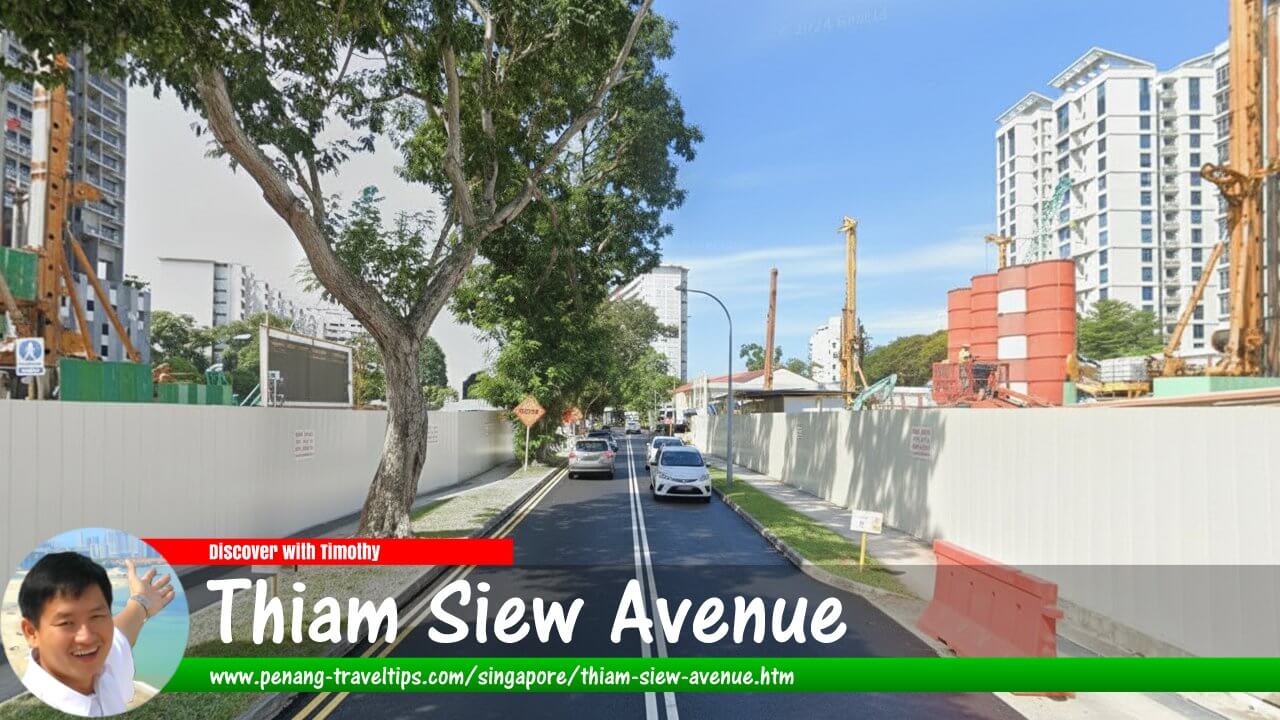 Thiam Siew Avenue, Singapore (AI-edited photograph on 3 May 2026)
Cassia Link is a short residential road in the Geylang area of Singapore, measuring approximately 376 metres in length and connecting Guillemard Road in the north to Old Airport Road in the south. Located within a mature housing estate, the road forms part of a network of streets developed during the mid-twentieth century to support one of Singapore’s early planned residential communities.
Quick Facts
- Road length: Approximately 376 metres
- Postal District: 14
- Planning Area: Geylang
- Northern connection: Guillemard Road
- Southern connection: Old Airport Road
- Nearest MRT station: Dakota (CC8)
- Development era: Singapore Improvement Trust (circa 1950s)
Introduction and Urban Context
Cassia Link is situated within a historically significant residential precinct in eastern Singapore. Although modest in length, it plays an important role in linking two major roads—Guillemard Road and Old Airport Road—while serving as an access street for residents living in the surrounding housing blocks.
The road lies within the former Singapore Improvement Trust (SIT) estate, widely regarded as one of the earliest examples of public housing in Singapore. This gives Cassia Link not just a functional role, but also historical value as part of the nation’s urban development story.
Historical Development
The area surrounding Cassia Link was developed in the 1950s by the Singapore Improvement Trust, the predecessor to the Housing and Development Board (HDB). The SIT aimed to provide better housing conditions for the growing population, replacing overcrowded inner-city dwellings with planned estates featuring improved sanitation, ventilation, and community facilities.
Old Airport Road itself takes its name from the former Kallang Airport, which operated from the 1930s until the opening of Paya Lebar Airport in 1955. The construction of residential estates nearby coincided with this period of transition, as land was repurposed for housing following the airport’s decline in use.
Cassia Link, along with neighbouring streets, was likely laid out during this phase of development, forming part of a cohesive residential grid that remains largely intact today.
Origin of the Name
The name “Cassia” refers to a genus of flowering plants, many of which are known for their bright yellow blossoms. Streets in the surrounding estate follow a botanical naming theme, with roads such as Cassia Crescent and Pine Close reflecting a preference for nature-inspired names.
This naming convention was common in early public housing estates, where planners sought to create a pleasant and harmonious living environment through both physical design and street nomenclature.
The suffix “Link” indicates that the road serves as a connector between larger roads, reinforcing its functional role within the estate’s layout.
Character and Streetscape
Cassia Link retains much of its original residential character, with low- to mid-rise apartment blocks, mature trees, and open spaces contributing to a relaxed neighbourhood atmosphere. The street is relatively quiet, with traffic primarily consisting of residents, visitors, and delivery vehicles.
Pedestrian-friendly pathways and greenery line the road, reflecting the SIT’s early emphasis on livability. While some buildings in the vicinity have been upgraded or redeveloped, the overall layout still reflects mid-twentieth-century planning principles.
Surrounding Streets and Connectivity
Cassia Link connects directly to Guillemard Road in the north, a major arterial route that links the city centre to the eastern parts of Singapore. To the south, it joins Old Airport Road, a well-known road famous for its food centres and residential estates.
Nearby streets include Cassia Crescent, Dakota Crescent, and Pine Close, all of which form part of the same housing estate. Together, these roads create a cohesive network that supports local movement while maintaining a sense of community.
Points of Interest Nearby
One of the most notable attractions near Cassia Link is the Old Airport Road Food Centre, a popular destination for local hawker fare. The area is also close to Dakota Crescent, known for its heritage value and iconic SIT housing blocks.
Recreational spaces, schools, and community facilities are also located within walking distance, making the area convenient for families and long-time residents.
Residential Property and Prices
Properties around Cassia Link are predominantly public housing flats, with some newer developments in the wider Geylang area. As of late 2024 and early 2025, resale HDB flats in this part of Geylang typically range from about SGD 600 to SGD 900 per square foot.
Flat sizes generally range between 700 and 1,300 sq ft (65–121 sq m). Depending on the type and condition of the unit, resale prices usually fall between SGD 500,000 and SGD 950,000.
Rental prices in the area typically range from SGD 2,500 to SGD 4,200 per month. Compared to the national average, prices are moderately high due to the estate’s proximity to the city centre and established amenities.
Public Transport and MRT Access
The nearest MRT station to Cassia Link is Dakota MRT Station (CC8) on the Circle Line. This provides convenient access to key interchanges such as Paya Lebar, Bishan, and HarbourFront, making it easy for residents to travel across Singapore.
The station is within walking distance or a short bus ride from Cassia Link, enhancing the area’s overall connectivity.
Bus Services and Stops
Bus stops are located along both Guillemard Road and Old Airport Road, offering a wide range of services. These buses connect the area to the Central Business District, eastern suburbs, and other parts of the island.
The presence of frequent bus services ensures that residents have multiple transport options in addition to the MRT.
Fun Fact
Cassia Link is part of a neighbourhood that has become increasingly appreciated for its heritage value, with some of the surrounding SIT flats gaining recognition as rare surviving examples of Singapore’s earliest public housing designs1.
Map of Thiam Siew Avenue, Singapore
References
Page Details
This page was created on 3 May 2026. Hi, my name is Timothy and created it from my research, for my own entertainment, knowledge and to satisfy my curiosity. I am providing the information to you in good faith and hope it is useful. I try to get the details as accurate as possible. I also try to update the page whenever I stumble on new details. So this and all my other pages are perpetual work in progress. If you discover any error, please politely inform me, pointing out where the error lies, and I will correct it as soon as possible. Your helpfulness will keep this page accurate, relevant and helpful to those who need the information.Streets of Singapore Directory
My videos of Singapore
Want to share your Singapore travel experiences or get tips from fellow travellers?
Join the Singapore Travel Tips Facebook GroupMore information for visiting and living in Singapore
Here are some related articles to help you get to know Singapore better.- Cost of Living in Different Singapore Neighbourhoods (2025 Guide)
- EZ-Link Card
- Owning a Car in Singapore
- Singapore MRT Map & Guide 2025
- Singapore Postal Districts and Postcodes
- Singapore Tourist Pass
- Taking the Bus in Singapore: A Visitor's Guide
- Understanding CCR, RCR and OCR in Singapore real estate
 Latest Pages & Updates
Buy Me A Coffee
If you enjoy the information I provide and want to support the work I do, please buy me a coffee! I appreciate it immensely, thank you so much!
