
 Go Back
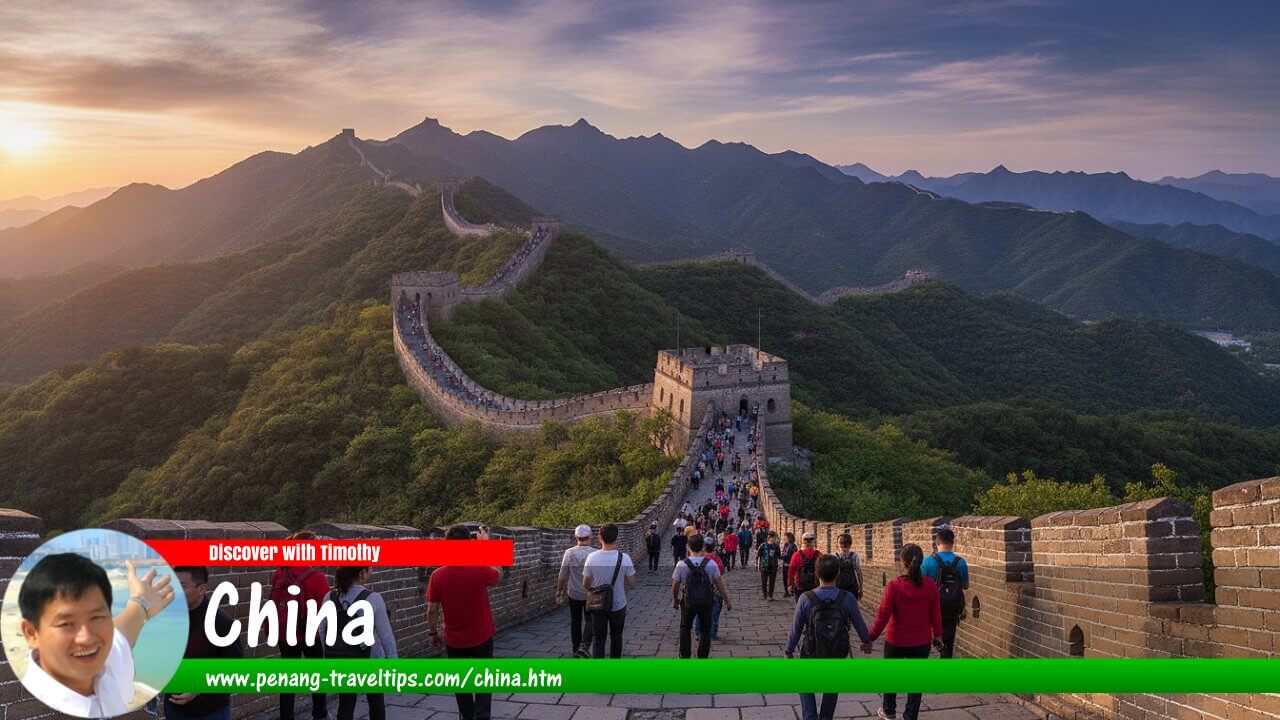 The Great Wall of China (Photo edited with AI on 15 June 2026)
Also available: Panduan Melawat China
Overview of China
China, officially known as the People’s Republic of China, is a vast and diverse country in East Asia, home to the world’s largest population and one of its oldest continuous civilizations. With a land area of over 9.5 million square kilometers, it is the fourth-largest country by area, encompassing a wide range of landscapes—from towering mountains and fertile river basins to arid deserts and picturesque coastlines.
China’s civilization dates back thousands of years, with a rich cultural heritage shaped by dynasties, philosophies, inventions, and exchanges along the ancient Silk Road. Today, it is a global power, known not only for its economic and technological advancements but also for its deep-rooted traditions, iconic landmarks, and dynamic cities.
From the modern skylines of Beijing and Shanghai to the serene beauty of the Yangtze River and the Great Wall stretching across the countryside, China presents a compelling blend of ancient and modern. It is a country of contrasts, where Confucian temples stand alongside high-speed railways, and where regional customs and languages reflect a rich mosaic of ethnic diversity.
China is also a leader on the world stage, playing a critical role in global trade, politics, and culture. With its Belt and Road Initiative, rapid urban development, and growing influence in technology and innovation, China is shaping the future while honoring its past.
This overview is just the beginning. On this site, we invite you to explore the many facets of China—from its intricate history and administrative structure to its people, places, and pace of life.
Brief History of China
The history of China spans thousands of years, making it one of the world’s oldest continuous civilizations. Archaeological evidence points to early human settlements along the Yellow River as far back as 7000 BCE. From these Neolithic roots, Chinese civilization evolved through a succession of dynasties that shaped its culture, politics, and identity.
The first unified Chinese state emerged under the Qin Dynasty in 221 BCE, from which the name “China” is derived. The Qin established the foundations of centralized imperial rule and began construction of the Great Wall. The Han Dynasty (206 BCE – 220 CE) followed, ushering in a golden age of science, trade, and cultural development that saw the expansion of the Silk Road.
Subsequent dynasties—including the Tang, Song, Yuan, Ming, and Qing—each left a distinct legacy. The Tang Dynasty was known for its cosmopolitan culture and artistic achievements; the Song for innovation and urban growth; the Yuan marked the Mongol rule under Kublai Khan; and the Ming and Qing periods brought imperial splendor, vast exploration, and, later, isolation.
China’s imperial era ended in 1912 with the fall of the Qing Dynasty and the establishment of the Republic of China. Decades of internal conflict, warlordism, and foreign invasions culminated in the founding of the People’s Republic of China in 1949 under Communist leadership.
Since then, China has undergone radical transformations—from the upheavals of the Cultural Revolution to the era of economic reform and opening-up launched in the late 1970s. Today, China stands as a major global power, with a history deeply embedded in its people’s identity and its modern resurgence.
Videos about Chinese civilisation
I run the Chinese Civilisation Channel, where I explain Chinese civilisation through a series of videos. The following are the videos in the channel.
- What Does It Mean To Be Chinese
- Prehistoric China Explained
- China Before History Began
- The Three Sovereigns and Five Emperors of Chinese Mythology
- The Xia Dynasty: China's First Dynasty
- China During the Bronze Age: The Shang Dynasty
- The Zhou Dynasty: The Dynasty That Changed China
- Zhou Dynasty: The Western Zhou
- Zhou Dynasty: The Eastern Zhou
- Zhou Dynasty: The Spring & Autumn Period
- Zhou Dynasty: The Warring States Period
- The Qin Dynasty: China's First Empire
Videos about Chinese culture
- The Hongbao (Chinese Red Envelope)
- Before Chinese New Year Got Its Name
- Why Shouldn't Chinese New Year Be Called Lunar New Year?
- The Five Directional Emperors of Heaven in Chinese Mythology
- The Lantern Festival
- Chinese Reunion Dinner
- The Yellow Emperor of Chinese Mythology
- Qingming (Tomb Sweeping Day)
- Religion In China
- Who Are The Han Chinese? The Story Behind China's Majority
- The Jade Emperor, Supreme Ruler of Heaven in Chinese Mythology
Videos about the History of the Chinese Diaspora
- The History of the Chinese in Southeast Asia
- The History of the Chinese in Singapore
- The History of the Chinese in Indonesia
- The History of the Chinese in Malaysia
- The History of the Chinese in Thailand
- The Chinese Ports That Sent Millions To Southeast Asia
- Geographical Distribution of the Chinese Communities of Thailand
- Why Are Most Chinese-Thais Teochew?
- The History of the Chinese in Myanmar
- The History of the Chinese in Cambodia
- The History of the Chinese in Laos
Videos about the History of Chinese Cities
Videos about the History of Chinese Provinces
Videos about Chinese Literature
Videos about the Famous People in Chinese History
Videos about Modern China
Articles on the history of China
Geography of China
China's geography is as vast and varied as its history. Covering approximately 9.6 million square kilometers, it is the fourth-largest country in the world by area, stretching across East Asia from the Pacific coast in the east to the towering mountain ranges of Central Asia in the west. Its sheer size and diverse terrain have given rise to a rich array of climates, ecosystems, and natural landmarks.
Eastern China is dominated by fertile plains and river deltas, where most of the population resides. The North China Plain, traversed by the Yellow River, is the cradle of Chinese civilization, while the Yangtze River basin to the south supports major agricultural and industrial centers. The Yangtze is China’s longest river and a lifeline for the country’s economy and environment.
In the west, the landscape becomes rugged and dramatic, with vast deserts like the Gobi and Taklamakan, and formidable mountain ranges such as the Tian Shan and the Himalayas. Mount Everest, the world’s highest peak, straddles China’s border with Nepal. These regions are sparsely populated but rich in natural resources and cultural heritage.
To the south, China shares borders with several Southeast Asian nations and features lush subtropical forests and karst landscapes, while the north includes the steppes of Inner Mongolia and the frigid terrain of Heilongjiang, bordering Russia.
China's climate ranges from tropical in the far south to subarctic in the northeast, contributing to an exceptional diversity of flora and fauna. The country is home to numerous national parks, UNESCO World Heritage Sites, and environmental conservation zones, reflecting growing efforts to balance development with sustainability.
Major Rivers in China
Major geographical features of China
Major manmade features of China
Demographics
China is the world’s most populous country, home to over 1.4 billion people. Its population accounts for nearly one-fifth of the global total, making demographic trends in China particularly significant on a worldwide scale. The majority of Chinese people live in the eastern and coastal regions, where economic development and urbanization are most concentrated.
The dominant ethnic group in China is the Han Chinese, comprising over 90% of the population. However, China officially recognizes 55 other ethnic minority groups, each with its own distinct culture, language, and traditions. Among them are the Zhuang, Hui, Manchu, Uyghur, Miao, Tibetan, and Mongol peoples, many of whom reside in autonomous regions or border provinces.
China’s demographic profile has undergone dramatic changes in recent decades. The implementation of the one-child policy in the late 20th century slowed population growth, but it also led to challenges such as an aging population, gender imbalances, and shrinking workforce. The policy has since been relaxed, and families are now allowed to have up to three children, though birth rates remain low.
Urbanization is another defining demographic trend. Over 60% of China’s population now lives in cities, compared to just 20% in 1980. Megacities like Shanghai, Beijing, Guangzhou, and Shenzhen have become economic powerhouses and cultural centers, while rural areas are experiencing depopulation and social transformation.
China’s population is also increasingly educated and connected. Literacy rates are high, and internet penetration continues to rise rapidly. These demographic shifts have profound implications for China’s economy, labor market, social policies, and future development as the country navigates the challenges of modernization and sustainability.
Languages of China
China is a linguistically rich country, with a vast tapestry of languages and dialects spoken across its territory. The official language is Standard Mandarin, also known as Putonghua (普通话), which is based on the Beijing dialect and taught nationwide. It serves as the lingua franca for communication across China's many regions and ethnic groups.
Mandarin is one of several major varieties within the broader Sino-Tibetan language family. Other prominent Chinese “dialects” — many of which are mutually unintelligible — include Cantonese (Yue), Shanghainese (Wu), Hokkien (Min Nan), Hakka, and Xiang. These are often spoken natively in specific provinces or cities and are rich in local heritage and oral traditions.
Beyond Han Chinese languages, China is home to numerous minority languages spoken by its 55 recognized ethnic minority groups. These include Tibetan, Mongolian, Uyghur, Zhuang, Korean, Kazakh, and many others, which belong to diverse language families such as Turkic, Tibeto-Burman, Mongolic, and Tai-Kadai. In autonomous regions, local languages may be used alongside Mandarin in education, media, and government.
The Chinese writing system is unified through Chinese characters, or Hanzi (汉字), which are used to write Mandarin and many other Chinese varieties. However, some ethnic groups use their own scripts, such as the Arabic-derived Uyghur alphabet or the Tibetan script. In recent years, simplified Chinese characters have become the norm on the mainland, while traditional characters are still used in Hong Kong, Macau, and Taiwan.
Efforts to preserve linguistic diversity are ongoing, though Mandarin continues to dominate public life. As urbanization and education expand, some regional languages and dialects face decline, sparking initiatives to document and revitalize them as integral parts of China’s cultural mosaic.
Administrative Division
China has a complex administrative structure designed to govern its vast and diverse territory efficiently. The country is divided into several levels of administration, with the central government in Beijing overseeing a hierarchy that extends down to villages and communities. At the top level, China is divided into 34 provincial-level units: 23 provinces, 5 autonomous regions, 4 direct-controlled municipalities, and 2 Special Administrative Regions (SARs).
The 23 provinces include populous regions like Guangdong, Sichuan, and Shandong, each with its own capital and local government. The 5 autonomous regions—Guangxi, Inner Mongolia, Ningxia, Tibet, and Xinjiang—are home to large populations of ethnic minorities and have additional legislative rights to preserve local languages and customs.
China’s 4 direct-controlled municipalities—Beijing, Shanghai, Tianjin, and Chongqing—are major urban centers that report directly to the central government. These cities function as provinces in terms of administration and are key economic, political, or logistical hubs.
The 2 Special Administrative Regions, Hong Kong and Macau, operate under the "one country, two systems" principle. They maintain separate legal, economic, and administrative systems from mainland China and enjoy a high degree of autonomy in most areas except foreign affairs and defense.
Below the provincial level, China is further divided into prefecture-level cities, counties, townships, and villages. Local governments are responsible for implementing national policies, managing public services, and maintaining order within their jurisdictions. This tiered structure enables the Chinese government to maintain control and coordination across a massive and highly varied landscape, balancing centralized authority with localized governance.
Map of the Provinces of China
Provinces in Northeast China Provinces in Northern China Provinces in Central China Provinces in Southern China Provinces in Southwest China Provinces in Western China Autonomous Regions of China


- Guangxi Zhuang Autonomous Region

- Inner Mongolia Autonomous Region

- Ningxia Hui Autonomous Region

- Tibet Autonomous Region

- Xinjiang Uyghur Autonomous Region

Republic of China
Taiwan, which the People's Republic of China regard as one of its provinces, is controlled by the government of the Republic of China.Cities of China
China is home to some of the world’s largest and most dynamic cities, reflecting its rapid urbanization, economic growth, and regional diversity. With over 160 cities housing more than one million people each, China’s urban landscape ranges from global financial centers to ancient capitals and bustling industrial hubs.
Beijing, the capital, serves as the political and cultural heart of the nation. It is known for its historic landmarks such as the Forbidden City, the Temple of Heaven, and Tiananmen Square, alongside modern institutions and government headquarters. Shanghai, China’s largest city by population, is a global financial hub famed for its futuristic skyline, colonial-era waterfront (the Bund), and vibrant commercial life.
Other major cities include Guangzhou and Shenzhen in the south, both economic powerhouses within the Pearl River Delta. Shenzhen, in particular, transformed from a fishing village into a tech-driven metropolis in just a few decades and is now a leader in innovation and manufacturing.
Chongqing, a sprawling inland municipality, is a vital transportation and logistics center along the Yangtze River. Chengdu is known for its relaxed lifestyle, spicy cuisine, and proximity to panda reserves, while Xi’an is celebrated as the ancient starting point of the Silk Road and home of the Terracotta Army.
China’s urban development also includes planned cities and economic zones, such as Xiong’an New Area and the Greater Bay Area initiative, which aim to balance growth and sustainability. Despite the spotlight on megacities, smaller cities and regional capitals also play crucial roles in the cultural and economic fabric of the country.
Together, these cities paint a portrait of a modernizing China—complex, fast-moving, and deeply rooted in history.
Map of Cities of China
Top-Tier Cities of China
- Beijing - capital

- Shanghai - biggest city

- Chengdu

- Chongqing

- Fuzhou

- Guangzhou

- Hangzhou

- Harbin

- Hong Kong

- Kunming

- Lhasa

- Macau

- Nanjing

- Qingdao

- Shenyang

- Shenzhen

- Taipei

- Tianjin

- Wuhan

- Xiamen

- Xian

Second-Tier Cities of China
- Baoding

- Cangzhou

- Changchun

- Changsha

- Chengde

- Dongguan

- Guilin

- Guiyang

- Haikou

- Hefei

- Jinan
- Jinghong

- Longyan

- Mianyang

- Nanchang

- Quanzhou

- Shijiazhuang

- Suzhou

- Taiyuan

- Ürümqi

- Xishuangbanna

- Zhangzhou

- Zhengzhou

Government Structure
China operates under a one-party socialist system led by the Communist Party of China (CPC), which holds ultimate authority over the state, military, and society. The political structure is centralized, with power flowing from the top levels of the CPC and the central government in Beijing down through the provinces and local administrations.
At the national level, the highest state body is the National People’s Congress (NPC), a legislative body that enacts laws, approves budgets, and elects key officials. Although officially the highest organ of state power, the NPC largely acts to formalize decisions made by the Communist Party leadership. The executive branch is led by the State Council, headed by the Premier, and is responsible for implementing policies and managing day-to-day governance.
The President of China serves as the head of state and is also the General Secretary of the CPC and the Chairman of the Central Military Commission—three powerful positions typically held by a single individual, consolidating political, party, and military leadership.
The Communist Party of China functions as the central guiding force, with its own internal hierarchy and leadership bodies, including the Politburo and the Politburo Standing Committee. The CPC sets the strategic direction for the country, manages personnel appointments, and ensures loyalty throughout all levels of government and society.
While China has various political consultative bodies and mechanisms for local participation, the system does not feature competitive multi-party elections. Instead, governance emphasizes stability, long-term planning, and economic development under the centralized leadership of the Party.
This political structure has enabled China to implement sweeping reforms and massive infrastructure projects with speed and coordination, though it continues to draw attention and debate globally regarding human rights, transparency, and political freedoms.
Economy of China
China has emerged as one of the world’s largest and most influential economies. Since the late 1970s, when it began shifting from a centrally planned system to a more market-oriented model, China has experienced unprecedented economic growth, lifting hundreds of millions out of poverty and transforming into a global manufacturing and trade powerhouse.
Today, China is the world’s second-largest economy by nominal GDP and the largest by purchasing power parity. It is a major player in global supply chains, producing everything from consumer electronics and textiles to heavy machinery and renewable energy technology. Its exports drive much of its economic engine, with key trade partners including the United States, the European Union, and Southeast Asia.
China's economic structure is diverse and evolving. While manufacturing and export industries remain vital, services now account for a growing share of GDP, and the digital economy is booming. Tech giants like Alibaba, Tencent, and Huawei have positioned China at the forefront of e-commerce, fintech, and telecommunications innovation.
The government continues to play a strong role in economic planning through five-year plans and state-owned enterprises (SOEs), especially in sectors deemed critical to national interests. At the same time, private entrepreneurship is thriving, particularly in the technology and consumer sectors.
China is also investing heavily in global infrastructure through its Belt and Road Initiative, strengthening its influence across Asia, Africa, and Europe. Domestically, priorities include rural revitalization, green energy development, and reducing reliance on foreign technology.
Despite its strengths, the Chinese economy faces challenges such as demographic shifts, income inequality, debt levels, and external trade tensions. Nevertheless, it remains a dynamic and central force in the global economy, with a strategic vision aimed at sustainable, high-quality growth.
Major Tourist Attractions of China
China is a land of breathtaking contrasts, offering visitors a rich tapestry of cultural landmarks, natural wonders, and modern marvels. Its vast territory and deep history make it one of the world’s most rewarding destinations for tourism, with sites that span dynastic eras, spiritual traditions, and stunning landscapes.
Among the most iconic attractions is the Great Wall of China, a UNESCO World Heritage Site that stretches over 20,000 kilometers across northern China. Equally famous is the Forbidden City in Beijing—an imperial palace complex that served as the political center of China for over 500 years. Nearby, the Temple of Heaven and the Summer Palace also reflect the grandeur of China’s imperial past.
To the west, the ancient city of Xi’an draws visitors to the awe-inspiring Terracotta Army, a subterranean army of life-sized warriors built to guard the tomb of Emperor Qin Shi Huang. Further south, the city of Chengdu is known for its giant panda sanctuaries and relaxed lifestyle, while the Li River near Guilin enchants travelers with its dramatic karst mountains and river cruises.
Modern cities also offer a wealth of attractions. Shanghai dazzles with its futuristic skyline and historic Bund, while Hong Kong and Macau blend East and West in unique cultural and culinary experiences. For spiritual and natural beauty, visitors flock to the sacred mountains of Huangshan and Emei, the Tibetan capital of Lhasa, and the vast grasslands of Inner Mongolia.
China’s attractions are as varied as its geography—ranging from the deserts of Dunhuang and the Silk Road ruins, to the tranquil beauty of Suzhou’s classical gardens and Hangzhou’s scenic West Lake. Whether you seek history, nature, or vibrant city life, China promises a journey of discovery at every turn.
Categories of sights in China
Transportation in China
China has developed one of the most extensive and advanced transportation networks in the world. Rapid infrastructure growth over recent decades has connected even remote regions, supporting economic development, tourism, and daily life for over a billion people. Whether traveling within cities or across provinces, transportation in China is fast, efficient, and increasingly high-tech.
The country is especially renowned for its high-speed rail (HSR) system, which is the largest of its kind globally. Trains regularly travel at speeds exceeding 300 km/h, linking major cities like Beijing, Shanghai, Guangzhou, and Chengdu with remarkable speed and convenience. For longer distances, China’s domestic air network connects hundreds of airports nationwide.
Urban transportation is also well-developed. Major cities such as Beijing, Shanghai, Shenzhen, and Guangzhou boast modern subway systems that are clean, affordable, and expanding rapidly. Buses, taxis, and app-based ride services like Didi provide additional mobility, while bike-sharing has become a popular and eco-friendly option in many urban areas.
China's road network is vast and includes national highways and expressways that span the entire country, facilitating freight transport and private car travel. Bridges and tunnels—such as the Hong Kong-Zhuhai-Macau Bridge, the world’s longest sea crossing—demonstrate China’s engineering prowess and commitment to connectivity.
In rural areas, transportation options can vary, but efforts are ongoing to modernize roads and public transit, ensuring access to education, healthcare, and markets. Meanwhile, logistics and delivery services—driven by China’s booming e-commerce sector—are supported by a sophisticated network of rail, air, and road links.
As China continues to urbanize and innovate, smart transportation, green mobility, and infrastructure investment remain national priorities, reinforcing the country’s role as a global leader in modern transport.
Major Gateways (Airports) of China
China is served by a wide network of modern international airports that act as vital gateways for both global travel and domestic connectivity. These airports handle hundreds of millions of passengers each year and are key hubs for tourism, trade, and business. Many are architectural landmarks in their own right, showcasing the country's commitment to innovation, efficiency, and capacity.
Beijing Capital International Airport (PEK) is one of the busiest in Asia and has long been the main international gateway to northern China. Complementing it is the newer Beijing Daxing International Airport (PKX), an architectural marvel with a starfish-shaped terminal designed for seamless passenger flow and high-capacity handling.
In the east, Shanghai is served by two major airports: Pudong International Airport (PVG), which handles most international flights, and Hongqiao International Airport (SHA), which caters mainly to domestic routes. Pudong is a major global hub with extensive links across Asia, Europe, and the Americas.
Guangzhou Baiyun International Airport (CAN) in southern China is a key connector for flights to Southeast Asia, Africa, and beyond. It is also a major hub for cargo traffic, supporting China’s export-oriented economy. Similarly, Shenzhen Bao’an International Airport (SZX) connects the Greater Bay Area to the world and is rapidly expanding its international reach.
Other important airports include Chengdu Tianfu International Airport (TFU), a new gateway to western China; Xi’an Xianyang International Airport (XIY), serving the historical heartland; and Kunming Changshui International Airport (KMG), linking southwest China with South and Southeast Asia.
With continuous upgrades and new terminals under construction, China’s airport network is designed to meet growing passenger demand and support its role as a global aviation powerhouse. These gateways are not just transit points—they are front doors to the culture, economy, and future of China.
Conclusion
This brief introduction offers just a glimpse into the depth and richness of China’s story—a country of ancient heritage and modern dynamism. Whether you're curious about its vibrant cities, complex history, diverse cultures, or remarkable achievements, Discover China is your gateway to understanding it all. We invite you to explore each section in more detail and join us on a journey through one of the most fascinating nations on Earth.
Page Details
This page was created on 25 August 2026. Hi, my name is Timothy and created it from my research, for my own entertainment, knowledge and to satisfy my curiosity. I am providing the information to you in good faith and hope it is useful. I try to get the details as accurate as possible. I also try to update the page whenever I stumble on new details. So this and all my other pages are perpetual work in progress. If you discover any error, please politely inform me, pointing out where the error lies, and I will correct it as soon as possible. Your helpfulness will keep this page accurate, relevant and helpful to those who need the information.Buy Me A Coffee
If you enjoy the information I provide and want to support the work I do, please buy me a coffee! I appreciate it immensely, thank you so much!
