
Fish Lane (Lorong Ikan), George Town
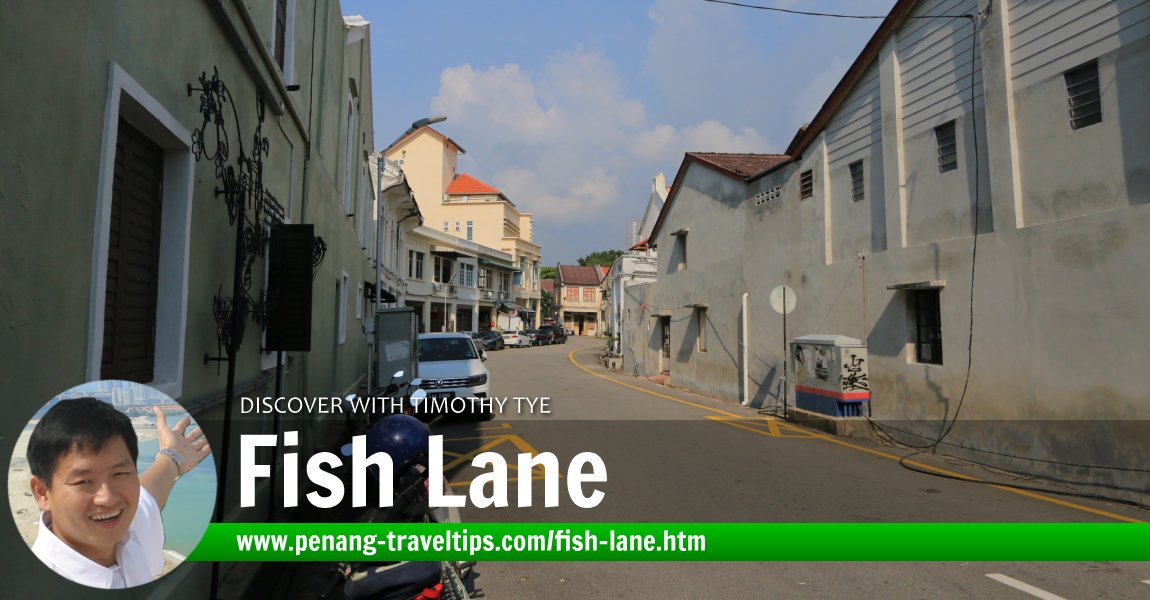 Fish Lane (Lorong Ikan), George Town, Penang (4 July 2019)
Also available: Lorong Ikan (Malay Version) and Lorong Ikan (Chinese Version)
Fish Lane, also known as Lorong Ikan in Malay, is a short historic lane in the Lower Beach Street area of George Town, Penang. The lane connects Prangin Lane with Malay Street, and is one of the smaller streets within the historic urban fabric of George Town. Its name reflects the area's former association with the fish trade, particularly the drying of salted fish. Fish Lane developed as a working-class neighbourhood during the 19th century, when the nearby Prangin Canal and Sia Boey Market supported a busy trade in fresh produce, fish, dried fish and other foodstuffs. Today, the lane is quiet and largely residential, but its surviving historic buildings, murals and street sculptures preserve reminders of its working-class and commercial past.1
The Name Fish Lane
The name Fish Lane is a direct reference to the activities that once took place here. Its Malay name is Lorong Ikan, literally meaning "Fish Lane", while the Penang Hokkien name is Kiam3 Hu3 Hang33, meaning "Salted Fish Lane". A Chinese form recorded for the street is 鹹魚巷, while 鹹魚仔巷 is another historical form. The names reflect the importance of salted fish to the area's former economy rather than simply indicating that fish were sold here.2
The salted-fish trade was particularly appropriate to the location. Fish landed from the sea could be salted and laid out to dry, producing a preserved food that could be stored and transported. The lane therefore became associated with an activity that connected fishing, food preservation, wholesale trade and the nearby produce market.
Fish Lane and Sia Boey Market
The history of Fish Lane is closely connected with the former Sia Boey Market, which developed around Prangin Road and the Prangin Canal. Sia Boey became one of George Town's important traditional markets, serving as a place where vegetables, fruit, fish and other produce were brought in and sold.
Fish Lane was located close enough to the market to support activities associated with the preparation and distribution of food. Historical accounts describe the drying of salted fish along the lane, while research on the historic buildings of Lorong Ikan notes that the lane functioned as a drying yard for salted fish during the mid-19th century.3
The relationship between Fish Lane and the market was strengthened by the area's former geography. Before extensive land reclamation altered the coastline, this part of George Town was considerably closer to the sea. The Prangin Canal also ran nearby, providing a waterway through which goods could move. The Penang Island City Council notes that the location was once suitable for landing catches of fish and squid, while wholesalers of eggs, rice, dried fish and squid continued to operate in the vicinity even after reclamation changed the shoreline.4
A Working-Class Neighbourhood
During the 19th century, Fish Lane formed part of a working-class neighbourhood serving the needs of George Town's growing commercial economy. The people living and working around the lane included those involved in activities associated with the market and food trade.
The lane's history therefore differs from that of some of George Town's better-known streets, which became associated with wealthy merchants, government institutions or grand commercial buildings. Fish Lane represents a more modest aspect of the city's history: the workers, small traders and food-processing activities that helped keep the larger trading city supplied.
The name of the lane has survived even though the original activity has disappeared. Modern visitors therefore encounter a quiet street whose name provides a clue to an earlier landscape in which fish were landed, salted, dried, transported and sold.
Land Reclamation and a Changing Waterfront
The physical setting of Fish Lane has changed considerably since the 19th century. The shoreline of George Town was progressively extended through land reclamation, moving the sea farther away from parts of the old city. The Penang Island City Council's account of the Cow & Fish sculpture at the corner of Fish Lane and Malay Street specifically recalls a time when this area was much closer to the sea and to the Prangin Canal.4
This change is important when interpreting the name Fish Lane. A visitor seeing the lane today might wonder why a small inland-looking street has a name associated with fish. Historically, however, the street was much more closely connected to the waterfront and the movement of seafood. Land reclamation gradually transformed that relationship, leaving the street name as a surviving reminder of the former geography.
Historic Buildings
Fish Lane is lined by traditional buildings that contribute to the historic character of this part of George Town. Among the most interesting are the courtyard shophouses at Halaman Khoo Cheow Teong, which is accessed from Fish Lane. The group includes Nos. 3, 5 and 7, which have been studied as examples of traditional courtyard shophouse architecture in George Town.5
Architectural research identifies Nos. 3, 5 and 7 Halaman Khoo Cheow Teong as late Straits Eclectic buildings dating from around 1926. Their courtyard arrangement differs from the more familiar continuous shophouse rows found on many of George Town's principal streets, making them an especially interesting architectural feature of this otherwise inconspicuous corner of the heritage city.5
Halaman Khoo Cheow Teong itself is a tiny lane branching from Fish Lane. It was formerly known as Khoo Cheow Teong Court and was named after Khoo Cheow Teong, a Penang-born businessman who made his fortune in Sumatra and later returned to Penang. He was appointed Kapitan China of Asahan in Sumatra by the Dutch administration in 1878.6
Street Art and Public Art
Although Fish Lane is small, it has acquired several pieces of public art that help visitors understand its history.
Cow & Fish
At the junction of Fish Lane and Malay Street stands the Cow & Fish sculpture, one of the more unusual pieces of public art in George Town. The Penang Island City Council explains that the sculpture recalls the area's former relationship with the sea and the Prangin Canal. The location was once much closer to the waterfront, and fish and squid could be landed nearby.4
The sculpture also alludes to the food-trading activities that once characterised the area. It provides a visual interpretation of Fish Lane's past and is particularly useful to visitors because the lane itself no longer looks like a place associated with the fish trade.
Fish Lane Mural
Near the Prangin Lane junction is a mural by Penang artist Chan Kai Lun. Sponsored by Nippon Paint Malaysia, the mural depicts street vendors from an earlier period, including the kinds of people and activities associated with the traditional food trade in the area.7
The mural complements the name and history of Fish Lane. Rather than being merely decorative street art, it helps illustrate the working-class character of the neighbourhood and the connection between the lane, food vendors and the nearby market.
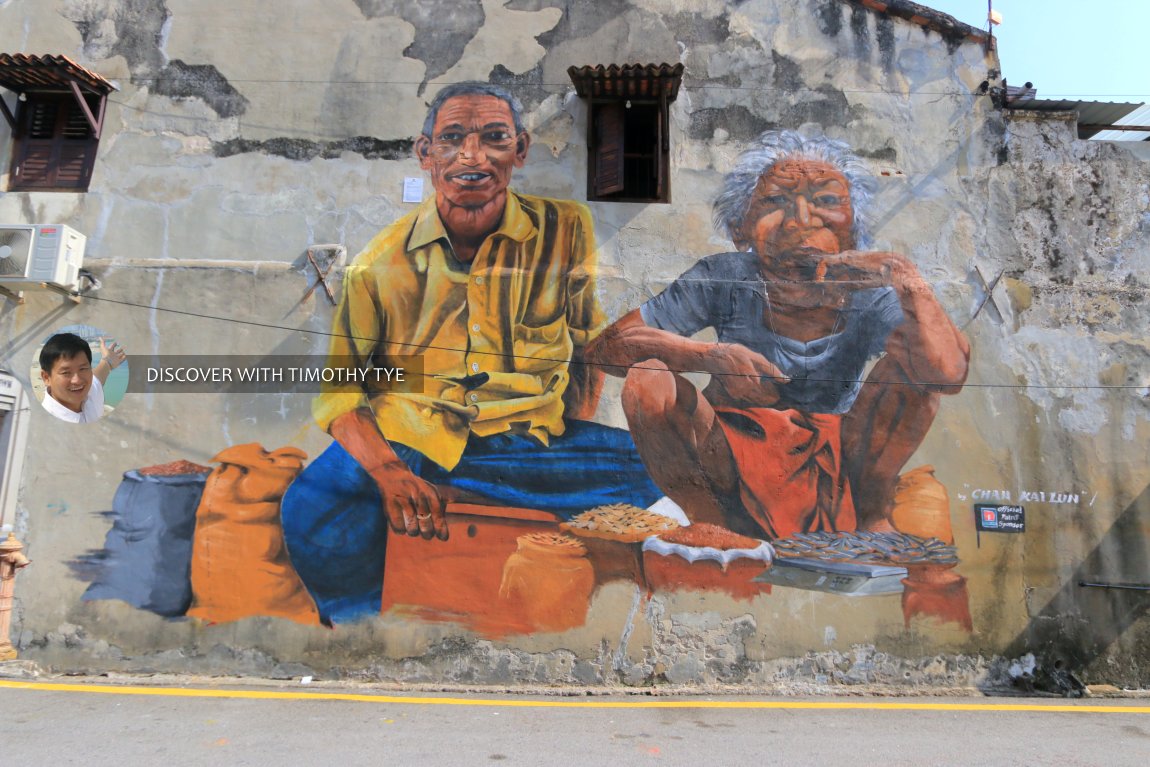 Mural on Fish Lane by Chan Kai Lun (4 July 2019)
Fish Lane and the George Town Heritage Area
Fish Lane forms part of the historic urban landscape of George Town, a city recognised by UNESCO for its outstanding multicultural heritage. George Town was inscribed together with Melaka in 2008 as the Historic Cities of the Straits of Malacca, reflecting the importance of the two cities as historic trading centres shaped by interactions among Asian and European cultures.8
The significance of Fish Lane lies not in monumental buildings but in the evidence it provides of everyday economic life. Its name, historic buildings, connection to Sia Boey Market, former proximity to the Prangin Canal and surviving public artworks collectively tell the story of a neighbourhood that supported George Town's food and trading economy.
Studies of the lane have also identified its heritage value within the wider George Town heritage area. Architectural research describes Lorong Ikan as a small and relatively quiet street containing traditional courtyard shophouses, while noting its former role as a salted-fish drying yard. The buildings and street layout provide a physical link to an earlier period of George Town's development.3
Fish Lane Today
Today, Fish Lane is a quiet lane that can easily be overlooked by visitors exploring the more famous streets of George Town. Its narrow scale and historic buildings give it a very different atmosphere from the larger streets nearby. Yet its location makes it worthwhile for anyone interested in the lesser-known stories behind the heritage city.
The lane can be explored together with Malay Street, Prangin Lane, Halaman Khoo Cheow Teong and the former Sia Boey Market area. Visitors interested in George Town's food history and traditional commerce will find that these small streets reveal a side of the city that is less visible in its grand colonial buildings and famous merchant houses.
Fish Lane is also an example of how a street name can preserve a vanished landscape. The sea is no longer immediately beside the lane, salted fish are no longer routinely laid out here to dry, and Sia Boey Market has disappeared in its historic form. Nevertheless, the name Fish Lane, the Chinese name 鹹魚巷, the surviving shophouses, the Cow & Fish sculpture and the Fish Lane mural continue to evoke the working waterfront and market neighbourhood that once existed here.
Getting to Fish Lane
Fish Lane is within walking distance of the Weld Quay Ferry & Bus Terminal. From the terminal, walk along Pengkalan Weld towards Gat Lebuh Melayu, turn into Gat Lebuh Melayu, cross Lebuh Pantai and continue into Malay Street (Lebuh Melayu). Fish Lane is on the left side of Malay Street, near its junction with the lane.
Because Fish Lane is small and easy to miss, it is useful to look for the street sign and the public artworks at the junction with Malay Street. The Cow & Fish sculpture provides a particularly recognisable landmark.
My videos about Fish Lane
 Map of Lorong Ikan, Penang
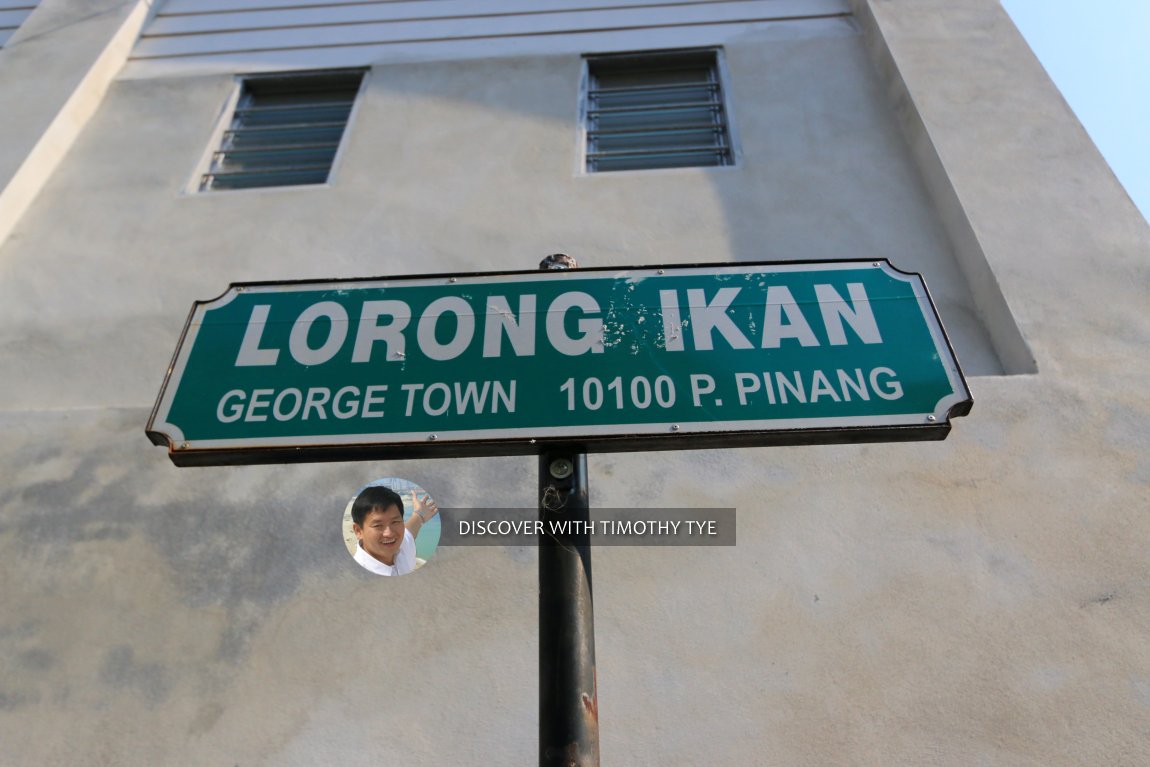 Lorong Ikan roadsign (4 July 2019)
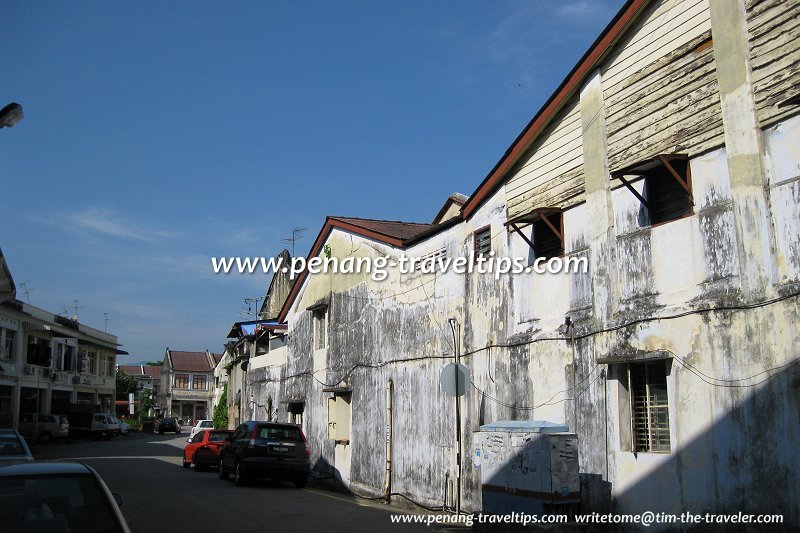 Fish Lane (4 December 2008)
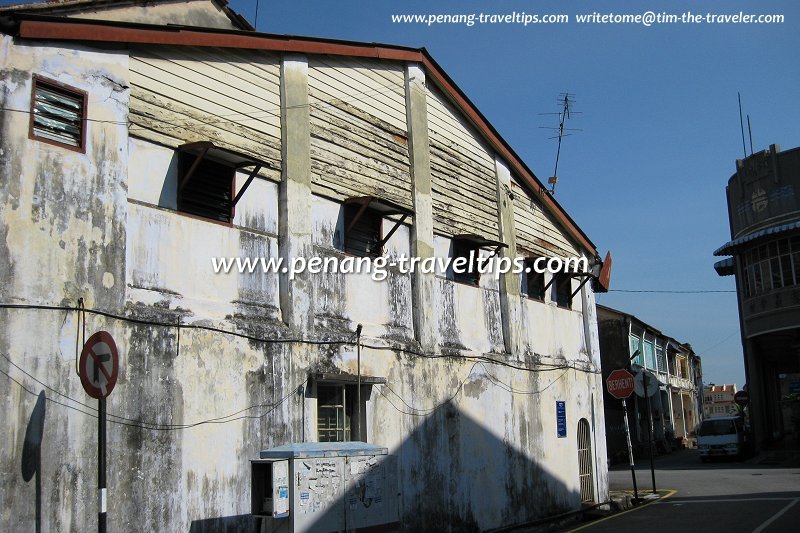 Fish Lane, George Town (2 December 2008)
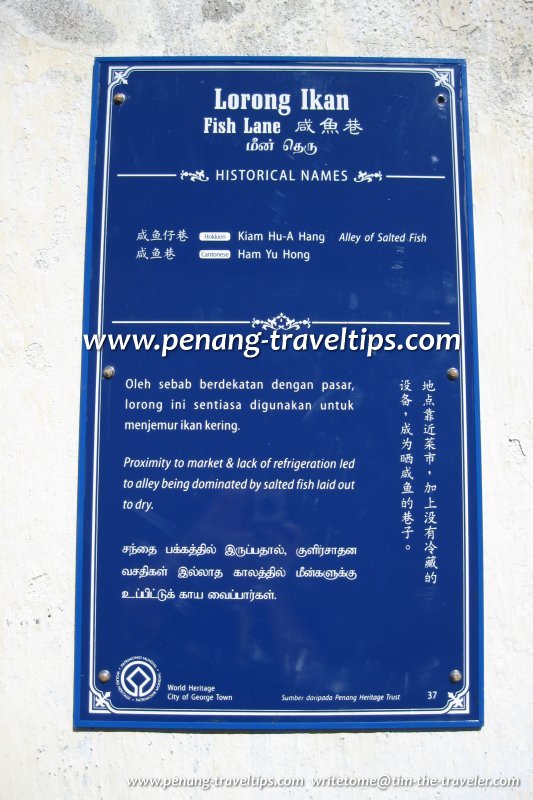 Fish Lane history plaque (2 December 2008)
References
- existing details of Penang Travel Tips, “Fish Lane (Lorong Ikan), George Town
- Wikipedia, “List of streets in George Town, Penang”
- International Journal of Engineering and Technology, “An Investigation on the Interior Traditional Courtyard Shophouses Based on the Identity Formation: Case Study of Lot Nos. 3, 5, and 7 Lorong Ikan, George Town, Malaysia”
- Majlis Bandaraya Pulau Pinang, “Sculpture 48: Cow & Fish”
- George Town World Heritage Incorporated, Nomination Dossier: Historic Cities of the Straits of Malacca
- Penang Travel Tips, “Khoo Cheow Teong Court (Halaman Khoo Cheow Teong), George Town”
- Travel 2 Penang, “Penang Street Art (Fish Lane Mural)”
- UNESCO World Heritage Centre, “Melaka and George Town, Historic Cities of the Straits of Malacca”
Fish Lane on the Map of Roads in Penang
Page Details
This page was created on 26 August 2026. Hi, my name is Timothy and created it from my research, for my own entertainment, knowledge and to satisfy my curiosity. I am providing the information to you in good faith and hope it is useful. I try to get the details as accurate as possible. I also try to update the page whenever I stumble on new details. So this and all my other pages are perpetual work in progress. If you discover any error, please politely inform me, pointing out where the error lies, and I will correct it as soon as possible. Your helpfulness will keep this page accurate, relevant and helpful to those who need the information.Want to share your Penang travel experiences or get tips from fellow travellers?
Join the Penang Travel Tips Facebook GroupUseful guides for visiting Penang
My Videos of Penang
 Latest Pages & Updates
Buy Me A Coffee
If you enjoy the information I provide and want to support the work I do, please buy me a coffee! I appreciate it immensely, thank you so much!
