
Expressways in Malaysia
Expressways in Malaysia (with “E” highway codes) form the backbone of the country’s high-speed road network, linking cities, towns and regions across Peninsular Malaysia. These tolled, controlled-access roads are designed for efficient intercity travel, bypassing local traffic, and forming a critical part of national infrastructure.
Quick Facts
- Expressways are tolled, controlled-access roads with grade separations and no direct property access.
- They carry the “E” prefix (e.g. E1, E5, E11, etc.).
- Many were built from the 1980s onward to connect major urban and economic centres.
- Operated by concessionaires under performance agreements.
- Part of a wider national road infrastructure which also includes federal and state roads (non-E).
History of Expressways in Malaysia
The concept of expressways in Malaysia began in the late 1970s and early 1980s when rapid urbanisation and economic growth increased demand for high capacity road links between cities. The first modern expressways adopted tolled models using concession agreements to handle the high financial costs. Over time, governments introduced more expressway projects, often as public-private partnerships (PPPs), to expand connectivity beyond Kuala Lumpur into all regions of the peninsula.
Initial expressways focused on linking the capital with surrounding regions, then progressively extended to north-south, east-west, and coastal corridors. Many expressways also served as catalysts for development, spurring new townships, economic corridors, and logistics zones.
Expressway concessions involve responsibilities for maintenance, toll collection, traffic monitoring, and expansion. Some expressways have undergone phases of widening, adding interchanges, and upgrading systems (electronic tolling, integrated traffic management) to cope with evolving traffic demands.
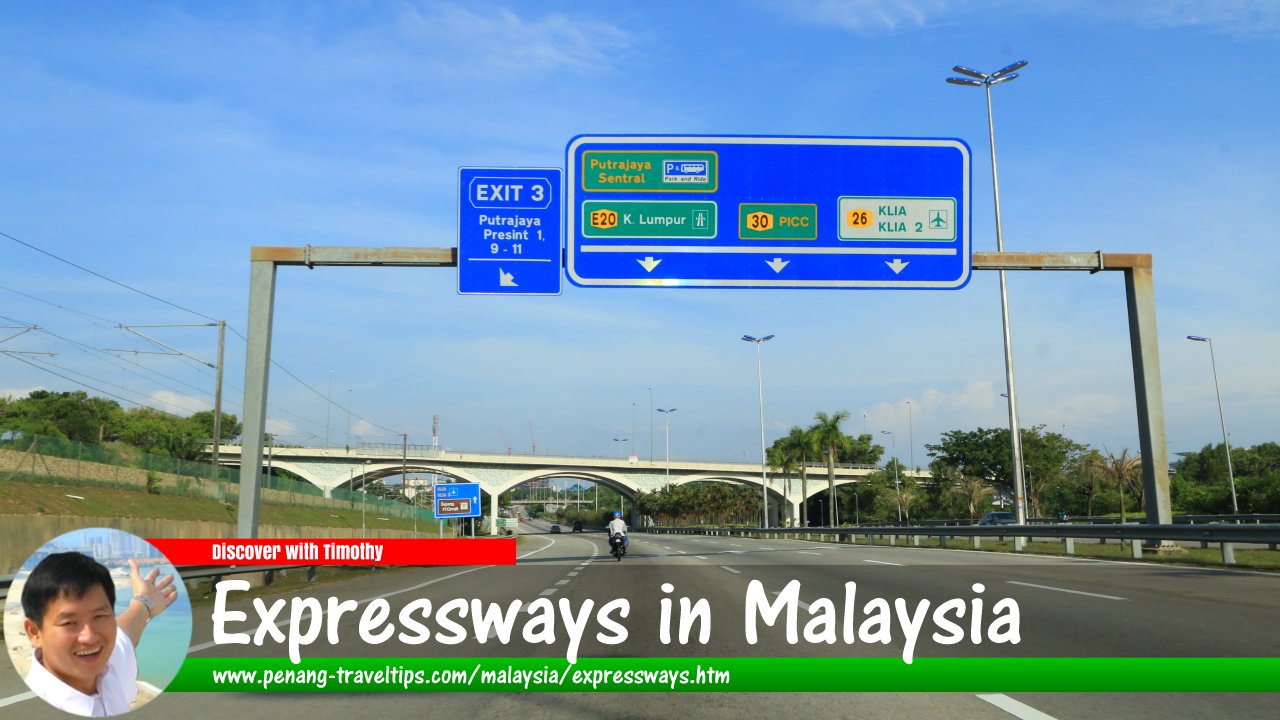 Expressways in Malaysia (6 July 2016)
Key Characteristics and Features
Expressways in Malaysia typically have design features such as divided carriageways (dual carriageways), at least two lanes per direction, grade-separated interchanges (no at-grade junctions), restricted access (no direct frontage access), and service/rest areas in some stretches. They often include bridges, viaducts, tunnels, and sometimes elevated sections in hilly or urban terrain.
Tolling is almost universal, using methods such as closed toll systems (distance-based), open toll systems (fixed tolls), and increasingly electronic tolling (RFID, transponder) to reduce congestion at toll plazas. Many newer expressways are designed to integrate with smart transport management systems (ITS) for traffic flows, incident detection, and traveler information.
Maintenance and expansion of expressways usually follow periodic performance audits. Traffic demand forecasting is critical, especially in rapidly growing urban corridors, to ensure that capacity keep pace with growth.
List of Expressways Covered
- E01 New Klang Valley Expressway
- E01 North-South Expressway Northern Route
- E02 North-South Expressway Southern Route
- E03 Second Link Expressway
- E04 South Kedah Expressway (SPIKE)
- E05 Shah Alam Expressway (KESAS)
- E06 North-South Expressway Central Link (ELITE)
- E07 Cheras-Kajang Expressway (Grand Saga)
- E08 Karak Expressway
- E09 Sungai Besi Expressway (Besraya)
- E10 New Pantai Expressway
- E11 Damansara Puchong Expressway
- E12 Ampang-Kuala Lumpur Elevated Highway
- E13 Kemuning-Shah Alam Expressway
- E14 Johor Bahru Eastern Dispersal Link Expressway
- E16 Butterworth-Kulim Expressway
- E17 Butterworth Outer Ring Road
- E18 Kajang Dispersal Link Expressway
- E19 Sungai Besi-Ulu Klang Elevated Expressway
- E20 Maju Expressway (MEX)
- E21 Kajang-Seremban Expressway
- E22 Senai-Desaru Expressway
- E23 Sprint Expressway
- E24 Tun Salahuddin Bridge
- E25 LATAR Expressway
- E26 South Klang Valley Expressway (SKVE)
- E27 East Klang Valley Expressway
- E28 Sultan Abdul Halim Mu'adzam Shah Bridge
- E29 Seremban-Port Dickson Highway+
- E30 New North Klang Straits Bypass (Sepadu)
- E31 Damansara-Shah Alam Elevated Expressway (DASH)
- E32 West Coast Expressway
- E33 Duta-Ulu Klang Expressway (DUKE)
- E35 Guthrie Corridor Expressway
- E36 Penang Bridge
- E37 East West Link Expressway (SALAK Highway) / Kuala Lumpur-Seremban Expressway
- E38 SMART Tunnel
- E39 Setiawangsa-Pantai Expressway (SPE)
Role in National Development
Expressways play a strategic role in Malaysia’s economic development. They enable faster movement of goods and people, support industrial corridors, reduce logistics costs, and connect peripheral regions to economic hubs. In land-use planning, expressways influence real estate development, urban sprawl, and spatial structuring of growth zones.
In recent years, expressway developers and planners have emphasised sustainability, green corridors, noise mitigation, wildlife crossings, and corridor integration with public transport (bus lanes, transit hubs) to manage environmental and social impacts.
Challenges and Future Directions
Key challenges facing Malaysia’s expressways include congestion in high demand zones, capacity constraints, toll controversies, balancing profitability with public interest, and upgrading aging infrastructure. As traffic volumes grow, widening and upgrading become disruptive and expensive. Integrating expressways with emerging mobility (autonomous vehicles, EV charging, toll interoperability) is an ongoing challenge.
Future directions include further expansion to underserved regions, smarter toll systems (all-electronic tolling, dynamic pricing), expressway integrations with MRT / LRT / BRT networks, green infrastructure (noise barriers, ecological corridors), and possibly conversion of some expressways into managed express lanes or high-occupancy vehicle lanes.
Related Pages
References
- Malaysian Highway Authority – Official Expressway Information
- JKR Malaysia – Road & Expressway Division
- Ministry of Transport Malaysia – Road Transport Policies
- MDEC – Smart Infrastructure & Mobility Initiatives
- The Star – Road projects & upgrades
Page Details
This page was created on 17 October 2025. Hi, my name is Timothy and created it from my research, for my own entertainment, knowledge and to satisfy my curiosity. I am providing the information to you in good faith and hope it is useful. I try to get the details as accurate as possible. I also try to update the page whenever I stumble on new details. So this and all my other pages are perpetual work in progress. If you discover any error, please politely inform me, pointing out where the error lies, and I will correct it as soon as possible. Your helpfulness will keep this page accurate, relevant and helpful to those who need the information.Back to Discover Johor mainpage; List of Sights in Johor and Sights in Malaysia
My Videos of Malaysia
 Latest Pages & Updates
Buy Me A Coffee
If you enjoy the information I provide and want to support the work I do, please buy me a coffee! I appreciate it immensely, thank you so much!
