
Simpang Pulai Travel Guide
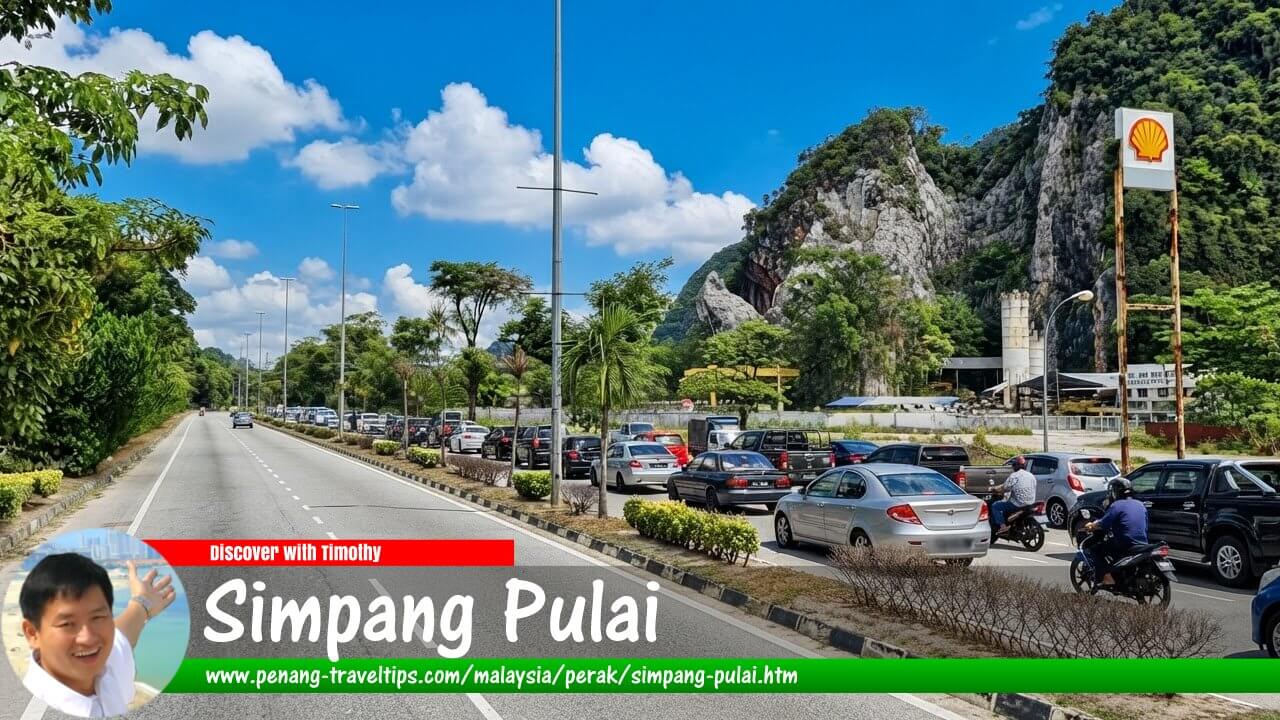 Simpang Pulai Travel Guide (AI generated on 10 September 2026)
Also available: Panduan Melawat Simpang Pulai
Simpang Pulai is a small town in Kinta District, Perak, located on the southern outskirts of Ipoh. Although it is not a major tourist destination in its own right, Simpang Pulai is an important transport junction and gateway to the highlands, particularly Cameron Highlands in Pahang. The town is also close to Gopeng, Kampung Kepayang, Gunung Lanno and several limestone landscapes in the Kinta Valley.
For travellers, Simpang Pulai is best understood as a gateway town. It provides access from the North-South Expressway to Ipoh, Gopeng and the road to Cameron Highlands. The surrounding area also contains natural attractions, former mining landscapes, Orang Asli settlements and heritage sites.
Quick Facts
Town: Simpang Pulai
State: Perak
District: Kinta
Mukim: Sungai Raia
Postcode: 31300
Nearest major city: Ipoh
Nearest towns: Gopeng and Kampung Kepayang
Main highway: North-South Expressway (E1)
Expressway exit: Simpang Pulai, Exit 137
Main road: Federal Route 1
Highland route: Route 185 towards Cameron Highlands
Known for: Gateway to Cameron Highlands, limestone hills, former tin-mining country and access to outdoor attractions
Where is Simpang Pulai?
Simpang Pulai is situated in the Kinta Valley, approximately 15 to 20 kilometres south of central Ipoh, depending on the point of departure. It lies along the historic Ipoh-Gopeng corridor and is connected directly to the North-South Expressway.
The town's most important transport feature is Exit 137, Simpang Pulai, on the northern route of the North-South Expressway. Tourism Perak lists Simpang Pulai as one of the main expressway exits serving Ipoh.
From the interchange, travellers can head north towards Ipoh, south towards Gopeng and Kampar, or turn towards the highlands through the Simpang Pulai-Cameron Highlands road.
This makes Simpang Pulai particularly useful for travellers driving between Penang, Ipoh and Cameron Highlands, as well as for travellers coming from Kuala Lumpur and southern Malaysia.
The Meaning and Origin of the Name Simpang Pulai
The name Simpang Pulai refers to a junction associated with the Pulai area. Local historical accounts connect the name Pulai with the pulai tree, while the settlement historically formed part of the wider Sungai Raia and Kampung Kepayang area.
A local community history describes the earlier settlement as Old Pulai, with the area also being referred to as Keramat Pulai. The history of the surrounding area is closely associated with Malay and Mandailing communities, tin mining and agriculture.
A Brief History of Simpang Pulai
The history of Simpang Pulai is closely connected to the development of the Kinta Valley's tin-mining economy. During the late 19th and early 20th centuries, the surrounding Sungai Raia area contained important tin-mining settlements and routes connecting the interior mining districts with larger towns.
The older settlement of Kampung Kepayang, immediately associated with present-day Simpang Pulai, was once considerably more important commercially than it is today. Historical research describes Kampung Kepayang as an important commercial centre in the Sungai Raia district, with businesses and buildings dating from before the Second World War.
The establishment and growth of Simpang Pulai as a newer township during the 20th century gradually shifted commercial activity away from the older Kampung Kepayang settlement. The widening and realignment of the Ipoh-Gopeng road further affected the older shophouses, contributing to the decline of Kampung Kepayang as a commercial centre.
The development of the modern road to Cameron Highlands subsequently gave Simpang Pulai a new strategic role. What had once been primarily a settlement associated with the Kinta Valley's mining and agricultural economy became an important road junction for journeys into the highlands.
Kampung Kepayang
Kampung Kepayang is one of the most interesting historical places to explore around Simpang Pulai. The old settlement lies along the former Ipoh-Gopeng road and retains traces of its earlier importance.
Historical research identifies several pre-war buildings in Kampung Kepayang, including old shophouses, the former post office, the Toh Sedewa Raja Abdul Wahab bungalow and Masjid Ahmadiah. Many of these buildings have suffered from declining commercial activity and changing road patterns.
The village therefore provides a different experience from the modern commercial areas of Simpang Pulai. Visitors interested in local history may find the contrast between the old settlement and the modern road network particularly interesting.
Masjid Ahmadiah
Masjid Ahmadiah at Kampung Kepayang is an important historical mosque in the Simpang Pulai area. It is associated with Toh Sedewa Ahmad, a prominent Malay leader in the area and a member of the Orang Besar Enam Belas of Perak.
Historical studies record the mosque as having been built in 1905, during the period when tin mining was flourishing in Kampung Kepayang and Simpang Pulai. Its timber construction and traditional Malay and Sumatran influences make it notable as part of the area's architectural heritage.
For visitors interested in Perak's Malay heritage, the mosque is particularly significant because it reflects the history of the Malay communities that developed alongside the mining economy of the Kinta Valley.
The Road to Cameron Highlands
For most modern travellers, the most important reason to know Simpang Pulai is its road to Cameron Highlands.
The Simpang Pulai route is commonly regarded as one of the main approaches to Cameron Highlands. The route passes through the northern part of the highlands via Kampung Raja, Kuala Terla, Tringkap, Kea Farm and Brinchang before continuing towards Tanah Rata. The Cameron Highlands District Council specifically identifies the Simpang Pulai route as the northern approach and notes that its road is generally wider and less winding than the Tapah approach.
The route is especially convenient for travellers coming from Ipoh and northern Malaysia. It is also an alternative to the older Tapah route from the south.
However, this remains a mountain road. Fog, heavy rain, landslides, slow-moving vehicles and traffic congestion can affect the journey. Drivers should check current road conditions before travelling, particularly during periods of heavy rain.
Why Use Simpang Pulai to Reach Cameron Highlands?
Travellers approaching Cameron Highlands from the north often choose the Simpang Pulai route because it generally has a more gradual climb than the older Tapah route. The road is also an important route for commercial vehicles supplying the highlands.
The route passes through agricultural areas as it climbs into the highlands. Visitors eventually reach Kampung Raja, followed by Kuala Terla, Tringkap, Kea Farm and Brinchang. The journey therefore provides access to many of the vegetable-growing areas and highland settlements of Cameron Highlands.
During school holidays and public holidays, however, traffic can become extremely heavy, particularly on the approach from Kampung Raja towards Brinchang and Tanah Rata. Travellers should allow considerably more time than the normal driving distance suggests.
Lubuk Timah Recreation Centre
One of the most accessible nature attractions near Simpang Pulai is Pusat Rekreasi Lubuk Timah, also known as Lubuk Timah Fall Hot Spring.
The recreation centre combines a cold waterfall environment with a hot spring. The Batu Gajah District Council describes the site as having a rebuilt hot-spring pool beside the river, with a second pool connected to the first. The area also contains basic facilities including toilets, a surau, gazebos and rest shelters.
Lubuk Timah is particularly convenient for visitors because it is only about 8 kilometres from the Simpang Pulai expressway interchange. The local authority describes access from the interchange via the road towards Cameron Highlands, followed by a turn into the recreation centre.
For Muslim visitors, the presence of a surau makes Lubuk Timah more convenient for a longer family outing. Nevertheless, visitors should check current operating hours and facilities before travelling.
Gunung Lanno and the Limestone Landscape
The hills around Simpang Pulai form part of the spectacular limestone landscape of the Kinta Valley. Gunung Lanno, together with other limestone hills in the surrounding area, is a prominent geographical feature.
The limestone country has long been associated with tin mining, quarrying and the settlement history of the Kinta Valley. Some hills have been affected by quarrying, while others remain important natural landmarks.
Visitors should not enter quarries or abandoned mining areas without permission. Quarry sites can contain unstable rock faces, deep water, machinery and other hazards.
Gopeng and Nearby Attractions
Simpang Pulai is close enough to Gopeng that the two can easily be combined in a single trip. Gopeng is one of Perak's better-known destinations for caves, forests, rivers and former tin-mining heritage.
Among the attractions within the wider Gopeng area are:
- Gua Tempurung, one of the best-known limestone caves in Perak;
- Gua Kandu and other limestone caves;
- Gopeng Museum;
- Gopeng Heritage House and old-town heritage;
- Batu Berangkai Waterfall;
- Gunung Bujang Melaka;
- the Perak Herbal Garden; and
- various river and rainforest activities.
Tourism and local-government sources identify Gopeng and the surrounding Kinta Valley as an area with a combination of heritage, nature and adventure attractions.
Gua Tempurung
Gua Tempurung is one of the most prominent natural attractions near Simpang Pulai and Gopeng. The extensive limestone cave system is located south of the town and is accessible by road.
The cave offers different types of visitor experiences, ranging from relatively straightforward cave visits to more demanding adventure routes. Travellers should select a route appropriate to their fitness and experience and follow the operator's safety instructions.
Because cave conditions can change after heavy rain, visitors should also check whether their selected cave route is operating before setting out.
Perak Herbal Garden
The Perak Herbal Garden is located in the wider Sungai Raia and Gopeng area. It provides an opportunity to learn about medicinal and aromatic plants and is suitable for visitors interested in Malaysian plant life.
The attraction is also useful for families because it provides a gentler alternative to activities such as caving, rafting and jungle trekking.
Food in Simpang Pulai
Simpang Pulai has a range of local eateries serving food to residents, commuters and travellers using the main road. The town's location along the route towards Cameron Highlands means that it is also a practical place to stop for a meal before beginning the mountain drive.
Local Malaysian dishes are widely available, including Malay rice dishes, noodles, roti, soups and drinks. Travellers should also look out for roadside stalls and restaurants in the surrounding villages.
Muslim travellers will generally find halal Malay food in the area, but foreign visitors should still check the status of individual restaurants if halal certification is important to them.
Accommodation
Simpang Pulai has accommodation suitable mainly for short stays and stopovers. Travellers looking for a larger selection of hotels can easily continue to Ipoh, where there is a much wider range of accommodation.
Another option is to stay in Gopeng or in rural accommodation around the surrounding countryside, particularly if the purpose of the visit is outdoor recreation.
Travellers heading to Cameron Highlands can also continue directly into the highlands and stay in Kampung Raja, Brinchang or Tanah Rata.
Getting to Simpang Pulai
By car
Driving is the easiest way to reach Simpang Pulai.
The North-South Expressway E1 has a dedicated Simpang Pulai interchange, Exit 137. The interchange provides direct access to the town and to the surrounding road network. PLUS lists Simpang Pulai among its toll plazas.
From the interchange, travellers can continue towards Ipoh, Gopeng, Cameron Highlands and other destinations in the Kinta Valley.
From Ipoh
From Ipoh, Simpang Pulai can be reached by following the main road south towards Gopeng. The journey is relatively short, making it practical to visit Simpang Pulai and nearby attractions as part of an Ipoh itinerary.
From Penang
Travellers from Penang can follow the North-South Expressway south towards Ipoh and exit at Simpang Pulai. This is also a convenient route for those travelling onward to Cameron Highlands.
From Kuala Lumpur
Travellers from Kuala Lumpur can take the North-South Expressway north towards Perak and exit at Simpang Pulai. From the interchange, the journey can continue towards Ipoh or south-west towards Gopeng.
By bus
Long-distance buses generally serve Ipoh rather than Simpang Pulai as their principal destination. Travellers arriving in Ipoh can continue by local transport or taxi/e-hailing to Simpang Pulai.
By train
Simpang Pulai does not have a major railway station. Travellers arriving by KTM train can use Ipoh railway station and continue by road.
Simpang Pulai as a Stopover
Simpang Pulai works particularly well as a stopover rather than as a destination requiring several days. A traveller driving from Penang towards Cameron Highlands, for example, can leave the North-South Expressway at Simpang Pulai, have a meal, visit a nearby attraction and then continue into the highlands.
Similarly, visitors staying in Ipoh can make a half-day excursion to the Simpang Pulai-Gopeng area before returning to the city.
Suggested One-Day Itinerary
A practical day trip combining Simpang Pulai and the surrounding area could be arranged as follows:
- Morning: arrive in Simpang Pulai and have breakfast or an early morning drink.
- Morning: visit Kampung Kepayang and see the older settlement and Masjid Ahmadiah from the public road.
- Late morning: continue towards Lubuk Timah Recreation Centre.
- Afternoon: have lunch and spend time at the recreation area.
- Late afternoon: continue towards Gopeng for a short visit or return towards Ipoh.
- Evening: return to Ipoh or continue your journey towards Cameron Highlands, depending on your itinerary.
Visitors intending to undertake caving, rafting or jungle trekking should allocate a full day to the activity rather than trying to fit too many attractions into one itinerary.
Suggested Weekend Itinerary
For travellers with more time, Simpang Pulai can be used as part of a two-day Kinta Valley itinerary.
Day 1: Simpang Pulai and Gopeng
- Arrive in Simpang Pulai.
- Explore Kampung Kepayang and its heritage.
- Visit Lubuk Timah.
- Continue to Gopeng.
- Explore Gopeng's heritage area and stay overnight.
Day 2: Nature and Adventure
- Visit Gua Tempurung or another cave attraction.
- Take part in a guided outdoor activity if desired.
- Visit the Perak Herbal Garden or another family-friendly attraction.
- Return to Ipoh or continue to another destination.
For Families
Simpang Pulai and its surrounding area can be suitable for families, particularly those travelling by car. Lubuk Timah offers a more relaxed outdoor experience than caving or rafting, while the wider Gopeng area provides attractions for different age groups.
Parents should exercise particular care around rivers, waterfalls, hot springs, caves, limestone cliffs and former mining sites. Children should remain under close supervision in natural areas.
For International Travellers
International visitors may find Simpang Pulai useful because it provides an insight into a less commercialised part of the Kinta Valley. The town itself is not designed as a major international tourist centre, but that is part of its appeal for travellers interested in local landscapes and transport routes.
The area illustrates several aspects of Malaysian history in one relatively small region: tin mining, Malay and Mandailing settlement, Chinese mining communities, limestone landscapes, road development and the growth of modern townships.
For visitors travelling from Kuala Lumpur or Penang to Cameron Highlands, Simpang Pulai can also be an informative stop rather than simply a place to pass through.
Practical Tips
- Use Simpang Pulai primarily as a gateway to the surrounding attractions rather than expecting a large concentration of tourist sights within the town itself.
- Keep an eye on weather conditions when planning cave, river and waterfall activities.
- Check current opening hours and admission arrangements before visiting attractions.
- Allow extra time when travelling towards Cameron Highlands during weekends, public holidays and school holidays.
- Drive carefully on the mountain road, especially in rain, fog and poor visibility.
- Do not enter active quarries or abandoned mining sites without permission.
- Wear suitable footwear for waterfalls, caves and forest trails.
- Carry drinking water and insect repellent for outdoor activities.
- For Muslim travellers, identify a suitable mosque or surau before entering remote areas. Lubuk Timah Recreation Centre has a surau according to the local authority.
- If travelling onwards to Cameron Highlands, fill the vehicle with fuel and make necessary preparations before beginning the mountain journey.
Best Time to Visit
Simpang Pulai can be visited throughout the year. For outdoor activities, however, weather is an important consideration. Heavy rain can affect waterfalls, rivers, caves and mountain roads.
The road to Cameron Highlands can also become congested during public holidays and school holidays. Travellers who are using Simpang Pulai only as a transit point should therefore allow extra time during peak periods.
For hiking, caving and other outdoor activities, mornings are generally preferable because they allow more time to complete the activity before afternoon weather changes.
Conclusion
Simpang Pulai is a small but strategically important town in Perak's Kinta Valley. Its significance comes less from a concentration of attractions in the town centre and more from its role as a junction connecting Ipoh, Gopeng, the North-South Expressway and Cameron Highlands.
The surrounding area has considerably more to offer than the town itself. Historical Kampung Kepayang, Masjid Ahmadiah, Lubuk Timah, limestone hills and the nearby attractions of Gopeng provide opportunities for travellers interested in heritage and nature.
For travellers heading to Cameron Highlands from northern Malaysia, Simpang Pulai is an important gateway. For those exploring Perak, it provides access to one of the Kinta Valley's distinctive landscapes, where the history of tin mining, Malay settlement, limestone hills and modern transport routes meet.
Map of Simpang Pulai, Perak
Simpang Pulai is  on the Map of towns in Perak
References
- Penang Travel Tips – Simpang Pulai, Perak
- Tourism Perak Malaysia – How to Come to Perak
- Tourism Perak Malaysia – Perak Guide Book
- Batu Gajah District Council – Tourist Attractions
- Batu Gajah District Council – Pusat Rekreasi Lubuk Timah
- Cameron Highlands District Council – Information for Visitors
- PLUS Malaysia – Facilities and Toll Plazas
- SISMIM – Surau Kampung Simpang Pulai
- UiTM – Heritage and Architectural Study of Masjid Ahmadiah
- University of Malaya – Heritage Research on Kampung Kepayang
Page Details
This page was created on 15 September 2026. Hi, my name is Timothy and created it from my research, for my own entertainment, knowledge and to satisfy my curiosity. I am providing the information to you in good faith and hope it is useful. I try to get the details as accurate as possible. I also try to update the page whenever I stumble on new details. So this and all my other pages are perpetual work in progress. If you discover any error, please politely inform me, pointing out where the error lies, and I will correct it as soon as possible. Your helpfulness will keep this page accurate, relevant and helpful to those who need the information.Buy Me A Coffee
If you enjoy the information I provide and want to support the work I do, please buy me a coffee! I appreciate it immensely, thank you so much!
