
Teluk Intan Travel Guide
 Teluk Intan Travel Guide (17 September 2016)
Also available: Panduan Melawat Teluk Intan
Teluk Intan is a historic town in southern Perak, Malaysia, situated on the banks of the Perak River. Formerly known as Teluk Anson, the town developed as an important river port and administrative centre during the late 19th and early 20th centuries. Today, Teluk Intan is best known for its distinctive Leaning Tower of Teluk Intan, but its heritage extends well beyond this landmark, encompassing colonial-era buildings, royal history, religious sites, war memorials, traditional food and the riverine landscape of Hilir Perak.
Quick Facts
- Town: Teluk Intan
- State: Perak, Malaysia
- District: Hilir Perak
- Municipal authority: Majlis Perbandaran Teluk Intan
- Former name: Teluk Anson
- Earlier name: Teluk Mak Intan
- Location: On the Perak River in southern Perak
- Best known for: Leaning Tower of Teluk Intan
- Other attractions: Teluk Intan Heritage Trail, Batu Tenggek War Memorial, Perak River, Pulau Bangau, Sungai Manik paddy fields and historic religious buildings
- Local specialities: Mee rebus, nasi kandar, giant freshwater prawns and other local dishes
Where Is Teluk Intan?
Teluk Intan is in the southern part of Perak, where the Perak River forms the geographical setting of the town. It is the principal urban centre and administrative headquarters of Hilir Perak District. The town is surrounded by the Perak River and Sungai Bidor, while the wider district consists of agricultural land, plantations, fishing settlements and villages.
Teluk Intan is located between several important towns in southern and central Perak. It is connected by road with Kampar, Tapah, Bidor, Hutan Melintang and Bagan Datuk, while the West Coast Expressway provides a faster road connection to other parts of Peninsular Malaysia.
For travellers, Teluk Intan is particularly suitable as a short stopover or a one- or two-day destination. The compact town centre contains many heritage sites within a relatively small area, making it possible to explore much of the historic centre on foot before venturing into the surrounding countryside.
Why Visit Teluk Intan?
Teluk Intan is different from Perak's better-known destinations such as Ipoh and Taiping. Its appeal lies in its combination of river history, colonial heritage, Malay royal history, local food and rural landscapes.
The town's most recognisable landmark is the Leaning Tower, an unusual 19th-century structure that originally functioned as a water tower. Around it are streets containing old commercial buildings and places associated with the town's development under British administration.
Beyond the town centre, visitors can explore the Perak River, paddy-growing areas, plantations and wetland environments. Pulau Bangau, for example, is associated with birdwatching and river-based ecotourism. This makes Teluk Intan a useful base for experiencing both the historical town and the agricultural landscape of Hilir Perak.
A Brief History of Teluk Intan
Teluk Mak Intan
The origins of modern Teluk Intan are associated with Teluk Mak Intan, a settlement traditionally linked to a woman named Mak Intan, described in local historical accounts as a trader and pioneer from Mandailing in Sumatra.
According to the historical account maintained by the Perak state administration, Mak Intan established a settlement here in the early 19th century. The settlement subsequently attracted people from Sumatra and other parts of the Malay world, including communities of Javanese, Rawa, Mandailing, Minangkabau and Kampar origin, as well as Indian traders.
Trade and agriculture were important to the early settlement. The location beside the Perak River gave it access to the river transport network that connected settlements and trading centres throughout the interior of Perak with the coast.
The Development of Teluk Anson
In the 19th century, Teluk Intan became increasingly important as British influence expanded in Perak following the Pangkor Treaty of 1874. The settlement became an administrative centre in the mid-1870s.
At that time, Durian Sebatang was an important administrative and river port centre. It served as a collection point for tin from the mining districts around Batang Padang, Bidor and Tapah. The development of a new administrative town at Teluk Mak Intan gradually shifted some of this importance towards the settlement.
Sir Hugh Low, the British Resident of Perak, supported the development of a new town at Teluk Malunting, referring to Teluk Mak Intan in a form that was subsequently associated with the name Teluk Anson. General Sir Archibald Edward Harbord Anson was involved in the planning of the new town, and on 15 March 1882 the settlement was officially named Teluk Anson in his honour.
River Port and Railway Town
During the late 19th and early 20th centuries, Teluk Anson became an important transportation centre. The Perak River was then a major commercial artery, carrying people and goods between the interior and the river's lower reaches.
The arrival of railways changed the movement of goods in Perak. A railway connection linked Teluk Anson with the wider Perak railway system, allowing tin, rubber, timber and agricultural produce to move more efficiently. Batak Rabit, close to Teluk Intan, also developed as an important port area.
For several decades, the town therefore functioned as both a river port and railway centre. Its importance declined during the second half of the 20th century as road transport became increasingly dominant and the Perak River became less suitable for commercial shipping because of siltation and changes to the riverbank.
From Teluk Anson to Teluk Intan
The name Teluk Anson remained in use for almost a century. On 1 January 1982, the town was renamed Teluk Intan. The name recalls the earlier name Teluk Mak Intan and is commonly translated as Diamond Bay.
Teluk Intan later became a municipal authority. The present Majlis Perbandaran Teluk Intan was established following the upgrading of the former district council, with the municipal declaration taking place in April 2004.
Teluk Intan and the Perak Royal Family
Teluk Intan also has a connection with the Perak royal institution. In 1938, the town was designated a royal town for the Raja Muda of Perak. This status forms part of the town's historical identity alongside its role as a commercial and administrative centre.
The wider Teluk Intan area contains several sites associated with the Perak Sultanate. One of the most significant is the tomb of Sultan Abdullah Muhammad Shah I, Sultan of Perak from 1825 to 1857, who was associated with Durian Sebatang.
Places to Visit in Teluk Intan
1. Leaning Tower of Teluk Intan
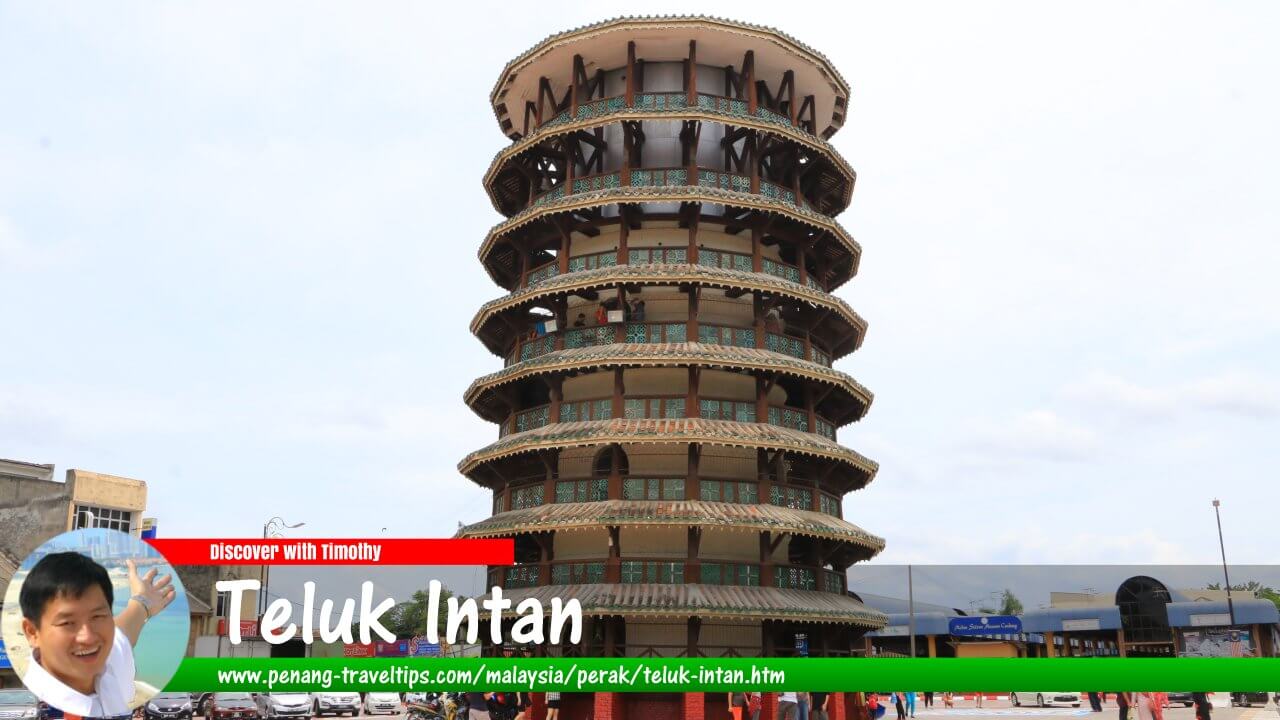
The Leaning Tower of Teluk Intan is the town's best-known landmark and the principal reason many visitors come to Teluk Intan. Built in 1885, the pagoda-like structure originally served as a water tower.
The tower is about 25 metres high and has eight storeys. It contains approximately 110 steps. Its distinctive inclination developed over time, influenced by the underlying ground conditions and the weight of the water tank.
The structure also contains a clock and bell. The tower's unusual appearance has resulted in frequent comparisons with the Leaning Tower of Pisa in Italy, although the two buildings have very different histories and functions.
The tower stands at the centre of the historic town and is surrounded by several roads and old commercial buildings. It is therefore a useful starting point for exploring Teluk Intan on foot.
2. Teluk Intan Heritage Trail
The Teluk Intan Heritage Trail brings together a number of historic buildings, monuments and places associated with the development of the town. The trail reflects the multicultural character of Teluk Intan, with Malay, Chinese, Indian, Islamic, Christian and colonial-era heritage represented among its sites.
Among the places identified by the municipal council are old government buildings, religious buildings, memorials and historic commercial areas. Because many are within the town centre, visitors interested in architecture and history can explore several sites during a walking tour.
3. Batu Tenggek War Memorial
The Hilir Perak War Memorial, popularly known as Batu Tenggek, is an unusual war memorial consisting of a large granite boulder placed on a concrete base.
The memorial originated from an initiative by the Central Perak Planters Association in 1917 during the First World War. It was officially unveiled on 16 January 1926. After the Second World War, the years 1939–1945 were added to commemorate those who died in that conflict as well.
The memorial is particularly distinctive because of its simple use of a large natural stone rather than a conventional statue or obelisk.
4. Tomb of Sultan Abdullah Muhammad Shah I
The tomb of Sultan Abdullah Muhammad Shah I is an important royal site in Teluk Intan. Sultan Abdullah Muhammad Shah I was the 22nd Sultan of Perak and died in 1857. He is also known as Marhum Itikadullah and Marhum Durian Sebatang.
The present tomb structure was reconstructed in 1969 based on the form of other Perak royal tombs and subsequently restored in 2015. The site has particular significance in the royal traditions of Perak and is associated with the ceremonial journey connected with Beting Beras Basah.
5. Perak River and Riverfront
The Perak River is fundamental to understanding Teluk Intan. Before modern roads and railways transformed transportation, the river was the principal route connecting settlements and commercial centres in the region.
Today, the riverfront provides a different experience. Visitors can enjoy the riverside scenery, watch boats and explore the town's relationship with the water. River cruises are also available, including trips associated with birdwatching around Pulau Bangau and evening firefly experiences, although schedules and operators may vary.
6. Pulau Bangau
Pulau Bangau, or Egret Island, is one of the ecotourism attractions promoted in the Teluk Intan and Hilir Perak area. The island and surrounding river environment provide opportunities to observe birds and experience the wetlands and waterways of the lower Perak River.
Birdwatching and river cruises are particularly suited to visitors who want to combine a heritage visit with a quieter natural environment. The best experience depends on river conditions, weather, seasonal bird activity and the operating schedule of local boat operators.
7. Sungai Manik Paddy Fields
The countryside around Teluk Intan includes extensive agricultural areas. Sungai Manik is particularly associated with rice cultivation and provides a contrasting landscape to the dense historic town centre.
Visitors travelling through the area can see paddy fields, irrigation channels, villages and agricultural activity. The landscape illustrates the continuing importance of agriculture to the economy and character of Hilir Perak.
8. Ladang Moccis
Ladang Moccis is another attraction in the wider Teluk Intan area. The plantation environment offers an opportunity to experience the agricultural landscape of Hilir Perak, complementing the town's heritage attractions.
Other Heritage Sites
Teluk Intan's heritage is not limited to the Leaning Tower. The municipal heritage programme includes a variety of religious, civic and commemorative sites.
Among the sites listed in the town's heritage trail are St. Anthony of Padua Church, Tamil Methodist Church, St Luke the Evangelist Church, Masjid India Muslim, Masjid Jamek Kampong Batak Rabit, Hock Soon Keong Temple, the old courthouse, the old post office and various memorials.
These buildings reflect the diverse communities that developed around Teluk Intan's commercial and river-port economy. A heritage walk is therefore one of the best ways to appreciate the town beyond its famous leaning tower.
Food in Teluk Intan
Teluk Intan is well known in Perak for its local food. The town's cuisine reflects its multicultural population and its long history as a trading centre.
Mee Rebus
Mee rebus is one of Teluk Intan's best-known local dishes. The noodles are served in a thick gravy with a sweet and savoury character, commonly accompanied by ingredients such as egg, bean sprouts, tofu, fried shallots and chilli.
Mastan Ghani is particularly associated with mee rebus in Teluk Intan. The establishment dates back to the 1950s and is widely regarded as one of the town's characteristic food stops.
Nasi Kandar and Indian-Muslim Food
Teluk Intan has a strong Indian-Muslim culinary tradition. Nasi kandar, fried chicken, curries, roti and Mamak-style noodles are widely associated with the local food scene.
The town's Indian-Muslim restaurants also illustrate the importance of migration and trade in the development of Teluk Intan. Indian traders were among the communities that settled in the town during its early development.
Giant Freshwater Prawns
The Perak River and surrounding waterways have also contributed to the local food culture. Giant freshwater prawns, or udang galah, are among the seafood specialities associated with Teluk Intan and the wider Hilir Perak region.
Visitors may find them served grilled, fried or prepared in other Malaysian styles. Availability and prices vary according to season and supply.
Other Local Foods
Other foods worth looking for include chee cheong fun, rojak, curry noodles, fried noodles, satay, traditional biscuits and local desserts. Food stalls and coffee shops around the town centre provide opportunities to sample everyday food rather than only dishes aimed at tourists.
Where to Stay in Teluk Intan
Teluk Intan has a selection of hotels, boutique hotels, budget accommodation and guesthouses. Most are located within or close to the main town area, making the central hotels convenient for visitors who want to explore the Leaning Tower and heritage sites.
The municipal council lists accommodation establishments including hotels along Jalan Changkat Jong, Jalan Padang Tembak, Jalan Pasar and other parts of the town. Travellers should check current facilities, prices and availability directly before booking.
For visitors planning to explore the surrounding countryside, a hotel in Teluk Intan can also serve as a base for day trips to Sungai Manik, Batak Rabit, Pulau Bangau, Hutan Melintang and Bagan Datuk.
How to Get to Teluk Intan
By Car
Driving is the most convenient way to reach Teluk Intan and to explore the surrounding district. The town is connected to the road network of southern and central Perak and can be reached from several directions.
The West Coast Expressway (WCE) provides a modern high-speed connection between Teluk Intan and other parts of the west coast of Peninsular Malaysia. Travellers approaching from Kuala Lumpur and Selangor can use the WCE and exit towards Teluk Intan.
For travellers already in Perak, routes from Ipoh, Kampar, Tapah, Bidor, Hutan Melintang and Bagan Datuk provide access to the town.
By Bus
Long-distance and intercity buses connect Teluk Intan with other towns and cities in Peninsular Malaysia. Bus travel can be practical for visitors arriving without a car, although the choice of direct services depends on the origin and current operator schedules.
By Train
Teluk Intan no longer has an operating passenger railway station in the town. Historically, however, the town was connected to the Perak railway network and the railway played an important role in transporting tin and other goods.
Travellers arriving by KTM ETS generally need to use a railway station elsewhere in Perak and continue to Teluk Intan by road. Tapah Road is one of the railway stations that historically served as a gateway to the Teluk Intan area, although the former branch railway to Teluk Intan is no longer in operation.
Getting Around Teluk Intan
The central heritage area is compact enough to explore on foot. Walking is particularly suitable around the Leaning Tower, old commercial streets, religious buildings and other heritage sites.
For attractions outside the town centre, such as Pulau Bangau, Sungai Manik and plantation areas, a private car or hired vehicle is more practical. Ride-hailing availability can vary, particularly outside the central urban area.
If you are visiting without a car, it is worth planning your transport for outlying attractions before leaving the town centre.
Suggested One-Day Teluk Intan Itinerary
- Morning: Begin at the Leaning Tower of Teluk Intan and explore the surrounding historic town centre.
- Late morning: Walk part of the Teluk Intan Heritage Trail, visiting selected historic buildings and religious sites.
- Lunch: Try local mee rebus, nasi kandar or another local speciality.
- Afternoon: Visit Batu Tenggek and the tomb of Sultan Abdullah Muhammad Shah I, depending on opening conditions and accessibility.
- Late afternoon: Spend time along the Perak River or at the riverfront.
- Evening: If pre-arranged, take a river cruise for birdwatching or a firefly experience around Pulau Bangau.
Suggested Two-Day Teluk Intan Itinerary
Day 1: Heritage Teluk Intan
Spend the first day concentrating on the historic town. Visit the Leaning Tower in the morning, followed by a walking tour of the heritage trail. Explore the old streets, religious buildings and memorials before stopping for local food.
In the afternoon, visit Batu Tenggek and other heritage sites before spending the late afternoon beside the Perak River. A river cruise can be arranged for the evening if available.
Day 2: River and Countryside
Use the second day to explore the rural surroundings of Teluk Intan. Visit Pulau Bangau or join a river excursion, then continue towards the agricultural landscape of Sungai Manik or other nearby rural areas.
This second day provides a useful contrast to the first, showing that Teluk Intan is more than a historic town centre. Its identity is closely connected with the river, agriculture, plantations and villages of Hilir Perak.
Best Time to Visit Teluk Intan
Teluk Intan can be visited throughout the year. The town has a tropical climate with high temperatures and humidity, while rainfall can occur at any time.
For walking around the heritage centre, mornings and late afternoons are generally more comfortable than the middle of the day. River activities are also influenced by weather and river conditions, so visitors should check with local operators before planning a cruise.
If your main interest is outdoor photography, birdwatching or the surrounding agricultural landscape, weather conditions become more important than they are for a purely heritage-focused visit.
Teluk Intan as a River Town
The Perak River is the key to understanding the historical geography of Teluk Intan. Before the development of modern highways, waterways provided the most efficient means of moving people and goods through much of Perak.
The town's historic prosperity was closely related to this river network. Tin from mining areas farther inland, together with agricultural produce and other commodities, could be transported downstream. Teluk Intan and nearby Batak Rabit consequently developed as important commercial centres.
Although road transport has replaced river transport for most commercial purposes, the river remains an important part of Teluk Intan's landscape and identity. Modern river cruises and ecotourism activities provide visitors with a way to experience this older relationship with the water.
Teluk Intan and the Wider Hilir Perak Region
Teluk Intan makes a useful base for exploring southern Perak. The surrounding Hilir Perak landscape includes paddy fields, plantations, fishing settlements and villages along the Perak River and its tributaries.
The nearby Bagan Datuk area is known for its river and coastal environments, while rural areas around Sungai Manik provide a view of Perak's agricultural economy. Visitors with more time can therefore combine a visit to Teluk Intan with several smaller destinations in southern Perak.
The town is also strategically positioned for travellers moving between central Perak, the west coast and southern parts of the peninsula, particularly since the development of the West Coast Expressway.
Practical Tips for Visitors
- Wear comfortable shoes: The central heritage area is well suited to walking, but the tropical heat can make long walks tiring.
- Visit the Leaning Tower early: Morning visits are generally more comfortable for photography and walking.
- Do not limit your visit to the tower: Teluk Intan's heritage trail contains many other buildings and memorials.
- Plan river activities in advance: River cruises and firefly trips operate according to schedules and conditions.
- Carry cash: Smaller food stalls and traditional shops may not always accept cards or cashless payments.
- Respect religious sites: Dress appropriately and observe local rules when visiting mosques, temples and churches.
- Allow extra time for rural attractions: Places outside the town centre are spread across the wider Hilir Perak area.
- Check opening hours: Heritage buildings and attractions may have different schedules, particularly on public holidays.
How Long Should You Stay?
A day trip is sufficient for travellers whose main objective is to see the Leaning Tower and explore the central heritage area. However, an overnight stay is preferable if you want to experience the town at a slower pace and include a river cruise or rural excursion.
Two days and one night is a comfortable length for a first visit. It allows time for the heritage centre on the first day and the river, agricultural landscape and surrounding attractions on the second.
Why Teluk Intan Is Worth Visiting
Teluk Intan offers a different perspective on Perak from the state's larger tourist centres. Its history is shaped not by a single industry or attraction but by the interaction of river trade, tin mining, agriculture, colonial administration, railway transport and Malay royal history.
The Leaning Tower provides an instantly recognisable symbol of the town, but the surrounding heritage gives the landmark its context. Old streets, religious buildings, memorials, the royal connection and the Perak River together tell the story of a town that grew from a river settlement into an important commercial centre.
For local travellers, Teluk Intan is an accessible destination for discovering the history of southern Perak. For foreign visitors, it offers an opportunity to experience a smaller Malaysian town where heritage, food, river life and rural landscapes remain closely connected.
Conclusion
Teluk Intan is one of southern Perak's most distinctive historic towns. Its famous Leaning Tower is an excellent introduction, but the town rewards visitors who take time to explore beyond the landmark.
From its origins as Teluk Mak Intan and its development as Teluk Anson, to its role as a river port, railway town and royal town, Teluk Intan reflects several important phases of Perak's history. Today, its heritage streets, local food, Perak River, surrounding agricultural landscapes and ecotourism attractions make it a worthwhile destination for travellers exploring Perak beyond the better-known cities.
Updates on Teluk Intan
25 May 2014Groundbreaking ceremony for the West Coast Expressway (E32) was held in Teluk Intan.
Map of Teluk Intan
Sights in Teluk Intan
- Gurdwara Sahib Teluk Intan (GPS: 4.02525, 101.0223)

- Leaning Tower of Teluk Intan (GPS: 4.02522, 101.01935)

- Pasar Besar Teluk Intan (GPS: 4.02522, 101.01935)

Categories of sights in Teluk Intan
- Churches in Teluk Intan
- Hindu Temples in Teluk Intan
- Hospitals in Teluk Intan
- Mosques in Teluk Intan
- Schools in Teluk Intan
- Shopping Malls in Teluk Intan
Petrol Stations in Teluk Intan
- BHP Jalan Changkat Jong (GPS: 4.01928, 101.02585)
- Petronas Jalan Changkat Jong (GPS: 4.00402, 101.04193)
- Shell Jalan Changkat Jong (GPS: 4.01949, 101.02567)
References
- Pejabat Daerah dan Tanah Teluk Intan – Sejarah Daerah
- Tourism Perak – Leaning Tower of Teluk Intan
- Tourism Perak – Hilir Perak
- Tourism Perak – District Clusters
- Majlis Perbandaran Teluk Intan – Official Portal
- Majlis Perbandaran Teluk Intan – Menara Condong
- Majlis Perbandaran Teluk Intan – Memorial Perang Hilir Perak
- Majlis Perbandaran Teluk Intan – Makam Sultan Abdullah Muhammad Shah I
- Malaysia Travel – Teluk Intan
- Perak State Government – My Local Stats: Hilir Perak
- Majlis Perbandaran Teluk Intan – Accommodation
Page Details
This page was created on 12 September 2026. Hi, my name is Timothy and created it from my research, for my own entertainment, knowledge and to satisfy my curiosity. I am providing the information to you in good faith and hope it is useful. I try to get the details as accurate as possible. I also try to update the page whenever I stumble on new details. So this and all my other pages are perpetual work in progress. If you discover any error, please politely inform me, pointing out where the error lies, and I will correct it as soon as possible. Your helpfulness will keep this page accurate, relevant and helpful to those who need the information.Buy Me A Coffee
If you enjoy the information I provide and want to support the work I do, please buy me a coffee! I appreciate it immensely, thank you so much!
