
Marang Travel Guide
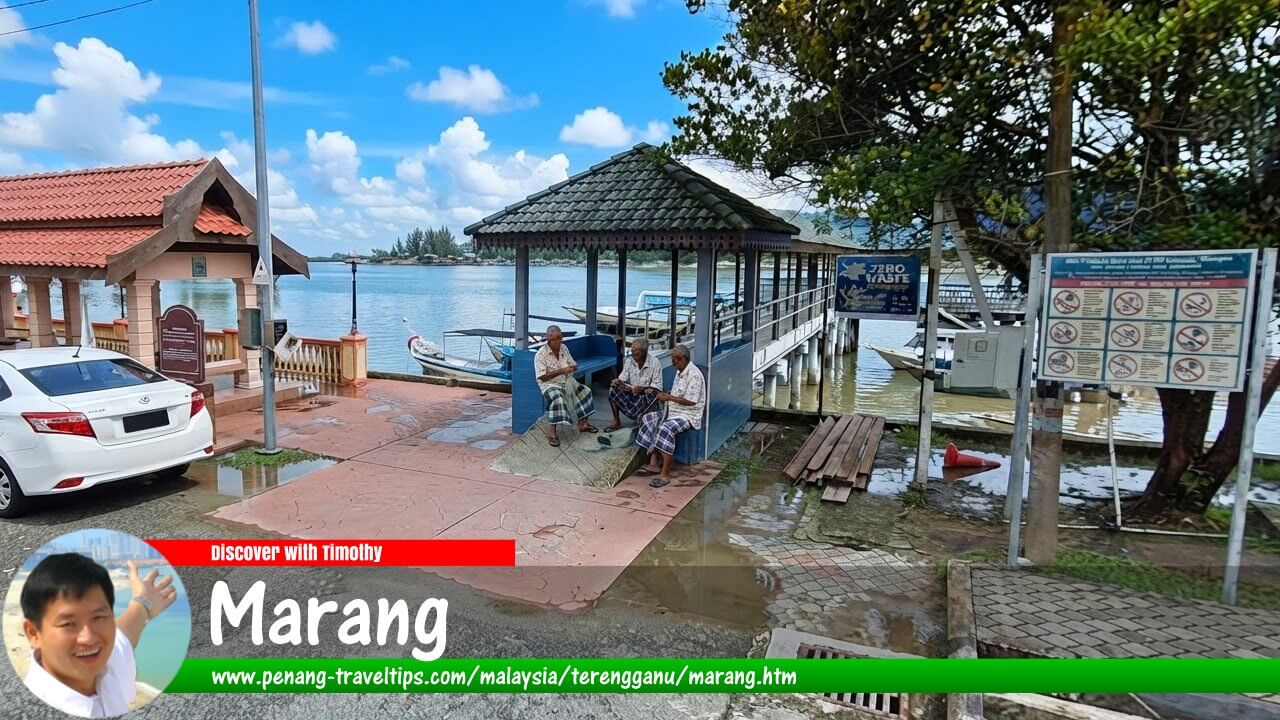 Marang Travel Guide (AI generated on 10 September 2026)
Also available: Panduan Melawat Marang
Marang is a coastal town and the administrative centre of Marang District in Terengganu, Malaysia. Located on the South China Sea between Kuala Terengganu and Dungun, it is best known as the mainland gateway to Pulau Kapas, while the town itself retains the character of a fishing community shaped by the Marang River, the sea and traditional village life.12
Quick Facts
- Town: Marang
- State: Terengganu, Malaysia
- District: Marang
- Role: Administrative centre of Marang District
- Location: South China Sea coast, south of Kuala Terengganu
- Distance from Kuala Terengganu: about 17 km by road
- Main attractions: Pulau Kapas, Pantai Kelulut, Benteng Marang, Pasar Marang, Kampung Jenang and Taman Rekreasi Kelulut
- Main industries and activities: Fishing, small-scale commerce, tourism and island transportation
- Main gateway: Jeti Marang for boat services to Pulau Kapas and nearby islands
- Main road: Federal Route 3 along the east coast of Peninsular Malaysia
- Local public transport: BAS.MY services connecting Marang with Kuala Terengganu and surrounding areas
Where is Marang?
Marang is situated on the east coast of Peninsular Malaysia, facing the South China Sea. The town lies approximately 17 km south of Kuala Terengganu and is connected to the state capital by the coastal Federal Route 3. Dungun is further south, making Marang a convenient stopping point for travellers following the coastal road through Terengganu.23
The town occupies the lower reaches of the Marang River, close to where the river reaches the sea. This location has influenced the character of Marang for generations. Fishing, small-scale maritime activities and movement along the coast remain important elements of local life, while tourism has grown around the beaches and the islands offshore.
Marang should therefore be understood as more than simply the departure point for Pulau Kapas. It is a district town with its own fishing, market, village and coastal landscapes, and provides an accessible introduction to the quieter side of Terengganu's east coast.
Geography and landscape
Marang District covers approximately 666.54 square kilometres and consists of six mukim: Rusila, Pulau Kerengga, Merchang, Jerong, Bukit Payong and Alor Limbat.4 The district extends inland from the South China Sea and contains a mixture of coastal plains, wetlands, agricultural land, hills and river valleys.
The Marang District Council describes the western part of the district as containing extensive swampy terrain, while moderately high hills occur in other parts of the district. The Marang River rises inland around the Bukit Kor and Mount Gajah Terom area before flowing towards the coast.5
The coastal landscape is particularly important to visitors. Sandy beaches, coconut trees, fishing settlements, river mouths and offshore islands give Marang a landscape typical of the east coast of Peninsular Malaysia. Offshore, Pulau Kapas is the best-known island associated with the town.
History of Marang
The history of Marang is closely connected with the traditional administrative system of Terengganu. During the 19th century, Terengganu was administered partly through river districts, in which appointed local nobles exercised authority and collected taxes and revenue on behalf of the Sultan. The area corresponding to the present Marang District included the river districts of Marang, Bukit Payong, Alor Limbat and Merchang.6
During the reign of Sultan Omar, who ruled Terengganu from 1839 to 1876, this system of administration became more formalised. Village heads remained responsible for local affairs, while district-level administration was increasingly placed under appointed authorities.
In 1912, the system of administration by local nobles was replaced by professional District Officers. A District Office building was subsequently established in Marang in 1915. The administrative arrangements were reorganised again in the 1920s as the colonial government introduced a different system of dependencies and district administration.6
The modern administrative history of Marang District continued to evolve during the 20th century. Before 1985, the district consisted of four mukim: Rusila, Pulau Kerengga, Jerong and Merchang. On 1 January 1985, Bukit Payong and Alor Limbat were transferred from the former Kuala Terengganu administrative area and incorporated into Marang District.4
The Marang District Council was established on 1 January 1981 as part of the reorganisation of local authorities. It initially covered only Rusila and Pulau Kerengga, with an area of 43.10 square kilometres and 13 villages. On 15 February 1996, its administrative area was expanded to cover the whole district, bringing the six mukim under the council's jurisdiction.7
How did Marang get its name?
The origin of the name Marang is not completely certain, and more than one explanation has been recorded. One traditional account attributes the name to a Chinese trader known as Ma, who was involved in the processing and drying of seafood such as fish and squid. The seafood was dried on racks known locally as rang. According to this story, the large number of drying racks associated with Ma eventually gave rise to the name “Ma-rang”.8
Another local explanation connects the name with Syed Muharram, suggesting that the pronunciation of the name gradually changed in local speech to become “Marang”. This version is recorded as a local tradition rather than a firmly established historical explanation.8
The story involving the Chinese seafood trader is particularly interesting because it reflects the historical importance of fishing and seafood processing in the coastal settlement. However, it is best presented as a traditional explanation of the place name rather than an established historical fact.
Things to see and do in Marang
Pulau Kapas
Pulau Kapas is the best-known tourist destination associated with Marang. The island lies approximately 6 km offshore and about 20 minutes by boat from Jeti Marang, according to the Marang District Council.9
The island is known for its clear waters, sandy beaches, coral reefs and relatively peaceful setting. Visitors can stay on the island, swim, snorkel, relax on the beach or take part in other marine activities depending on weather and sea conditions.
The name Kapas means “cotton” in Malay. The Marang District Council explains that the island was named after the cotton tree, whose white flowers resemble cotton.9
Jeti Marang is consequently an important part of the town's tourism economy. Travellers intending to visit Pulau Kapas should check the current boat schedules, fares, weather conditions and accommodation arrangements before travelling, particularly outside the main island season.
Benteng Marang
Benteng Marang is a coastal structure consisting of concrete and large rocks. It forms two curved sections, with one beginning around Pulau Kekabu and another extending from Kampung Seberang Marang.10
The embankment provides a useful place to experience Marang's coastal landscape without leaving the town. Visitors can walk or cycle along sections of it, while local residents also use the area for fishing and evening recreation. From the embankment, there are views across the South China Sea towards Pulau Kapas.10
Pantai Kelulut
Pantai Kelulut is a sandy beach between Marang and Rantau Abang. The beach is known for its relatively peaceful atmosphere, coconut trees and coastal scenery, and is suitable for visitors seeking a quieter beach experience.11
The area around Pantai Kelulut also contains traditional village settlements. This makes the beach useful not only as a place for recreation but also as an opportunity to see the relationship between coastal villages and the sea.
Taman Rekreasi Kelulut
Taman Rekreasi Kelulut is a recreational area in Kampung Kelulut. It provides another place for visitors to enjoy the coastal environment and is located close to Pantai Kelulut.12
Pasar Marang
Pasar Marang is a local market and is worth visiting for travellers who want to experience everyday life in the town. The market is associated with fresh seafood, traditional Malay food and local products, making it a useful stop for seeing the commercial side of Marang beyond its tourism facilities.13
A morning visit is generally the most suitable time for exploring a traditional market, particularly if the aim is to see fresh produce and seafood. Opening hours and individual stalls can vary.
Kampung Jenang
Kampung Jenang is a traditional village in Mukim Jerong, approximately 12 km from Bandar Marang and about 30 km from Kuala Terengganu. The village provides an opportunity to see a more rural side of Marang District away from the main coastal highway.14
For visitors interested in rural landscapes, traditional houses and village life, Kampung Jenang can be combined with a drive through the interior parts of the district.
Food in Marang
Marang's food culture reflects its position as a coastal fishing town. Fresh seafood is naturally one of the main things to look for, with fish, squid and other marine products appearing in local markets and restaurants.
Visitors can also look for familiar Terengganu dishes such as nasi dagang, nasi kerabu, keropok lekor, sata, ikan singgang, laksam and various traditional kuih. Seafood may be prepared grilled, fried, cooked in spicy sauces or incorporated into traditional Malay dishes.
The local market is a useful place to look for food products and snacks, while roadside food stalls and small restaurants provide a more informal dining experience. The Marang District Council maintains a local food and dining section that includes food businesses in the district.15
Visitors heading to Pulau Kapas should also consider eating in Marang before taking the boat, particularly if their island accommodation has limited dining options outside its own facilities.
Where to stay in Marang
Accommodation in Marang ranges from small hotels and chalets to homestays and island resorts. Staying in the town or along the nearby coast is particularly convenient for travellers who plan to take a morning boat to Pulau Kapas.
The Marang District Council's current accommodation listings include homestays and coastal accommodation in Marang and surrounding areas. Options include properties around Pantai Marang, Kampung Rusila and the road towards Pantai Kelulut.16
For a short stopover, accommodation on the mainland is usually the simplest choice. Travellers who want a beach holiday can instead stay on Pulau Kapas, where the accommodation consists mainly of chalets, resorts and smaller island properties. Tourism Malaysia's accommodation statistics have listed a number of properties on Pulau Kapas and nearby Pulau Gemia.17
Accommodation on Pulau Kapas should be booked in advance during busy periods. Weather and sea conditions can also affect boat services, so visitors should avoid scheduling an extremely tight connection between their arrival in Marang and their onward boat journey.
How to get to Marang
By car
Marang is one of the easier coastal towns in Terengganu to reach by road. The town lies on Federal Route 3, the principal coastal highway running along the east coast of Peninsular Malaysia.
From Kuala Terengganu, the road distance to Marang is about 17 km, and the drive can take around 15 to 20 minutes in normal traffic. This short distance makes it practical to visit Marang as a half-day or day trip from the state capital.3
Travellers coming from the south can follow Federal Route 3 northwards from Dungun, while those using the East Coast Expressway can leave the expressway around the Kuala Telemong interchange and continue towards Marang via the Bukit Payong area. The Kuala Telemong interchange provides access towards Bukit Payong, Marang and the Pulau Kapas jetty.18
By bus
Marang is connected to Kuala Terengganu by local bus services. The current BAS.MY Kuala Terengganu network, operated by Mara Liner, covers urban and rural routes in Kuala Terengganu, Marang, Ajil and Kuala Berang. The network has eight routes covering approximately 244 km, with service frequencies varying according to route and time of day.19
For visitors without a car, travelling first to Kuala Terengganu and then continuing to Marang by local bus is therefore a practical option. Long-distance bus passengers should check their exact stopping point because not every express bus serving the east coast necessarily enters the town centre.
By air
The nearest commercial airport is Sultan Mahmud Airport in Kuala Terengganu. From the airport, visitors can continue to Marang by taxi, ride-hailing service, rental car or local transport. Because Marang is close to Kuala Terengganu, the airport is a practical arrival point for visitors flying into Terengganu.
By boat
Boat transport is particularly important if Marang is being used as a gateway to Pulau Kapas. Jeti Marang is the principal mainland departure point for the island, which is approximately 6 km offshore and around 20 minutes away by boat under normal conditions.9
Boat services are weather-dependent. During the northeast monsoon period, sea conditions can become rough and island services may be affected. Visitors should therefore check with their boat operator and accommodation provider before travelling.
Getting around Marang
The central part of Marang is compact enough to explore partly on foot, particularly around the market, riverfront, coastal areas and access to the jetty. However, a car or ride-hailing service is more convenient for visiting attractions outside the town centre.
Local buses are useful for travelling between Marang and Kuala Terengganu and along established routes, but they are not designed primarily as a sightseeing network. Visitors who want to explore beaches, villages and inland attractions independently will find a private vehicle more practical.
For Pulau Kapas, the transport arrangement is different: once at the jetty, visitors depend on boat services for the crossing. It is therefore important to coordinate the timing of accommodation check-in, boat departure and return journey.
How long should you stay?
A day trip is sufficient for visitors who want to see the town, visit the market, walk along Benteng Marang and spend some time at a nearby beach. Because Kuala Terengganu is only about 17 km away, Marang can easily be incorporated into a wider Terengganu itinerary.
One night is more appropriate for travellers who want to experience Marang at a slower pace or who are taking an early boat to Pulau Kapas the following morning.
For a Pulau Kapas holiday, the appropriate length of stay depends on the purpose of the trip. Two or three nights is enough for a short island break, while longer stays allow more time for swimming, snorkelling and relaxing without rushing.
Suggested two-day itinerary
Day 1: Marang town and coast
- Morning: Arrive in Marang and explore Pasar Marang.
- Late morning: Walk around the town and waterfront area and observe the fishing-town environment.
- Lunch: Try a local Terengganu dish or fresh seafood.
- Afternoon: Visit Benteng Marang and enjoy the coastal views towards Pulau Kapas.
- Late afternoon: Continue to Pantai Kelulut or Taman Rekreasi Kelulut.
- Evening: Return to Marang for dinner and an overnight stay.
Day 2: Pulau Kapas
- Morning: Go to Jeti Marang and take a boat to Pulau Kapas.
- Morning to afternoon: Enjoy the beaches, swimming, snorkelling or other available marine activities.
- Afternoon: Return to Marang by boat.
- Late afternoon: Continue the journey to Kuala Terengganu or another destination in Terengganu.
Travellers who prefer not to visit the island can replace the second day with a drive through the rural parts of Marang District, including Kampung Jenang and other villages in the interior.
Best time to visit Marang
Marang can be visited throughout the year, but the timing of a trip to Pulau Kapas deserves particular attention. The east coast of Peninsular Malaysia experiences the northeast monsoon from roughly November to March, when heavy rain and rough seas can affect island travel. The Marang District Council's accommodation information also specifically notes that Pulau Kapas can be difficult to visit during the northeast monsoon season.20
The drier months are generally more suitable for beach and island activities. Even during the main travel season, however, weather conditions can change quickly, so boat operators' instructions should always be followed.
For visitors primarily interested in the town, market, food and village scenery, the weather is less restrictive. Marang can be incorporated into a coastal road trip whenever conditions are suitable.
Practical travel tips
- Check boat schedules before travelling to Pulau Kapas. Services can vary according to season, weather and operator.
- Allow extra time before an island departure. Do not schedule a boat trip immediately after a long-distance bus or flight without allowing for delays.
- Bring sun protection. The coastal environment can be hot and exposed during the middle of the day.
- Carry some cash. Small food stalls and rural businesses may not always accept cards or digital payments.
- Respect fishing communities. Fish landing areas, jetties and working boats are part of the local economy rather than purely tourist attractions.
- Take care at the sea and river. Swimming conditions can change with tides, currents and weather.
- Keep beaches clean. Marang's coastal environment is an important part of both local life and tourism.
- Check accommodation availability early if visiting Pulau Kapas during weekends, school holidays or public holidays.
Marang as a travel destination
Marang occupies an interesting position within Terengganu's tourism landscape. It is close enough to Kuala Terengganu to function as a convenient excursion, yet sufficiently removed from the state capital to retain the atmosphere of a smaller coastal town.
Its most obvious attraction is Pulau Kapas, but the town itself deserves attention. The fishing economy, Marang River, market, coastal embankment, traditional villages and nearby beaches provide a picture of everyday Terengganu that is different from the larger tourist centres.
For international visitors, Marang can be particularly useful as an introduction to the east coast of Peninsular Malaysia. The town combines accessible road connections, a functioning local community and a gateway to a tropical island without having the scale of a major resort centre.
Conclusion
Marang is a small but significant coastal town in Terengganu, best known as the mainland gateway to Pulau Kapas. Its identity, however, extends beyond island tourism. The town developed around the Marang River and the South China Sea and continues to reflect the traditions of a fishing and trading community.
Visitors can combine a short exploration of Marang's market, waterfront and coastal attractions with a visit to Pantai Kelulut or Benteng Marang, or use the town as the starting point for a longer stay on Pulau Kapas. Its proximity to Kuala Terengganu also makes Marang easy to include in a wider Terengganu itinerary.
For travellers interested in seeing both the tourist and everyday sides of Terengganu, Marang offers a useful combination of coastal scenery, fishing culture, traditional villages, local food and access to one of the state's better-known islands.
References
- Majlis Daerah Marang – Marang Info
- Penang Travel Tips – Marang, Terengganu
- Rome2Rio – Marang to Kuala Terengganu
- Majlis Daerah Marang – Latar Belakang
- Majlis Daerah Marang – Official Portal
- Marang District – historical and administrative background
- Majlis Daerah Marang – Local Authority Background
- Keunikan Warisan Terengganu – Sejarah Marang
- Majlis Daerah Marang – Pulau Kapas information
- Majlis Daerah Marang – Benteng Marang
- Majlis Daerah Marang – Pantai Kelulut
- Majlis Daerah Marang – Taman Rekreasi Kelulut
- Majlis Daerah Marang – Pasar Marang
- Majlis Daerah Marang – Destinasi Menarik
- Majlis Daerah Marang – Makan / Food & Dining
- Majlis Daerah Marang – Penginapan
- Tourism Malaysia – Malaysia Hotel Supply Statistics
- Penang Travel Tips – East Coast Expressway E8
- Majlis Daerah Marang – Pengangkutan
- Majlis Daerah Marang – Sunrise Chalet and Pulau Kapas travel information
Page Details
This page was created on 11 September 2026. Hi, my name is Timothy and created it from my research, for my own entertainment, knowledge and to satisfy my curiosity. I am providing the information to you in good faith and hope it is useful. I try to get the details as accurate as possible. I also try to update the page whenever I stumble on new details. So this and all my other pages are perpetual work in progress. If you discover any error, please politely inform me, pointing out where the error lies, and I will correct it as soon as possible. Your helpfulness will keep this page accurate, relevant and helpful to those who need the information.Buy Me A Coffee
If you enjoy the information I provide and want to support the work I do, please buy me a coffee! I appreciate it immensely, thank you so much!
