
Paka Travel Guide
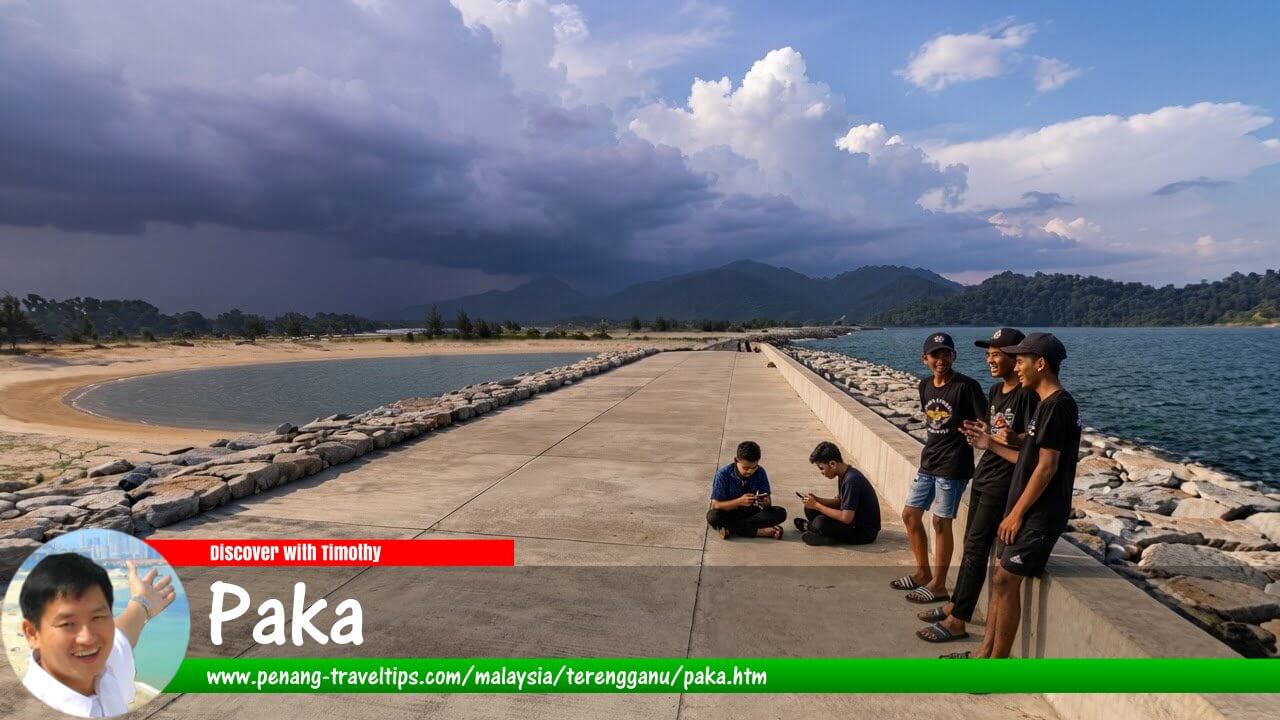 Paka Travel Guide: Teenages at the esplanade near the sea in Paka, Terengganu. (AI generated on 10 September 2026)
Also available: Panduan Melawat Paka
Paka is a coastal town in Dungun District, Terengganu, on the east coast of Peninsular Malaysia. Facing the South China Sea, it lies between Dungun to the north and Kerteh to the south. Although Paka is not a major resort destination, it is an interesting town to visit for its combination of coastal scenery, a riverine landscape, traditional settlement areas and its important role in Terengganu's petroleum and energy industries. The town also provides convenient access to beaches and turtle-conservation areas along the coast. Paka is about 95 km by road south of Kuala Terengganu, 21.5 km south of Dungun and about 15 km north of Kerteh.123
Quick Facts
- Location: Dungun District, Terengganu, Malaysia
- Setting: Coastal town on the South China Sea
- District: Dungun
- Nearby towns: Dungun to the north and Kerteh to the south
- Approximate road distance: 95 km to Kuala Terengganu, 21.5 km to Dungun and 15 km to Kerteh
- Main road: Federal Route 3, the principal coastal road along eastern Peninsular Malaysia
- Expressway access: Paka Interchange, Exit 849 of the East Coast Expressway (E8)
- Natural features: South China Sea, Sungai Paka and surrounding coastal lowlands
- Nearby conservation site: Ma'Daerah Turtle Conservation Centre
- Known for: Petroleum and gas-related activities, power generation, beaches and coastal communities
- Best suited for: Road trips, coastal exploration, local food and travellers interested in the industrial geography of Terengganu
Where is Paka?
Paka is situated in the southern part of Dungun District, roughly midway between Kuala Terengganu and the Kemaman district. The town occupies a coastal position beside the South China Sea, while the Sungai Paka provides the principal riverine feature around which the older settlement developed. The district boundary with Kemaman lies farther south, around the Kerteh and Kemasik area.
Administratively, Paka forms part of Dungun District, which is one of Terengganu's large districts. The Dungun Municipal Council states that its present administrative area covers the entire Dungun District and includes 11 mukim, among them Mukim Kuala Paka and Mukim Hulu Paka. Paka itself is recognised by the local authority as the district's other principal town after Kuala Dungun.4
For travellers, Paka is best understood as a working coastal town rather than a conventional beach resort. Its identity has been shaped by several overlapping landscapes: the old town and river, fishing and coastal villages, plantations and lowland countryside, and the large-scale energy and petroleum facilities that developed around Paka and neighbouring Kerteh.
Geography and Landscape
The landscape around Paka is predominantly low-lying and coastal. The South China Sea forms the eastern boundary, while Sungai Paka drains the interior before reaching the sea. The river has historically been important to settlement because waterways provided an easier means of movement and access before the development of modern roads.
Sungai Paka is one of the principal rivers of southern Dungun. Local historical accounts describe early settlement developing along the river, with communities occupying its banks and nearby areas. The river therefore helps explain why Paka developed where it did rather than being simply a roadside settlement established after the construction of modern highways.5
The coast around Paka consists mainly of sandy beaches and open stretches of shoreline. Pantai Paka is the most immediately accessible beach associated with the town. It is more useful as a place for a seaside walk, watching the sea and experiencing the local coastal environment than as a heavily developed resort beach.
The wider Paka area also contains a mixture of villages, agricultural land, wooded areas and industrial sites. This combination gives the locality a distinctive character: within a relatively short drive, a visitor can move from a traditional kampung landscape to a beach, a river crossing and a major industrial complex.
History of Paka
Paka's history predates its modern reputation as an oil and energy town. Historical references to Paka occur in accounts of the east coast of the Malay Peninsula, while the river and coastal location provided a natural basis for settlement and movement. The old settlement was considerably smaller than the present-day urban area, and local accounts recall Paka as a small town surrounded by villages before the rapid industrial development of the late 20th century.5
The development of modern Paka accelerated dramatically with the emergence of the petroleum industry in southern Terengganu. The Paka-Kerteh area became part of a major industrial zone associated with petroleum processing, gas processing, electricity generation and related industries. Government planning documents from the early 1980s already identified petroleum projects in the Paka-Kerteh area, including a refinery, gas-processing facilities and a power station at Paka.6
This industrial transformation changed the physical and economic character of the town. Paka became an important residential and service centre for workers associated with the energy industry, while its location along the coast and near Kerteh placed it within one of Terengganu's most important industrial corridors.
The Sultan Ismail Power Station
One of the most prominent symbols of Paka's industrial history was the Sultan Ismail Power Station. The original station was completed in 1987 and officially opened in 1988. At the time, it was described by Tenaga Nasional Berhad as the first combined-cycle power station in Southeast Asia and, when completed, the largest such power station built by the national electricity utility. It had an installed capacity of 1,400 MW.7
The original plant was decommissioned on 31 December 2019 after 33 years of operation. Its retirement marked the end of an important chapter in Paka's industrial history, although the site remains significant to the energy sector.7
The site is also associated with a new phase of development. TNB announced plans for a new 1,400 MW combined-cycle gas-turbine power plant at Paka, with hydrogen-ready technology. In 2026, TNB's corporate listings included a Letter of Notification for development of the new plant. Earlier planning had targeted completion around 2029, subject to the project's approvals and development schedule.89
Paka is also connected to the wider gas-processing network. PETRONAS Gas operates the Gas Processing Santong complex at Kampung Tok Arun, off Jalan Santong in Paka, illustrating how the town's industrial role extends beyond electricity generation into natural-gas processing and transmission.10
How Did Paka Get Its Name?
The origin of the name Paka is less clearly documented than that of some other towns in Terengganu. The name is shared by the town, the mukim and Sungai Paka, and it is therefore reasonable to regard the river as central to the historical place-name. However, a reliable authoritative source explaining the original linguistic meaning of the word Paka has not been firmly established.
For this reason, explanations that assign a specific meaning or legendary origin to the name should be treated cautiously. What is more certain is that Paka is an old geographical name in Terengganu, and that the river was important to the early development of the settlement. Local historical accounts describe the river as a major influence on the location and growth of early communities.5
Things to See and Do in Paka
Pantai Paka
Pantai Paka is the most obvious place to begin exploring the town. The beach provides an open view of the South China Sea and is particularly suitable for travellers who enjoy quiet coastal scenery rather than heavily commercialised seaside attractions.
The beach is also useful for understanding Paka's relationship with the sea. Fishing, coastal settlement and marine conservation form part of the wider identity of this section of the Terengganu coast. As with other east-coast beaches, sea conditions can become rough during the northeast monsoon, so visitors should exercise caution when swimming or approaching the water.
Sungai Paka
The Sungai Paka area offers a different perspective of the town. Rather than simply visiting Paka as a coastal stop, travellers can observe the river and the settlements around it, which provide clues to the town's older geographical character.
River crossings and the surrounding lowland landscape are particularly noticeable when travelling along the main road. The river also separates the older riverside environment from some of the newer residential and industrial development that has grown around Paka.
Ma'Daerah Turtle Conservation Centre
One of the most important environmental attractions near Paka is Ma'Daerah, a turtle conservation area on the coast between Paka and Kerteh. Administratively, Ma'Daerah is associated with Kerteh in Kemaman District, but its proximity makes it a natural excursion from Paka.
The Department of Fisheries Malaysia lists Ma'Daerah as one of the country's Turtle Conservation Centres. Such centres serve several purposes, including conservation, public education, hatchery activities and research. The local authority describes Ma'Daerah Beach as a turtle sanctuary and picnic area, with a turtle information and hatchery centre.1112
Visitors should remember that turtle conservation sites are working conservation areas rather than ordinary tourist beaches. Turtles and hatchlings should never be disturbed, and visitors should follow any restrictions or instructions in force when they arrive. The Department of Fisheries specifically advises the public not to disturb nesting turtles or hatchlings and not to consume or purchase turtle eggs or products.11
Nearby Beaches and Natural Areas
Paka is well placed for exploring the coastline of southern Dungun. Beaches such as Pantai Teluk Gadong, Pantai Teluk Bidara and the beaches around Dungun can be incorporated into a longer coastal drive. To the south, the Kerteh and Kemasik coastline provides additional beaches and coastal landscapes.
Travellers interested in inland nature can also consider Bukit Bauk, near Dungun. The forested area provides a contrast to Paka's coastal and industrial scenery and can be combined with a visit to Dungun itself.
Paka and the Petroleum Industry
The energy industry is impossible to overlook when considering modern Paka. The town lies immediately north of Kerteh, one of Malaysia's most important petroleum and petrochemical centres. Gas-processing facilities, pipelines, power generation and industrial plants have created a continuous economic landscape extending across the Paka-Kerteh area.
PETRONAS Gas states that its Gas Processing Santong facilities are located at Kampung Tok Arun, Paka, while its wider Terengganu operations include the Gas Processing Kertih complex. The processed gas supplies power generation and industrial customers, including the petrochemical sector.10
For visitors, most industrial facilities are working sites rather than tourist attractions, and access is restricted. Their significance is instead best understood from the public roads around the town. The industrial landscape helps explain why Paka grew much more rapidly during the late 20th century than might otherwise be expected for a small coastal settlement.
Where to Stay in Paka
Paka has a modest range of accommodation suitable for travellers making a short stop, visiting the energy sector or using the town as a base for exploring the southern Dungun coast. The Dungun Municipal Council's current accommodation directory includes establishments in Paka such as Paka Inn, Hotel Dida Dz Inn, SG Paka Hotel, Hotel Santong, Qisya Hotel and The Qamar, as well as beach and chalet accommodation in the wider Dungun area.13
For most independent travellers, staying in Paka is convenient if the main interests are the Paka-Kerteh industrial area, nearby beaches or Ma'Daerah. Travellers looking for a larger selection of hotels, restaurants and tourist facilities may prefer to stay in Dungun, about 20–25 km to the north.
Accommodation availability can change, particularly among smaller hotels and guesthouses, so it is advisable to confirm current operating status and facilities before travelling.
What to Eat in Paka
Food in Paka reflects the wider cuisine of Terengganu. Visitors can expect nasi dagang, nasi kerabu, keropok lekor, sata, grilled fish, seafood and various traditional Malay kuih. The coastal location means that fish and other seafood feature prominently in local eating habits.
For a more local experience, look for small restaurants, roadside stalls and evening food markets rather than expecting a concentrated tourist dining district. The Paka night market is currently held on Wednesdays and Saturdays, from 5.00pm to midnight, according to the Dungun Municipal Council.14
As elsewhere in Terengganu, market food is a good opportunity to try regional snacks and inexpensive meals in an informal setting. Popular choices may include keropok lekor, fried snacks, grilled seafood, rice dishes and local desserts.
How to Get to Paka
By Car
For most visitors, driving is the easiest way to reach Paka. The town is served by Federal Route 3, the main coastal highway connecting towns along the east coast of Peninsular Malaysia.
From Kuala Terengganu, Paka is approximately 95 km south by road, with a normal driving time of around 1 hour 25 minutes, although actual journey time depends on traffic and road conditions.2
Travellers using the East Coast Expressway (E8) can leave at Exit 849, Paka Interchange. The interchange connects to Jalan Jerangau-Jabor Penghantar 5, also known as Terengganu State Route T22. From the interchange, travelling east leads towards Paka, while the westbound direction serves Bandar Ketengah Jaya and other inland settlements.15
The Paka Interchange is particularly useful for visitors arriving from Kuala Lumpur, Kuantan and the interior of Pahang. It also provides an alternative to travelling the entire distance along Federal Route 3.
By Bus
Long-distance buses serve Paka, although Dungun has the principal express-bus terminal for the district. The Dungun Municipal Council lists operators such as Utama Express, Mutiara Express, Mara Liner and Transnasional among the services serving the district.16
There are also bus services linking Paka with Kuala Terengganu and other east-coast towns. Current ticketing information shows direct services between Paka and Kuala Terengganu, with journey times generally around two hours depending on the service and route.17
Paka is also connected by bus with Dungun, although travellers should check current schedules before departure because service frequency varies.
By Air
The nearest major commercial airport is Sultan Mahmud Airport near Kuala Terengganu. From the airport, travellers can continue south by road towards Paka. Because Paka is nearly 100 km from Kuala Terengganu, a rental car, taxi or pre-arranged transfer is generally more practical than relying on several local transport connections.
Travellers should also note that Kerteh Airport is geographically much closer to Paka. However, its usefulness depends on the availability of commercial flights at the time of travel, so flight schedules should be checked before making plans around it.
Getting Around Paka
Paka is compact enough to explore by car or motorcycle, but a private vehicle is the most practical option for visitors who want to see the beach, river, villages and nearby conservation areas. Local taxis and passenger vans form part of the wider Dungun district's public-transport network, although services are less frequent than in major Malaysian cities.16
Walking is practical around the central commercial area, particularly for short trips to shops and food outlets, but the town is spread out enough that the beach and more distant attractions are better reached by vehicle.
Paka and the East Coast Rail Link
Paka will not have its own ECRL station. The current East Coast Rail Link alignment provides stations at Dungun and Kemasik on either side of the Paka-Kerteh area. In Terengganu, the six ECRL stations are Jerteh, Bandar Permaisuri, Kuala Terengganu, Dungun, Kemasik and Chukai. Dungun and Chukai are planned as passenger-and-cargo stations, while the others serve passengers only.18
The ECRL's first phase between Kota Bharu and Gombak is scheduled for completion in December 2026 and operation from January 2027, according to Malaysia Rail Link. For a visitor to Paka, the Dungun or Kemasik stations may eventually provide useful rail connections, although onward road transport will still be required to reach the town.18
How Long Should You Spend in Paka?
One night is sufficient for most visitors who simply want to experience Paka itself. A short stay allows time to visit Pantai Paka, explore the town and river area, eat locally and continue along the coast.
Paka becomes more useful as a base if you want to explore the surrounding region. A two-day itinerary could combine Paka with Ma'Daerah, Kerteh, Kemasik and selected beaches, while a longer trip could include Dungun, Bukit Bauk, Rantau Abang and other attractions in the wider Dungun District.
Suggested One-Day Paka Itinerary
- Morning: Explore central Paka and the older settlement areas around Sungai Paka.
- Late morning: Visit Pantai Paka and spend some time along the coast.
- Lunch: Try a local Terengganu rice dish or seafood meal.
- Afternoon: Drive south towards the Paka-Kerteh area and, if access is available, visit the Ma'Daerah turtle conservation area.
- Late afternoon: Return to Paka for a quiet coastal stop or explore the surrounding villages.
- Evening: Visit the Paka night market if travelling on Wednesday or Saturday, or have dinner at a local restaurant.
Best Time to Visit Paka
The east coast of Peninsular Malaysia is affected by the northeast monsoon, which normally brings wetter and rougher conditions to Terengganu from roughly November through February or early March. For beach activities and coastal sightseeing, the drier months are generally more comfortable.
Nevertheless, Paka can be visited throughout the year. During wetter periods, the town's river, villages, food outlets and industrial landscape remain accessible, although sea conditions may make swimming and other water activities unsuitable.
Practical Tips for Visitors
- Use a car if possible: A private vehicle makes it much easier to explore Paka and neighbouring coastal areas.
- Check beach conditions: Sea conditions can change quickly, particularly during the northeast monsoon.
- Respect turtle-conservation rules: Do not disturb turtles, hatchlings or protected areas.
- Do not enter industrial facilities: Petroleum, gas and power-generation sites are working facilities and are not ordinary tourist attractions.
- Carry cash: Small food stalls and night-market vendors may not accept cards or electronic payments.
- Check accommodation availability: Paka has fewer hotels than larger towns such as Kuala Terengganu or Dungun.
- Plan onward transport: If travelling without a car, check bus and taxi arrangements in advance, particularly for trips to beaches and conservation sites.
Paka as a Travel Destination
Paka is not a town that depends on a long list of conventional tourist attractions. Its interest lies instead in the way several aspects of Terengganu come together in one relatively compact area. The town has a traditional coastal setting, a river that influenced its early settlement, beaches facing the South China Sea, and a modern industrial landscape created by the petroleum and energy sectors.
For visitors travelling along the east coast, Paka provides an opportunity to see a different side of Terengganu beyond the state's better-known beaches and heritage destinations. The nearby Ma'Daerah conservation area adds an environmental dimension, while the Paka-Kerteh industrial corridor illustrates the importance of petroleum and natural gas to the modern development of the state.
Its location also makes Paka a practical stopping point between Dungun and Kerteh. Travellers interested in the geography and economic development of Malaysia's east coast will find the town particularly informative, while those simply making a coastal road trip can use it as a convenient place to eat, rest and explore the shoreline.
In short, Paka is a working coastal town rather than a conventional resort town. Its beaches, river, local food, conservation areas and industrial history make it worthwhile for travellers who want to understand the less-touristed parts of Terengganu.
References
- Paka, Terengganu — Penang Travel Tips
- Rome2Rio — Paka to Kuala Terengganu
- Rome2Rio — Paka to Kerteh
- Majlis Perbandaran Dungun — Info Dungun
- Paka Indah — Sungai Paka dan Sejarah Perkembangan Penduduk
- Japan International Cooperation Agency — Socio-Economic Framework and Industrial Projects
- Tenaga Nasional Berhad — Sultan Ismail Power Station Decommissioned After 33 Years
- Tenaga Nasional Berhad — Corporate Listings, including Paka Power Plant Notification
- Tenaga Nasional Berhad — Integrated Annual Report 2024
- PETRONAS Gas Berhad — Our Presence
- Department of Fisheries Malaysia — Management of Marine Parks, Turtle Centres and Sanctuaries
- Majlis Perbandaran Kemaman — Ma' Daerah Beach
- Majlis Perbandaran Dungun — Accommodation
- Majlis Perbandaran Dungun — Night Markets
- East Coast Expressway (E8) — Penang Travel Tips
- Majlis Perbandaran Dungun — Transportation
- CheckMyBus — Paka to Kuala Terengganu
- Malaysia Rail Link — ECRL Terengganu Stations and Project Schedule
Page Details
This page was created on 11 September 2026. Hi, my name is Timothy and created it from my research, for my own entertainment, knowledge and to satisfy my curiosity. I am providing the information to you in good faith and hope it is useful. I try to get the details as accurate as possible. I also try to update the page whenever I stumble on new details. So this and all my other pages are perpetual work in progress. If you discover any error, please politely inform me, pointing out where the error lies, and I will correct it as soon as possible. Your helpfulness will keep this page accurate, relevant and helpful to those who need the information.Buy Me A Coffee
If you enjoy the information I provide and want to support the work I do, please buy me a coffee! I appreciate it immensely, thank you so much!
