
Chung Keng Quee 鄭景貴
Chung Keng Quee (鄭景貴, Zhèng Jǐngguì) was one of the most influential Chinese figures in 19th-century British Malaya. Born in Guangdong, China, he migrated to Penang as a young man and rose from humble beginnings to become a wealthy tin magnate, a secret society leader, and the Kapitan Cina of Perak. His story is emblematic of the Chinese migrant experience during the colonial era, blending entrepreneurship, conflict, and community leadership.
Hakka Origins in Guangdong
Chung Keng Quee was born in Zengcheng (增城, Zēngchéng) in Guangdong Province, China. A member of the Hakka ethnic group, his early years were marked by hardship in southern China, which was beset by population pressures and economic difficulties. Like many Hakka migrants of his generation, Chung left his homeland in search of better fortunes in Southeast Asia, known as Nanyang (南洋, "South Seas").
Early Years in Penang
Arriving in Penang in the mid-19th century, Chung began as a small-time trader and miner. He integrated into Penang's Chinese community and soon joined the Hai San secret society, a powerful organization originally dominated by Cantonese members but increasingly led by Hakka migrants in Perak. Chung's leadership abilities and strategic acumen allowed him to ascend rapidly within the Hai San ranks.
Leadership of the Hai San Society
Under Chung's leadership, the Hai San Society became a dominant force in the tin-rich Larut district of Perak. The society controlled thousands of Chinese miners and functioned as both a labor organization and a paramilitary force. Chung Keng Quee became known as the 'Shanzhu' (山主), or 'Leader of the Mountain,' reflecting his command over the Hai San network.
The Larut Wars
The Hai San's dominance was challenged by the rival Ghee Hin Society (義興, Yìxìng), whose local factions, including significant Cantonese elements, contested the tin mining territories. The result was a series of bloody conflicts known as the Larut Wars, fought between 1861 and 1874. These wars devastated the tin mining economy and caused widespread disruption throughout Perak.
Chung Keng Quee proved to be both a formidable military leader and a pragmatic negotiator. Despite commanding armed miners in battle, he sought alliances and solutions that would benefit the Chinese community and protect his economic interests.
The Pangkor Treaty and Appointment as Kapitan Cina
British intervention brought an end to the Larut Wars in 1874. Chung Keng Quee participated in negotiations that resulted in the Pangkor Treaty, which not only resolved Malay succession disputes but also mandated peace between Chinese secret societies. Recognizing his leadership, the British appointed Chung as the Kapitan Cina of Perak, an official title granting him authority over the Chinese community in the state.
Throughout Perak's history, only two individuals held the title of Kapitan Cina: Chung Keng Quee and his son, Chung Thye Phin (鄭大平, Zhèng Dàpíng), who became the last Kapitan Cina of Perak and British Malaya.
Wealth and Business Empire
Chung’s wealth grew through extensive tin mining operations centered around Taiping and Kamunting. He expanded his investments in property and commerce, particularly in Penang, where he chose to base much of his business activities. His grand mansion, Hai Kee Chan, located on Church Street in George Town, Penang, became a symbol of his success.
Today, his mansion has been preserved as the Pinang Peranakan Mansion, a popular museum that celebrates Straits Chinese culture. His name endures in Penang through Ah Quee Street and Keng Kwee Street, both named in his honor.
Community Leadership and Philanthropy
As Kapitan Cina, Chung Keng Quee played a crucial role in community development. He donated generously to Chinese schools, temples, and clan associations. His support helped foster Hakka identity and community cohesion, while also contributing to wider Chinese society in Malaya.
He participated in charitable works, funded disaster relief efforts, and contributed to religious and cultural activities, elevating the status of the Chinese community in the eyes of both the British administration and the local Malay population.
Decline of Secret Societies and Final Years
In his later years, the influence of secret societies waned as the British implemented policies to suppress their power. The Societies Ordinance of 1889 was a key step in this effort. Chung, however, had already shifted his focus from secret society leadership to legitimate business and community roles.
He passed on much of his responsibilities to his son, Chung Thye Phin, who continued the family’s business empire and public leadership.
Death and Enduring Legacy
Chung Keng Quee died in 1901. His funeral was attended by a wide cross-section of Penang society, reflecting his prominence. His legacy remains visible in Penang's streets, historical landmarks, and the memories of the Chinese community he helped shape.
From warlord and secret society leader to respected businessman and community patriarch, Chung Keng Quee's life embodies the complex story of Chinese migration and enterprise in 19th-century Malaya.
Related Pages
- Kapitan Chung Keng Quee's Tomb
- Hai Kee Chan, former residence of Kapitan Cina Chung Keng Quee
- Keng Kwee Street, street famous for its street food, particularly the Teochew cendol.
- Ah Quee Street
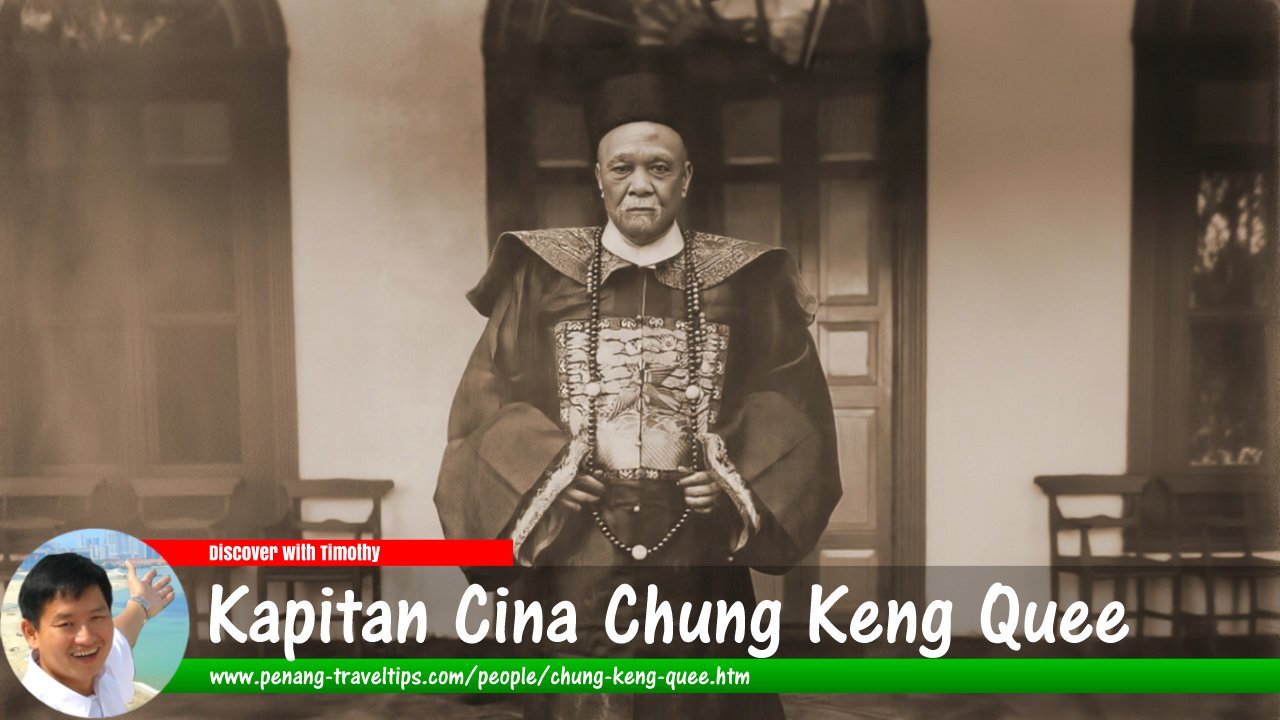 Kapitan Cina Chung Keng Quee
Chung Keng Quee, the Hakka Kapitan of Perak
In search of the Tomb of Kapitan Chung Keng Quee
Page Details
This page was created on 22 July 2025. Hi, my name is Timothy and created it from my research, for my own entertainment, knowledge and to satisfy my curiosity. I am providing the information to you in good faith and hope it is useful. I try to get the details as accurate as possible. I also try to update the page whenever I stumble on new details. So this and all my other pages are perpetual work in progress. If you discover any error, please politely inform me, pointing out where the error lies, and I will correct it as soon as possible. Your helpfulness will keep this page accurate, relevant and helpful to those who need the information.Famous People of Penang | Penang History
Want to share your Penang travel experiences or get tips from fellow travellers?
Join the Penang Travel Tips Facebook GroupUseful guides for visiting Penang
My Videos of Penang
 Latest Pages & Updates
Buy Me A Coffee
If you enjoy the information I provide and want to support the work I do, please buy me a coffee! I appreciate it immensely, thank you so much!
