
The Victoria Line of the London Underground
Overview of the Victoria Line
The Victoria Line is one of the most essential and fastest lines on the London Underground network. Renowned for its speed and efficiency, it connects several major transport hubs and neighborhoods across north and south London.Named after Queen Victoria, the line forms a north-south spine through central London, making it a key route for commuters, tourists, and residents alike.
Geography and Route
The Victoria Line runs from Brixton in south London to Walthamstow Central in the northeast. It covers a distance of approximately 13.2 miles (21.2 km).The line crosses the River Thames and travels through the heart of central London, including key destinations such as Victoria, Green Park, and Oxford Circus. Its mostly underground route contributes to its reputation for fast, uninterrupted service.
Stations and Interchanges
There are 16 stations on the Victoria Line, and remarkably, all of them offer interchanges with other London Underground lines, national rail, or Overground services.- Walthamstow Central Tube Station (Travelcard Zone 3)
- Blackhorse Road Tube Station (Travelcard Zone 3)
- Tottenham Hale Tube Station (Travelcard Zone 3)
- Seven Sisters Tube Station (Travelcard Zone 3)
- Finsbury Park Tube Station (Travelcard Zone 2) is an interchange with the Piccadilly Line
- Highbury & Islington Tube Station (Travelcard Zone 2)
- King's Cross St Pancras Station (Travelcard Zone 1) is an interchange with the Circle Line, Hammersmith & City Line, Metropolitan Line, Northern Line, and Piccadilly Line.
- Euston Tube Station (Travelcard Zone 1) is an interchange with the Northern Line
- Warren Street Station (Travelcard Zone 1) is an interchange with the Northern Line
- Oxford Circus Station (Travelcard Zone 1) is an interchange with the Central Line
- Green Park Station (Travelcard Zone 1) is an interchange with the Piccadilly Line
- Victoria Station (Travelcard Zone 1) is an interchange with the Circle Line and District Line
- Pimlico Station (Travelcard Zone 1)
- Vauxhall Tube Station (Border of Travelcard Zone 1 & 2)
- Stockwell Tube Station (Travelcard Zone 2) is an interchange with the Northern Line
- Brixton Tube Station (Travelcard Zone 2)
History of the Victoria Line
The Victoria Line was one of the newest additions to the London Underground system. Construction began in the early 1960s, and it officially opened in 1968.It was the first entirely new underground line in central London in more than 50 years. The line was built to relieve congestion on other lines and to connect key areas that lacked direct service. The line opened in stages:
- 1968: The first section from Walthamstow Central to Highbury & Islington.
- 1969: Extension to Warren Street and Victoria.
- 1971: Final extension to Brixton completed.
Why Is It Called the Victoria Line?
The line takes its name from Victoria Station, which is one of its major stops. Victoria Station itself is named after Queen Victoria, the British monarch who reigned from 1837 to 1901.The name "Victoria Line" was chosen during the planning stages in the 1950s and was officially adopted during the construction and early operation in the 1960s.
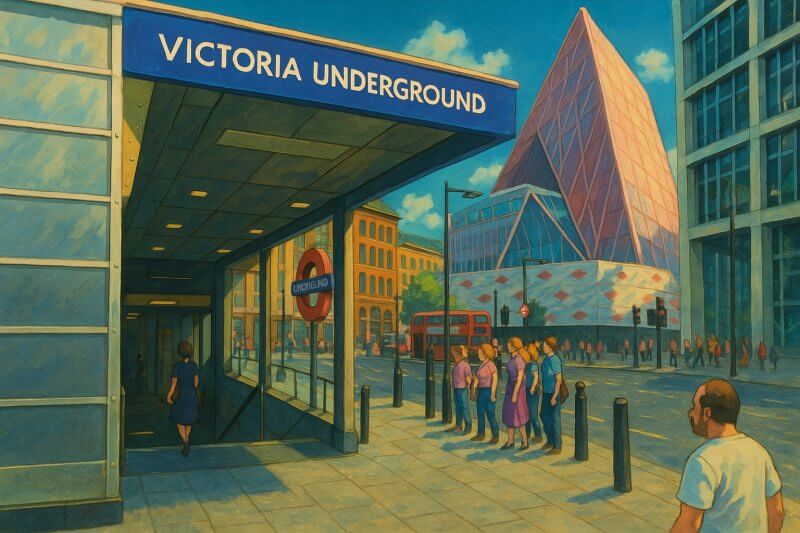
Painting of entrance to the Victoria Station (View full-size image here)
Areas and Neighbourhoods Served
The Victoria Line connects a wide variety of London areas, offering a quick link between suburban zones and the city centre.From north to south, it serves:
- Walthamstow and Tottenham – Residential areas in northeast London.
- Seven Sisters and Finsbury Park – Diverse, vibrant communities with national rail connections.
- Highbury & Islington – Trendy and well-connected.
- King’s Cross and Euston – Major transport hubs and knowledge centres.
- Oxford Circus – The heart of London's West End shopping district.
- Green Park and Victoria – Close to Buckingham Palace and government buildings.
- Pimlico – A quieter residential area.
- Brixton – A culturally rich and energetic part of south London.
Speed and Efficiency
The Victoria Line is known for being the fastest line in the Underground system. This is largely due to:- Automatic Train Operation (ATO), which was implemented in the 1960s and upgraded in the 2000s.
- Long straight sections that allow for high-speed travel.
- Minimal service interruptions since it doesn't share track with other lines.
Fun Facts About the Victoria Line
- It was the **first automatic railway** in the UK, with drivers simply supervising operations rather than manually driving the train.
- At **Pimlico station**, you’ll find unique tile art inspired by the Tate Britain art gallery nearby.
- Each station on the line has a distinctive tile motif, designed to help illiterate or non-English-speaking passengers identify stations by artwork alone.
- Despite being fully underground, the Victoria Line is surprisingly **one of the least delayed** lines on the network.
- Oxford Circus is the **busiest station on the line**, particularly during the holiday shopping season.
Conclusion
The Victoria Line is much more than just a method of getting from A to B. It’s a key artery through the beating heart of London, connecting neighbourhoods, linking people to major landmarks and workplaces, and helping tourists explore the city with ease. Whether you're commuting from Walthamstow, exploring museums near Green Park, or heading out for a night in Brixton, the Victoria Line is an indispensable part of London life.Map of London Underground
List of London Underground Lines
Want to share your London travel experiences or get tips from fellow travellers?
Join the London Travel Tips Facebook GroupMore information for visiting London
Here are some related articles to help you get to know London better.- Cost of Living in London: Discover the true cost of living in London, including housing, transport, groceries, and more - plus tips for budgeting in one of the world's most expensive cities.
- Driving in London: Planning to drive in London? Learn about roads, car rentals, parking, tolls, and key tips for tourists and visitors from outside the capital.
- Driving Tips for Visiting London: Thinking of driving to London? Discover the best times to travel, congestion tips, parking apps, breakdown help, and petrol advice for a smoother journey.
- Evolution of London's Streets: Discover the fascinating history of how London's streets developed from ancient footpaths to today's complex network of roads across the capital.
- History of Immigration to London: Discover the rich history of immigration to London, from Huguenots to Bangladeshis, and how diverse communities have shaped the city's vibrant identity.
- How Big Is London Compared to Other World Cities?
- How London's Streets Measure Up: A Global Comparison of Road Widths
- How Streets of London are Named: Discover how London streets get their names, who decides them, and how historic, political, and public influences shape street naming in the capital.
- How the Grosvenor Family Came to Own Much of Mayfair, Belgravia and Pimlico: Explore how the Grosvenor family came to own much of Mayfair, Belgravia, and Pimlico, and learn about their historical connection (or lack thereof) with the British royal family and government.
- Living and working in London
- London's Quiet Collapse: How Living Standards Fell as Costs Skyrockted (1975-2025): Explore how London residents endured rising costs and falling living standards from 1975 to 2025 - from rocketing rents to wage stagnation and inflation.
- Marvel of the London Underground: Discover the history, challenges, and triumphs of the London Underground - the world's first underground railway and a vital transport lifeline for the UK capital since 1863.
- Moving to London: Expat Tips for Settling in Westminster: Essential advice for expats moving to London's Westminster: neighborhood insights, cost of living, transportation, housing, healthcare, schools, and tips to help you feel at home in the heart of the city.
- Places in London that aren't pronounced the way they're spelled
- Shopping in London: Discover London's diverse shopping scene
- Taking the bus in London: This is your complete guide to taking the bus when in London.
- The Anglican Faith: A Visitor's Guide to the Church of England: Learn about the Anglican faith and its deep ties to London's landmarks like Westminster Abbey and St Paul's Cathedral.
- Top 10 London Streets Every Visitor Must See: Discover London through its most iconic thoroughfares - 10 streets every visitor must experience. From historic Abbey Road to vibrant Camden High Street, explore culture, shopping, and hidden gems.
- Why are most roads in Central London so narrow? Learn why there are so few multi-lane roads and elevated highways in the heart of the city.
 Latest Pages & Updates
Buy Me A Coffee
If you enjoy the information I provide and want to support the work I do, please buy me a coffee! I appreciate it immensely, thank you so much!
