
Alor Setar
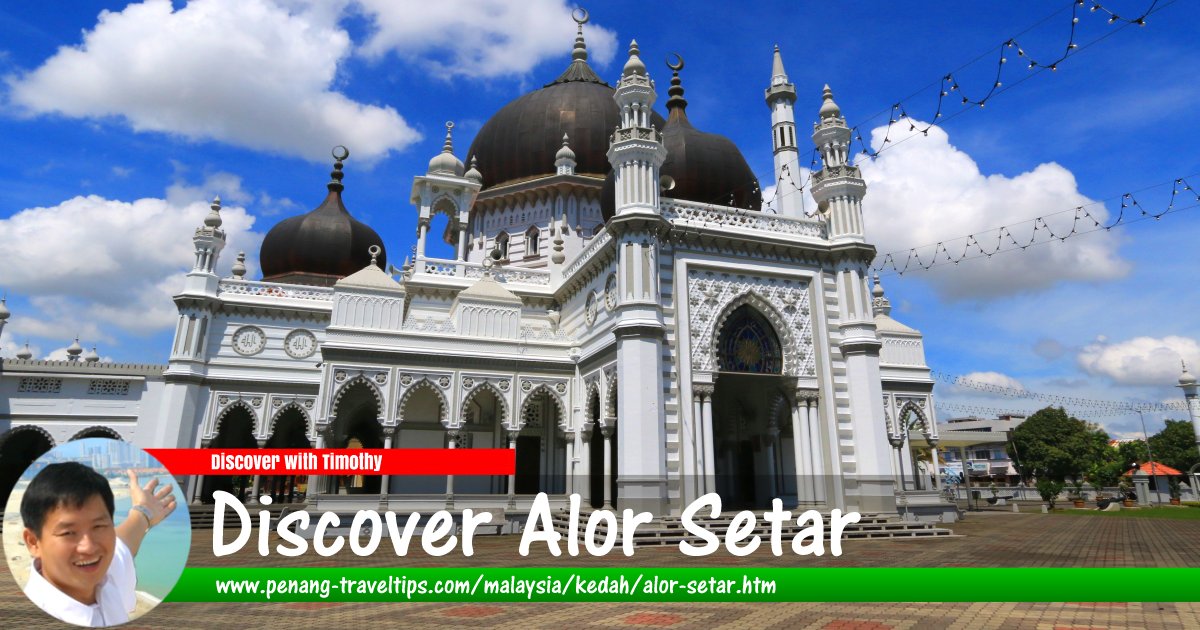 Alor Setar (10 November, 2015)
Alor Setar
Alor Setar (GPS: 6.12587, 100.37109) is the capital city of the state of Kedah, located in the northwestern part of Peninsular Malaysia. As one of the oldest cities in the country, it serves as the administrative, political, and cultural centre of Kedah. The city is often regarded as the heart of the “Rice Bowl of Malaysia” due to its close association with vast paddy fields that dominate the surrounding landscape.
While Alor Setar is not a large metropolis, it plays a significant role in Malaysia’s history and governance. The city is known for its royal heritage, traditional Malay culture, and relaxed pace of life, offering visitors and residents a distinct contrast to Malaysia’s larger urban centres.
History
Alor Setar was founded in 1735 by Sultan Muhammad Jiwa Zainal Adilin II, the 19th Sultan of Kedah. Originally named Alor Setar, the name is believed to derive from a small stream (“alor”) and the setar tree, which was common in the area at the time. From its early days, the settlement functioned as an important administrative hub for the Kedah Sultanate.
Throughout its history, Alor Setar has witnessed periods of Siamese influence, British colonial administration, and Japanese occupation during the Second World War. Despite these changes, the city retained its importance as Kedah’s seat of power. Many historical buildings, royal structures, and colonial-era landmarks still stand today, reflecting the city’s layered past.
Alor Setar is also notable as the birthplace of several prominent Malaysian figures, including Malaysia’s fourth and seventh Prime Minister, Tun Dr Mahathir Mohamad, further cementing its place in the nation’s modern political history.
Geography and Climate
Geographically, Alor Setar is situated on a flat coastal plain near the northern reaches of Peninsular Malaysia, close to the border with Thailand. The city lies inland from the Strait of Malacca and is surrounded by expansive agricultural land, particularly rice fields irrigated by an extensive network of canals and rivers.
One of the most prominent natural features visible from the city is Gunung Keriang, a limestone hill rising sharply from the otherwise flat terrain. This landmark has become one of Alor Setar’s most recognisable geographical features.
Alor Setar experiences a tropical rainforest climate, characterised by consistently warm temperatures and high humidity throughout the year. Rainfall is common, especially during the monsoon seasons, which play an important role in sustaining Kedah’s agricultural activities.
Administration and Economy
As the state capital, Alor Setar houses the main administrative offices of the Kedah state government, including the royal palace and key government institutions. The city functions primarily as a centre for public administration, education, and services.
The local economy is closely tied to agriculture, particularly rice cultivation, which has long been the backbone of Kedah’s economy. In addition to agriculture, Alor Setar supports retail, healthcare, education, and small-scale manufacturing. Its role as a regional service centre makes it an important hub for surrounding rural communities.
Culture and Lifestyle
Alor Setar is deeply rooted in traditional Malay culture, with strong influences from royal customs, Islamic heritage, and rural Kedahan traditions. The city is known for its mosques, traditional architecture, and cultural events linked to the Kedah Sultanate.
The local lifestyle is generally slower-paced compared to major Malaysian cities, contributing to Alor Setar’s reputation as a calm and approachable destination. Local cuisine, particularly dishes associated with northern Malaysian flavours, forms an important part of daily life and cultural identity.
Transportation and Accessibility
Alor Setar is well connected to other parts of Peninsular Malaysia by road and rail, serving as an important gateway to northern Malaysia. The city is also served by Sultan Abdul Halim Airport, which provides domestic air connections and supports regional travel.
Within the city, transportation primarily consists of private vehicles, taxis, and limited public transport services. Its compact urban layout makes many central attractions relatively easy to access.
Role as a Visitor Destination
As a visitor destination, Alor Setar appeals to travellers interested in history, royal heritage, and authentic northern Malaysian culture. The city acts as a base for exploring Kedah’s historical sites, religious landmarks, and natural attractions, as well as nearby destinations such as Langkawi.
Today, Alor Setar continues to balance its historical legacy with modern development, maintaining its identity as a royal capital, administrative centre, and cultural heart of Kedah.
Map of Alor Setar
What to eat in Alor Setar
- Curry Mee at Telok Wanjah (GPS: 6.123378, 100.370774) in Alor Setar was recommended by Chang Chee Meng on 5 September, 2019
- Satay at Malay stalls in front of Grand Alora Hotel (GPS: 6.129536, 100.342032) in Alor Setar was recommended by Chang Chee Meng on 29 August, 2019
- Popiah Jamal at Tesco Mergong Food Court (GPS: 6.129122, 100.342641) was recommended by Chang Chee Meng on 28 August, 2019
Sights in Alor Setar
- Alor Setar Chinese Methodist Church (GPS: 6.12679, 100.3676)

- Balai Besar (GPS: 6.11991, 100.36648)

- Balai Nobat (GPS: 6.12099, 100.3666)

- Balai Seni Negeri (GPS: 6.11877, 100.36558)

- Bangunan Jam Besar (GPS: 6.12118, 100.36589)

- Church of St Michael (GPS: 6.11759, 100.37463)

- Dewan Perhimpunan Melayu Kedah (GPS: 6.1272, 100.36802)

- Gunung Keriang (GPS: 6.19107, 100.33074)

- Istana Anak Bukit (GPS: 6.20982, 100.43186)

- Istana Kuning (GPS: 6.1237, 100.36813)

- Istana Sepachendera, Kampung Baru (GPS: 6.12301, 100.36955)

- Istana Tunku Kudin, Bukit Pinang (GPS: 6.20982, 100.43186)

- Kedah Paddy Museum (GPS: 6.19107, 100.32648)

- Kedah State Museum (GPS: 6.13609, 100.36885)

- Mahathir's Birth House (GPS: 6.11325, 100.36287)

- Galeri Sultan Abdul Halim Muadzam Shah (GPS: 6.12139, 100.36692)

- Masjid Albukhary (GPS: 6.13244, 100.38729)

- Masjid Zahir (GPS: 6.12033, 100.36515)

- Menara Alor Setar (GPS: 6.12444, 100.3674)

- Muzium Diraja Negeri Kedah (GPS: 6.11945, 100.36688)

- Pusat Akuatik Negeri Kedah (GPS: 6.18978, 100.32327)

- Pusat Sains Negara Wilayah Utara (GPS: 6.19157, 100.32384)

- Rumah Merdeka (GPS: 6.12304, 100.36003)

- Pekan Cina-Pekan Melayu Arch (GPS: 6.11574, 100.36362)

- Taman Jubli Emas (GPS: 6.16438, 100.36103)

- Taman Rekreasi Gunung Keriang (GPS: 6.18816, 100.33408)

- Tugu 0 KM (GPS: 6.11682, 100.36545)

- Tugu Pahlawan (GPS: 6.14733, 100.37291)

- Tunku Abdul Rahman Mural (GPS: 6.11679, 100.36429)

- Wan Muhammad Saman Building (GPS: 6.11881, 100.36629)

Streets in Alor Setar
- Jalan Anak Bukit
- Jalan Gangsa
- Jalan Gunung Keriang
- Jalan Istana Lama
- Jalan Langgar
- Jalan Menanti
- Jalan Pintu Sepuluh
- Jalan Putra
- Jalan Raja
- Jalan Sekerat
- Jalan Selamat
- Jalan Stadium
- Jalan Sultan Bahishah
- Jalan Sultan Muhammad Jiwa
- Jalan Teluk Wanjah
- Jalan Tengah
- Jalan Tun Razak
- Jalan Tunku Bendahara
- Jalan Tunku Ibrahim
- Lebuhraya Darul Aman
- Lebuhraya Sultan Abdul Halim
- Lebuhraya Sultanah Bahiyah
- Persiaran Sultan Abdul Hamid
- Taman Tunku Habsah
Places in Alor Setar
- Pekan Cina (GPS: 6.11881, 100.36629)

- Pekan Melayu (GPS: 6.11649, 100.36418)

- Tanjung Chali (GPS: 6.11703, 100.36218)

Category of Sights in Alor Setar
- Bakeries in Alor Setar
- Bridges in Alor Setar
- Churches in Alor Setar
- Coffee Shops in Alor Setar
- Government Buildings in Alor Setar
- Hindu temples in Alor Setar
- Historic buildings in Alor Setar
- Hospitals in Alor Setar
- Hotels in Alor Setar
- Monuments in Alor Setar
- Mosques in Alor Setar
- Museums in Alor Setar
- Palaces in Alor Setar
- Parks in Alor Setar
- Schools in Alor Setar
- Shopping malls in Alor Setar
- Stadiums in Alor Setar
- Streets in Alor Setar
- Thai Temples in Alor Setar
- Tourist Attractions in Alor Setar
Eateries in Alor Setar
- Nasi Lemak Ong (GPS: 6.1231, 100.36339)
Petrol Stations in Alor Setar
- Petronas Jalan Putra, Alor Setar (GPS: 6.123613, 100.360800)
- Petronas Jalan Putra, Mergong (GPS: 6.13782, 100.34033)
Banks in Alor Setar
- Bank Simpanan Nasional Main Branch (GPS: 6.119125, 100.368131)
- Bank Simpanan Nasional Mergong (GPS: 6.125837, 100.357399)
Airports in Alor Setar
- Alor Setar Airport (GPS: 6.19186, 100.39506)

Residential Properties in Alor Setar
- Amansuri Residences (GPS: 6.12936, 100.36712)

Other interesting sights in Alor Setar
Page Details
This page was created on 27 December 2025. Hi, my name is Timothy and created it from my research, for my own entertainment, knowledge and to satisfy my curiosity. I am providing the information to you in good faith and hope it is useful. I try to get the details as accurate as possible. I also try to update the page whenever I stumble on new details. So this and all my other pages are perpetual work in progress. If you discover any error, please politely inform me, pointing out where the error lies, and I will correct it as soon as possible. Your helpfulness will keep this page accurate, relevant and helpful to those who need the information.Want to share your Kedah travel experiences or get tips from fellow travellers?
Join the Kedah Travel Tips Facebook GroupKedah Streets & Sights
Buy Me A Coffee
If you enjoy the information I provide and want to support the work I do, please buy me a coffee! I appreciate it immensely, thank you so much!
