
Jalan Tun HS Lee, Kuala Lumpur
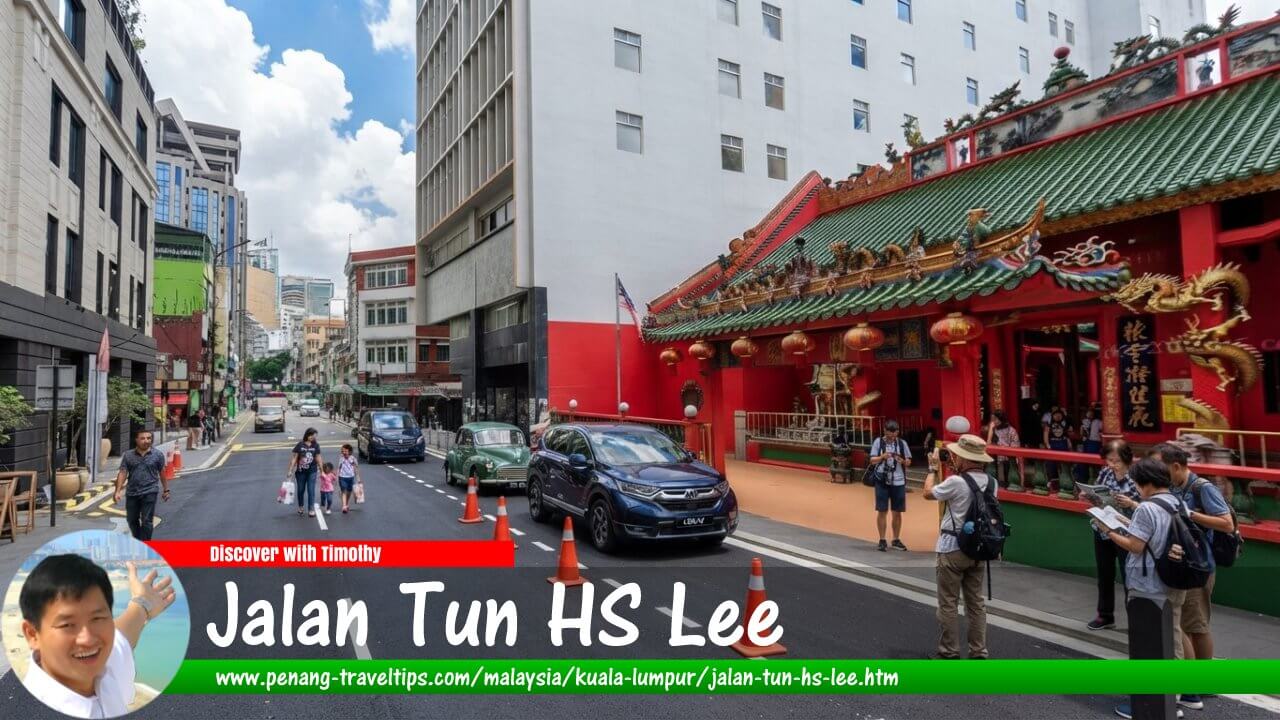 Jalan Tun HS Lee, Kuala Lumpur (AI Edited on 16 July 2026)
Jalan Tun HS Lee is one of the oldest, longest and most historically significant roads in Kuala Lumpur. Running for approximately one kilometre through the heart of the city's historic core, it links the civic quarter near Jalan Gereja with Chinatown before continuing south towards Jalan Kinabalu. Originally known as High Street during the colonial era, and later as Jalan Bandar, the road has witnessed almost every stage of Kuala Lumpur's development—from the muddy frontier town established during the tin-mining boom of the 1850s to the modern metropolis it has become today. Lined with temples, heritage shophouses, old businesses, budget hotels and colourful streetscapes, Jalan Tun HS Lee remains one of the best places to experience the city's multicultural heritage on foot.1
Quick Facts
- Former names: High Street, Jalan Bandar
- Current name: Jalan Tun HS Lee
- Named after: Tun Henry Lee Hau Shik, Malaysia's first Finance Minister
- Length: Approximately 1 kilometre
- Direction: North–south through Kuala Lumpur's historic core
- Northern end: Jalan Gereja
- Southern end: Jalan Kinabalu / Bulatan Merdeka / Jalan Syed Putra
- Districts: Historic Triangle and Chinatown
- Notable landmarks: Sin Sze Si Ya Temple, Guan Di Temple, Sri Mahamariamman Temple, Junk Book Store
- Nearest rail stations: Masjid Jamek LRT Station, Pasar Seni MRT & LRT Station, Maharajalela Monorail Station
One of Kuala Lumpur's Historic Main Streets
Few roads in Kuala Lumpur tell the story of the city as completely as Jalan Tun HS Lee. While roads such as Jalan Ampang and Jalan Raja trace the city's earliest administrative and mining history, Jalan Tun HS Lee illustrates how commerce, religion and everyday life developed alongside them. It traverses some of the oldest continuously occupied neighbourhoods in Kuala Lumpur, including parts of the Historic Triangle and Chinatown, where pre-war shophouses stand beside temples that have served local communities for more than a century.2
Unlike many modern arterial roads designed primarily for traffic, Jalan Tun HS Lee remains a street meant to be explored. Although sections carry vehicles, other portions have been pedestrianised, allowing visitors to appreciate its architecture, heritage buildings and places of worship at a leisurely pace. Every few hundred metres, the character of the street changes—from the commercial heart near Jalan Tun Perak to the religious quarter around Chinatown and finally the southern approach towards Merdeka 118.
Jalan Tun HS Lee: Where Kuala Lumpur Began
From High Street to Jalan Bandar
Jalan Tun HS Lee has existed almost since the birth of Kuala Lumpur itself. During the British colonial period, it was known simply as High Street. In many colonial towns throughout the British Empire, "High Street" referred to the principal commercial road, and Kuala Lumpur was no exception.3
As Kuala Lumpur grew from a frontier mining settlement into the capital of Selangor, High Street developed into one of its principal commercial thoroughfares. Merchants, traders and craftsmen established businesses along the road, while nearby market areas bustled with commerce. The street also became an important connector between the administrative centre near the Klang River and the Chinese commercial district developing around Petaling Street.
Following independence, the road was renamed Jalan Bandar, literally meaning "Town Street". This name reflected its central role within the commercial heart of Kuala Lumpur, though it would not remain for long. In later years, the street received its present name to honour one of Malaysia's founding political leaders.
Tun H.S. Lee: The Man Behind the Name
Today, the road commemorates Tun Henry Lee Hau Shik, better known as Tun H.S. Lee. Born into a wealthy family in Guangdong Province, China, he arrived in Malaya in 1924 to manage his family's tin mining interests in the Klang Valley. Over time, he became one of the country's most influential businessmen, community leaders and politicians.4
Lee was among the founders of the Malaysian Chinese Association (MCA) and played an instrumental role in forging the political cooperation between UMNO, MCA and MIC that eventually led to the Alliance Party. Following the Federation of Malaya's independence in 1957, he became the nation's first Minister of Finance before later serving as Minister of Transport.4
The renaming of Jalan Bandar to Jalan Tun HS Lee recognised not only his political contributions but also his long association with Kuala Lumpur, whose growth was closely tied to the tin industry that first brought him to Malaya.
A Unique Traffic Pattern
Although Jalan Tun HS Lee appears to be a continuous road on maps, travelling its entire length by car is surprisingly difficult. Over the decades, changing traffic management schemes have divided the road into several one-way sections that flow in opposite directions.
From its northern end at Jalan Gereja to Jalan Tun Tan Siew Sin, traffic travels southbound. However, between the junction of Jalan Yap Ah Loy and Leboh Pasar Besar towards Jalan Tun Tan Siew Sin, vehicles travel in the opposite direction, northbound. Adding to the complexity, the section between Leboh Pudu and the Leboh Pasar Besar/Jalan Yap Ah Loy junction has been converted into a pedestrian-friendly street as part of Kuala Lumpur's ongoing heritage revitalisation programme.5
South of Leboh Pudu, vehicular traffic once again proceeds southbound until the road reaches Jalan Kinabalu, where it splits towards Bulatan Merdeka and Jalan Syed Putra. This unusual arrangement reflects decades of adaptation as Kuala Lumpur attempted to balance modern traffic demands with the preservation of its historic city centre.
Walking Along Jalan Tun HS Lee
The best way to appreciate Jalan Tun HS Lee is on foot. Beginning at its northern end near Jalan Gereja, the street immediately reveals a quieter side of downtown Kuala Lumpur. The northern section is less tourist-oriented than Chinatown, consisting mainly of older commercial buildings, educational institutions and small businesses that continue serving the local community.
Shortly after leaving Jalan Gereja, the road reaches its first major intersection with Jalan Tun Perak near Wisma Teck Choon. This junction marks the transition from the civic quarter into the older commercial district. The surrounding streets retain many mid-twentieth-century buildings that reflect Kuala Lumpur's post-war development.
Continuing south, one encounters one of the street's more unusual attractions: the Junk Book Store. Established decades ago, it is widely regarded as one of Malaysia's largest second-hand bookshops. Its shelves contain everything from rare colonial publications and out-of-print Malaysian history books to vintage magazines, maps and old school textbooks. For historians, collectors and bibliophiles, the shop has become something of a hidden institution within Kuala Lumpur's heritage landscape.6
Further south, Jalan Tun HS Lee begins to curve gently from its earlier southwesterly direction towards a more direct north-south alignment. Along this stretch, the street intersects Jalan Hang Lekiu before approaching the edge of the Historic Triangle, one of Kuala Lumpur's most significant conservation zones. Here, visitors begin to notice a marked change in atmosphere as restored pre-war shophouses, colourful murals and pedestrian-friendly streets gradually replace the more conventional commercial buildings of the northern section.
The road then reaches one of its most historically important landmarks: the Sin Sze Si Ya Temple, located just before the junction with Jalan Tun Tan Cheng Lock. Founded in 1864 by Kapitan Cina Yap Ah Loy, it is widely regarded as the oldest Taoist temple in Kuala Lumpur. Dedicated to Sin Sze Ya and Si Sze Ya, two deified Chinese leaders associated with the early development of the settlement, the temple predates many of the surrounding buildings and remains an active place of worship today.7
The temple also marks the gateway into the heart of Chinatown, where Jalan Tun HS Lee becomes one of Kuala Lumpur's richest heritage corridors. Beyond this point, the street passes an extraordinary concentration of historic religious buildings, traditional businesses and cultural landmarks—a journey that continues in the next section of this guide.
The Heart of Chinatown
After crossing Jalan Tun Tan Cheng Lock, Jalan Tun HS Lee enters what many visitors consider the cultural heart of Kuala Lumpur's Chinatown. This section of the road has a distinctly different character from the quieter northern stretches. Rows of pre-war shophouses line both sides of the street, many of them carefully restored and occupied by budget hotels, hostels, cafés, traditional medicine halls, souvenir shops and long-established family businesses. The architecture reflects the evolution of Kuala Lumpur from a nineteenth-century mining settlement into a prosperous commercial centre, with façades displaying influences ranging from Southern Chinese to Art Deco and Straits Eclectic styles.8
Unlike the bustling Petaling Street market a short distance away, Jalan Tun HS Lee offers a more relaxed experience. Visitors can admire historic buildings without the dense crowds typically associated with the main shopping streets. The area has also become increasingly popular with photographers and history enthusiasts who appreciate its combination of heritage architecture, colourful street art and places of worship that continue to serve their original communities.
A Street of Many Faiths
One of the most remarkable aspects of Jalan Tun HS Lee is the close proximity of several important places of worship representing different faiths. Few streets in Malaysia illustrate the country's multicultural heritage as vividly.
Guan Di Temple
Shortly after the junction with Jalan Hang Lekir stands the Guan Di Temple, one of Kuala Lumpur's oldest Chinese temples. Established in 1888, it is dedicated to Guan Di (also known as Guan Yu), the legendary Chinese general revered as the god of righteousness, loyalty and justice. The temple's beautifully decorated entrance, intricate roof ornaments and richly carved interior attract both worshippers and visitors throughout the year.9
Among the temple's most treasured artefacts is a ceremonial halberd believed by devotees to possess spiritual significance. Incense smoke continuously fills the prayer hall, creating an atmosphere that has changed little over the past century.
Sri Mahamariamman Temple
Further south stands another of Kuala Lumpur's iconic religious landmarks: the Sri Mahamariamman Temple. Founded in 1873, it is recognised as the oldest Hindu temple in Kuala Lumpur and serves as the spiritual centre of the city's Tamil Hindu community.10
The temple's magnificent five-tiered gopuram, adorned with hundreds of colourful sculptures depicting Hindu deities, is among the most recognisable landmarks in Chinatown. During festivals such as Thaipusam, the temple becomes the starting point for the annual procession to Batu Caves, attracting tens of thousands of devotees and spectators.
The close proximity of the Sin Sze Si Ya Temple, Guan Di Temple and Sri Mahamariamman Temple within just a few hundred metres demonstrates how Chinese and Indian communities developed side by side during Kuala Lumpur's formative years, each contributing to the city's rich cultural identity.
The Historic Triangle
Part of Jalan Tun HS Lee passes through the Historic Triangle, the oldest surviving section of Kuala Lumpur. This district encompasses the area where the city first emerged in the nineteenth century at the confluence of the Klang and Gombak rivers. Many of the streets, including Jalan Tun HS Lee, Jalan Tun Tan Cheng Lock, Jalan Petaling and Leboh Pasar Besar, retain their original street alignments despite extensive redevelopment elsewhere in the city.11
In recent years, Kuala Lumpur City Hall has undertaken conservation efforts aimed at preserving the district's historical character. Improvements have included widened pedestrian walkways, decorative street lighting, restoration of heritage façades and the creation of pedestrian-only sections. These enhancements have made the area considerably more attractive for both tourists and local residents while helping to preserve one of Malaysia's most important urban heritage precincts.
Southern Section of Jalan Tun HS Lee
South of Jalan Sultan, Jalan Tun HS Lee gradually leaves the historic commercial core and enters a more modern urban landscape. The road passes beneath the elevated roads carrying Jalan Kuching before continuing towards Jalan Kinabalu. This southern section is considerably wider and busier than the heritage district, reflecting decades of road improvements designed to accommodate increasing traffic into central Kuala Lumpur.
At its southern end, Jalan Tun HS Lee divides into separate carriageways leading towards Bulatan Merdeka and Jalan Syed Putra. Nearby, the skyline is now dominated by the towering Merdeka 118, whose presence dramatically contrasts with the low-rise shophouses that characterise the northern portion of the street. This juxtaposition symbolises Kuala Lumpur itself—a city where historic neighbourhoods and modern skyscrapers coexist within a remarkably compact urban landscape.
Public Transport
Jalan Tun HS Lee enjoys excellent public transport connectivity, making it one of the easiest heritage streets in Kuala Lumpur to explore without a car.
The northern end of the road is within easy walking distance of Masjid Jamek LRT Station, which serves both the Kelana Jaya Line and the Ampang/Sri Petaling Line. This station provides convenient access from many parts of the Klang Valley.
The central Chinatown section is served by Pasar Seni MRT Station on the MRT Kajang Line, as well as Pasar Seni LRT Station on the Kelana Jaya Line. These stations are only a short walk from the Sin Sze Si Ya Temple, Guan Di Temple and Sri Mahamariamman Temple.12
Towards the southern end of the road, Maharajalela Monorail Station lies within walking distance, providing another convenient option for visitors exploring Chinatown or travelling towards Bukit Bintang and KL Sentral.
Together, these stations make Jalan Tun HS Lee one of the most accessible heritage streets in Kuala Lumpur, allowing visitors to explore much of its length on foot.
Real Estate Along Jalan Tun HS Lee
Although Jalan Tun HS Lee itself contains relatively few residential properties, it is surrounded by a diverse range of apartments, serviced residences and heritage shophouses. Many of the older buildings along the street continue to serve commercial purposes on the ground floor, with offices, hostels or residential accommodation occupying the upper floors.
As of early 2025, apartments and serviced residences in the Chinatown and Pasar Seni vicinity typically range from 500 to 1,200 sq ft (46–111 sq metres). Sale prices generally range between RM600 and RM1,000 per sq ft, depending on the age of the development, facilities and proximity to MRT and LRT stations. A 700 sq ft (65 sq metres) apartment typically sells for between RM420,000 and RM700,000.13
Rental demand remains healthy due to the area's popularity with students, young professionals, expatriates and tourists. As of 2025, apartments measuring around 700 sq ft (65 sq metres) generally rent for between RM2,000 and RM3,500 per month, while larger serviced residences command correspondingly higher rents.
Heritage shophouses along Jalan Tun HS Lee are among the most sought-after commercial properties in Kuala Lumpur. Fully restored buildings suitable for restaurants, boutique hotels or cafés often command premium prices because of their historical significance and strategic location within Chinatown.
Why Jalan Tun HS Lee Matters
Few streets encapsulate Kuala Lumpur's history as comprehensively as Jalan Tun HS Lee. Its successive names—High Street, Jalan Bandar and finally Jalan Tun HS Lee—mirror the city's own transformation from colonial trading post to the capital of an independent nation. Along its one-kilometre length stand some of Kuala Lumpur's oldest surviving temples, heritage shophouses, long-established businesses and cultural landmarks, each representing different chapters in the city's story.
For visitors, the street offers far more than a convenient route through Chinatown. It is an open-air museum where every junction reveals another layer of history, from colonial commerce and Chinese settlement to Hindu traditions and modern urban renewal. Whether exploring the Historic Triangle, visiting centuries-old temples, browsing second-hand books or simply walking beneath rows of restored shophouses, Jalan Tun HS Lee provides one of the richest heritage experiences in Kuala Lumpur.
Map of Jalan Tun HS Lee, Kuala Lumpur
Sights along Jalan Tun HS Lee
- Guandi Temple (GPS: 3.14405, 101.69676)
- Historic Triangle (GPS: 3.14608, 101.69667)

- Maybank's Oldest Branch (GPS: 3.14704, 101.6967)

- Bangunan Bangkok Bank (GPS: 3.14611, 101.69631)

- Reggae Mansion (GPS: 3.14806, 101.69707)

- RHB Bank Tun HS Lee (GPS: 3.14733, 101.69647)

- Wisma Teh Wan Sang (GPS: 3.14905, 101.69826)

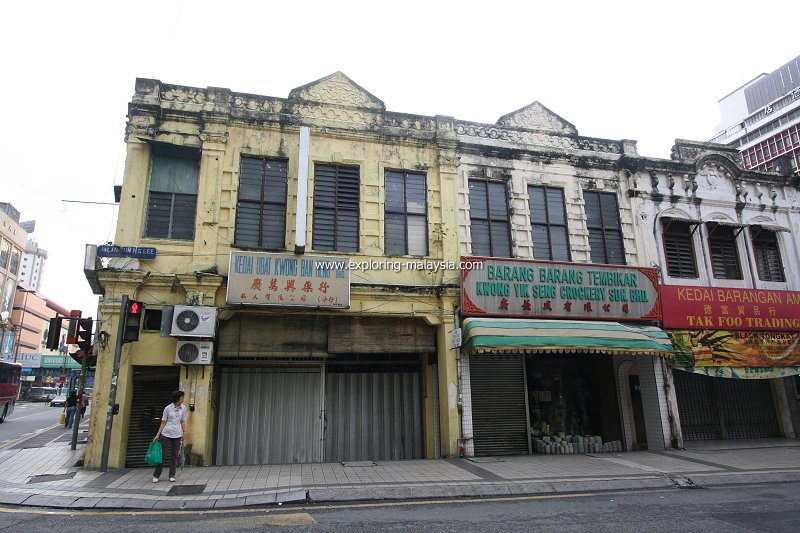 Jalan Tun HS Lee (2 January 2010)
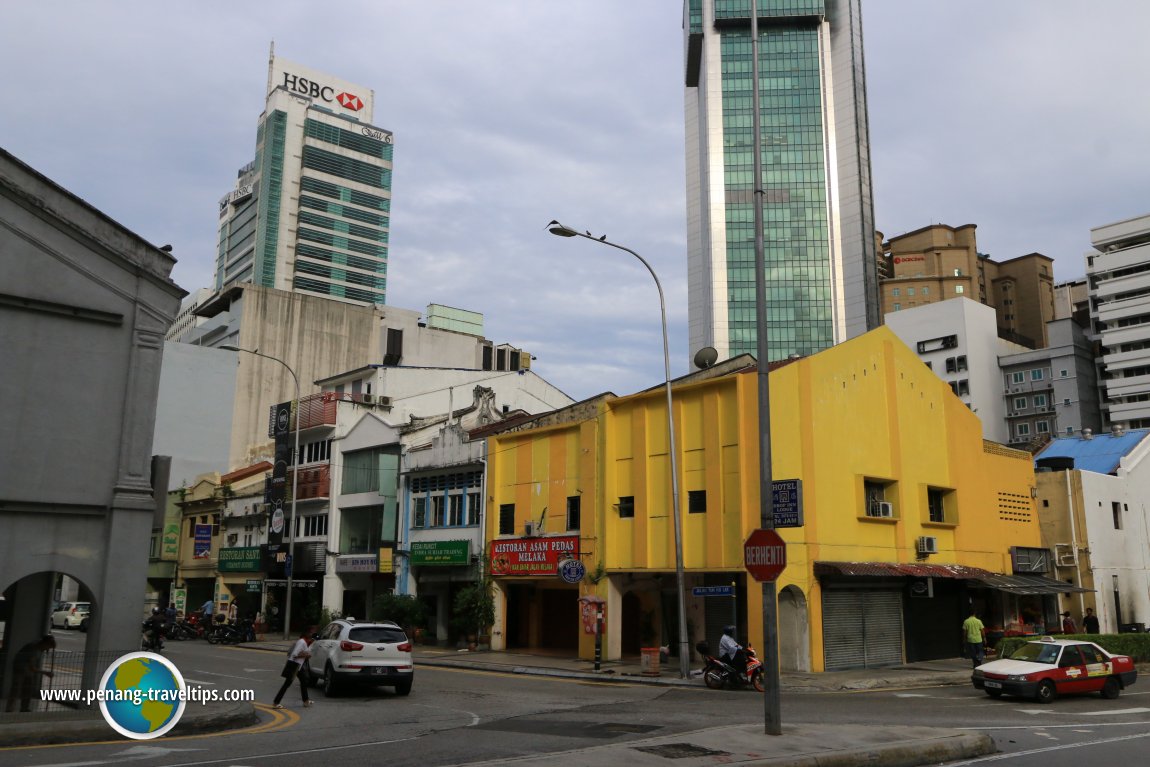 Jalan Tun HS Lee, at the junction with Jalan Gereja (7 July, 2016)
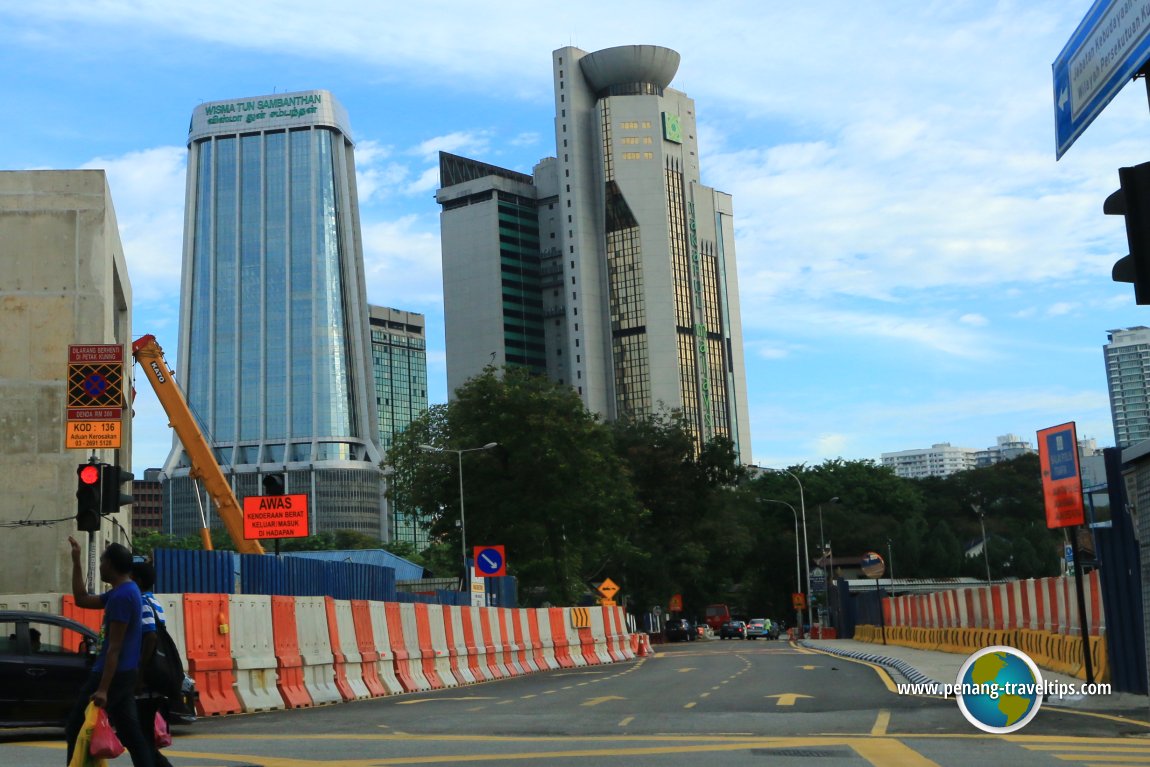 Stretch of Jalan Tun HS Lee south of Jalan Sultan, during construction of the Pasar Seni MRT Station (7 July, 2016)
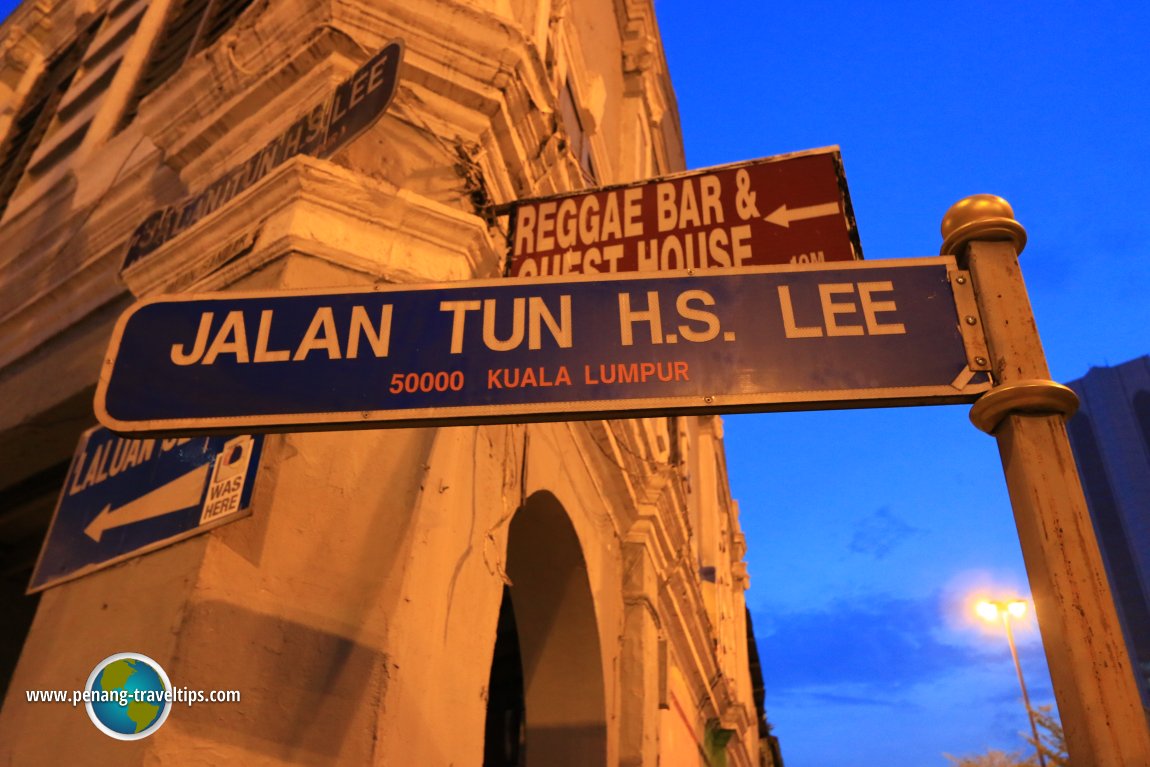 Jalan Tun HS Lee road sign (6 July, 2016)
References
- Kuala Lumpur City Hall (DBKL) – Heritage Conservation Information.
- Mariana Isa & Maganjeet Kaur. Kuala Lumpur Street Names: A Guide to Their Meanings and Histories.
- Government of Malaysia – Biography of Tun H.S. Lee.
- Malaysian Chinese Association – Tun H.S. Lee Biography.
- Think City – Historic Triangle Conservation Programme.
- Junk Book Store – Official Website.
- Time Out Kuala Lumpur – Chinatown Heritage Guide.
- Tourism Malaysia – Chinatown, Kuala Lumpur.
- Lonely Planet – Guan Di Temple.
- Sri Mahamariamman Temple – Official Information.
- UNESCO – Historic Urban Conservation Resources.
- Rapid KL – Rail Network Map and Station Information.
- PropertyGuru Malaysia – Chinatown Property Market Data (2025).
Page Details
This page was created on 16 July 2026. Hi, my name is Timothy and created it from my research, for my own entertainment, knowledge and to satisfy my curiosity. I am providing the information to you in good faith and hope it is useful. I try to get the details as accurate as possible. I also try to update the page whenever I stumble on new details. So this and all my other pages are perpetual work in progress. If you discover any error, please politely inform me, pointing out where the error lies, and I will correct it as soon as possible. Your helpfulness will keep this page accurate, relevant and helpful to those who need the information.More Streets of Kuala Lumpur here
Want to share your Kuala Lumpur travel experiences or get tips from fellow travellers?
Join the Kuala Lumpur Travel Tips Facebook GroupMore information for visiting and living in Kuala Lumpur
Here are some related articles to help you get to know Kuala Lumpur better. Latest Pages & Updates
Buy Me A Coffee
If you enjoy the information I provide and want to support the work I do, please buy me a coffee! I appreciate it immensely, thank you so much!
