
Bandar Permaisuri Travel Guide
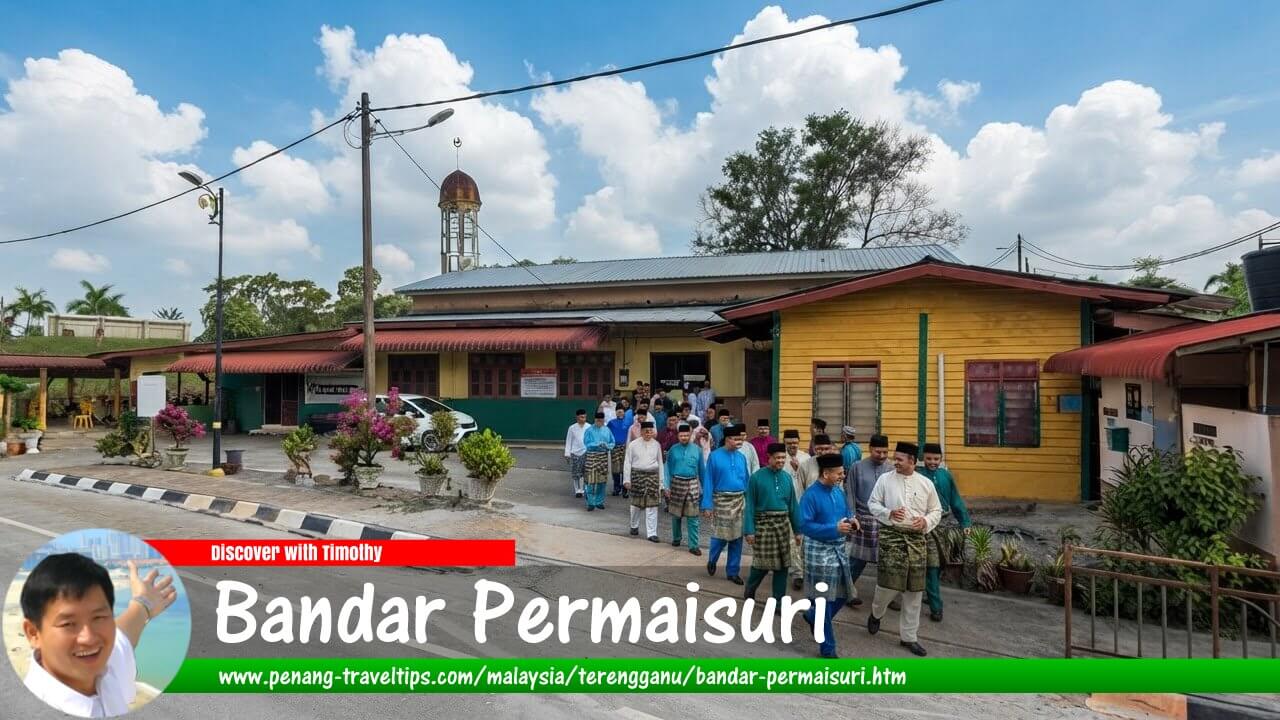 Bandar Permaisuri Travel Guide (AI generated on 10 September 2026)
Also available: Panduan Melawat Bandar Permaisuri
Bandar Permaisuri is the administrative centre of Setiu District in Terengganu, Malaysia. Located in the northern part of the state, the town serves as the principal administrative and commercial centre for the district and provides access to Setiu's coastal villages, beaches, wetlands and rural countryside.1
Bandar Permaisuri is situated about 70 kilometres north of Kuala Terengganu and approximately 40 kilometres south of Jerteh. Although it is not a major tourist destination in its own right, the town is useful as a base for exploring the wider Setiu area, including Setiu Wetlands, Pantai Penarik, Rhu Sepuluh, Merang and other coastal settlements.
Quick Facts
- Location: Setiu District, Terengganu, Malaysia
- District: Setiu
- Status: District administrative centre
- Established as district centre: 1985
- Earlier name: Kampung Buluh
- Distance from Kuala Terengganu: About 70 km
- Distance from Jerteh: About 40 km
- Nearest major airport: Sultan Mahmud Airport, Kuala Terengganu
- Nearby attractions: Setiu Wetlands, Pantai Penarik, Rhu Sepuluh, Merang and Lata Chakah
Geography and Location
Bandar Permaisuri lies in the interior of the coastal plain of northern Terengganu and is surrounded by the predominantly rural landscape of Setiu District. The district extends from the South China Sea on the east towards the inland areas bordering Hulu Terengganu and Besut districts. To the south, Setiu borders Kuala Terengganu District.
Setiu is one of the seven administrative districts of Terengganu and is the youngest district in the state. It was formally established on 1 January 1985. The district covers about 1,359 square kilometres and is divided into seven mukim: Hulu Nerus, Calok, Hulu Setiu, Guntung, Tasik, Pantai and Merang.1
Within this administrative area, Bandar Permaisuri functions as the main urban centre. Other important settlement centres include Sungai Tong, Chalok, Guntong Luar, Saujana, Penarik and Merang. Bandar Permaisuri is therefore an important reference point for travelling through the district, even though many of Setiu's best-known natural attractions are located outside the town itself.
History
The history of Bandar Permaisuri is closely connected with the older settlement of Kampung Buluh. Before Setiu became a separate district, the area was administratively part of Besut District. The settlement that later developed into the present town was known as Kampung Buluh.
According to information recorded by the Malaysian Islamic Information and Management System, Kampung Buluh had already developed as a settlement before the creation of Setiu District. The local mosque, now associated with Masjid Bandar Permaisuri, has roots going back to the early 20th century. An earlier mosque was established around 1910 at Kampung Buruk, before being moved to higher ground in 1967 because of flooding.2
The creation of Setiu District in 1985 brought a major change to the settlement. A new district administrative centre was established at the Kampung Buluh area, transforming what had been a village settlement into the administrative town of the new district.
Development after 1985
Setiu District was formally established on 1 January 1985, and the Majlis Daerah Setiu was subsequently established on 1 June 1985. Bandar Permaisuri became the headquarters of the district administration.1
Historical accounts from the early period of the district administration also refer to the settlement as Pekan Kampung Buluh. The name Bandar Permaisuri was already associated with the developing administrative centre at the time the new district was created.3
The town subsequently developed with government offices, schools, shops, mosques, transport facilities and other services required by the district population. Its growth was therefore closely related to its administrative role rather than to large-scale industrial or commercial development.
Origin of the Name Bandar Permaisuri
The name Bandar Permaisuri can be understood linguistically as meaning the "Queen's Town", with bandar referring to a town or urban settlement and permaisuri meaning queen or royal consort in Malay.
The available historical sources clearly associate the present town with the earlier settlement of Kampung Buluh, but they do not provide a sufficiently reliable explanation for why the name Permaisuri was adopted. It is therefore preferable to distinguish the documented transition from Kampung Buluh to Bandar Permaisuri from later stories or explanations whose historical basis is uncertain.
The name Setiu, meanwhile, refers to the district rather than specifically to the town. A local historical tradition attributes the name Setiu to a figure known as Tok Setiu, described as a Bugis warrior who settled in the area. This account forms part of the traditional history of the district, although details concerning the early history of Setiu are not fully documented in surviving written sources.
Bandar Permaisuri as the Centre of Setiu District
Bandar Permaisuri is primarily an administrative town. The district offices and local government institutions located here serve communities spread across a large rural territory.
The town's role is reflected in the settlement hierarchy of Setiu, where Bandar Permaisuri is identified as the principal settlement centre. Smaller centres such as Sungai Tong, Chalok, Guntong Luar, Saujana, Penarik and Merang serve more local functions.
For travellers, this means that Bandar Permaisuri is often more useful as a gateway and service centre than as a destination filled with conventional tourist attractions. Visitors travelling through Setiu can use the town to obtain food, fuel, basic supplies and local transport before continuing towards the coast or inland areas.
Places to Visit around Bandar Permaisuri
Bandar Permaisuri Town Centre
The town centre provides an opportunity to observe everyday life in a small Terengganu district capital. Its streets are lined with government buildings, shops, eateries, schools and residential areas. The scale is considerably smaller than Kuala Terengganu, making the town relatively easy to explore.
Masjid Bandar Permaisuri
Masjid Bandar Permaisuri serves as an important mosque in the district centre. Its history is linked to the earlier mosque serving Kampung Buluh and the surrounding community. The present mosque was constructed between 1997 and 1999 as the district developed and the earlier facilities became inadequate for the growing population.2
Setiu Wetlands
One of the most significant natural attractions in the wider district is the Setiu Wetlands. The wetland system consists of interconnected coastal and inland environments, including sea, beaches, mudflats, lagoons, estuaries, rivers, islands, coastal forests and mangrove forests.
The wetlands are also an important environment for local communities. Fishing and aquaculture are among the economic activities associated with the area, while the natural environment provides opportunities for ecological observation and nature-based tourism.
Access to the Setiu Wetlands is possible from locations including Gong Batu and Pengkalan Gelap in the Penarik area. The wetlands are outside Bandar Permaisuri itself, so visitors should allow additional travelling time when making an excursion there.4
Pantai Penarik
Pantai Penarik is one of the best-known coastal areas in Setiu. The beach is located to the east of Bandar Permaisuri and is associated with the fishing village of Penarik.
The coastline is relatively open and provides a different experience from the more developed beaches around Kuala Terengganu. Visitors can combine a visit to Pantai Penarik with exploration of the surrounding fishing settlements and the Setiu Wetlands.
Rhu Sepuluh
Rhu Sepuluh is another coastal attraction in the Penarik area. The name refers to the local landscape and vegetation, while the beach is known for its broad sandy shoreline and traditional coastal atmosphere.
The area is also associated with ikan celup tepung, a popular east-coast Malaysian preparation in which fish and other seafood are coated in batter and fried. Several food stalls and small eateries in the wider coastal area cater to visitors.
Merang
Merang is another important coastal settlement in Setiu District. It is located further south of Bandar Permaisuri and has become associated with beach tourism and access to offshore islands. The coastal landscape around Merang includes beaches, fishing activity and small-scale tourist accommodation.
Lata Chakah
For visitors interested in inland scenery, Lata Chakah is one of the natural attractions identified by the Setiu district authorities. It provides an alternative to the beaches and wetlands and illustrates the diversity of landscapes within Setiu District.
How to Get to Bandar Permaisuri
By Car
Driving is the most convenient way to reach Bandar Permaisuri and to explore Setiu District. The town is connected to the main road network running along the east coast of Peninsular Malaysia.
From Kuala Terengganu, the journey is approximately 70 kilometres. From Jerteh, the distance is about 40 kilometres. Driving is particularly useful for travellers who intend to visit several places in Setiu, since attractions such as Penarik, Rhu Sepuluh, Merang and the wetlands are spread across the district.
By Express Bus
Long-distance express buses serve Setiu, with an express bus terminal located in the town centre of Bandar Permaisuri. Services connect the district with destinations including Kuala Lumpur and parts of northern Peninsular Malaysia.5
Travellers arriving by long-distance bus should check the latest schedules before travelling, as service frequencies and routes can change.
By Local Bus
Local bus services connect Bandar Permaisuri with other settlements in Setiu and with nearby towns. According to the district council, buses operate from the early morning until around 7.00 pm, with services between Setiu and Kuala Terengganu operating at approximately hourly intervals, while services between Setiu and Jerteh are less frequent.5
By Air
The nearest major airport for visitors approaching from the south is Sultan Mahmud Airport in Kuala Terengganu. From the airport, travellers can continue north by road to Bandar Permaisuri.
Another option is Sultan Ismail Petra Airport near Kota Bharu in Kelantan. This airport can be useful for travellers approaching Setiu from the north, particularly when their itinerary also includes Besut, Kuala Besut or the Perhentian Islands.
Where to Stay
Bandar Permaisuri has a relatively small supply of accommodation compared with Kuala Terengganu or the major beach destinations of Terengganu. Travellers who want to stay in the town can find small hotels, inns and guesthouses, while a wider range of accommodation is available along the Setiu coast.
One accommodation recorded in Tourism Malaysia's accommodation statistics is Najmi Inn Hotel in Kampung Buluh, Bandar Permaisuri.6
For a more coastal experience, visitors can stay around Penarik, Rhu Sepuluh or Merang. Accommodation in these areas ranges from small resorts and guesthouses to homestays and more distinctive heritage-style properties.
Terrapuri Heritage Village, located in the Penarik area, is one of the better-known accommodation properties in the wider Setiu area. Other accommodation options listed by the Setiu district authorities include Peladang Setiu Agro Resort, Rumah Rehat Setiu, Nelayan Resort, Merang Suria Resort, Teamate Training Resort and Pandan Laut Beach Resort.7
What to Eat
Food in Bandar Permaisuri reflects the cuisine of the Terengganu east coast. The town and surrounding villages have small restaurants, coffee shops and food stalls serving local dishes.
Nasi dagang is one of the characteristic dishes of the region. It is commonly eaten for breakfast and consists of rice cooked with coconut milk, usually served with fish curry and accompanying condiments.
Nasi kerabu, with its distinctive coloured rice and assortment of herbs and accompaniments, is also widely associated with the east coast of Peninsular Malaysia. Other Terengganu foods worth looking for include sata, keropok lekor, budu and various preparations of fresh fish and seafood.
Along the coast, particularly around Penarik and Rhu Sepuluh, ikan celup tepung is a popular choice. Fresh fish and seafood are dipped in batter and fried, making it particularly suitable for a meal or snack while visiting the beach.
Getting Around
Bandar Permaisuri town centre is compact enough to explore on foot, particularly if the purpose of a visit is to see the shops, public buildings and local eateries around the centre.
For travelling beyond the town, however, a private car is considerably more practical. Setiu District is geographically large, and its beaches, wetlands, fishing villages and inland attractions are dispersed over a substantial area.
Taxis are also available for journeys to destinations such as Kuala Terengganu, Jerteh, Merang and other parts of the region. Travellers without their own vehicle should arrange transport in advance when visiting more remote attractions.
Best Time to Visit
Bandar Permaisuri can be visited throughout the year, but the weather becomes particularly important when the itinerary includes beaches, boat trips or wetland activities.
The east coast of Peninsular Malaysia experiences the Northeast Monsoon, generally from November through February or early March. During this period, heavier rainfall and rougher seas can affect coastal activities and boat services.
For visitors intending to spend substantial time on the coast, a period with generally calmer weather is preferable. Nevertheless, weather conditions vary from year to year, so travellers should check local forecasts before undertaking boat or outdoor activities.
How Long to Stay
Bandar Permaisuri itself can be seen relatively quickly, since it is a small administrative town rather than a large tourist centre. A short stop of several hours is sufficient for visitors merely passing through.
However, one or two nights can be worthwhile for travellers who want to explore the wider Setiu area. A longer stay allows time for the beaches of Penarik and Rhu Sepuluh, the Setiu Wetlands, Merang and inland attractions such as Lata Chakah.
Suggested Itinerary
One-Day Visit
- Arrive in Bandar Permaisuri in the morning.
- Explore the town centre and have breakfast or lunch at a local eatery.
- Continue towards Penarik and Rhu Sepuluh.
- Explore part of the Setiu Wetlands.
- Have ikan celup tepung or another local seafood dish along the coast.
- Return to Bandar Permaisuri or continue to another destination in Terengganu.
Two-Day Visit
- Day 1: Explore Bandar Permaisuri, then travel to Penarik and Rhu Sepuluh.
- Day 2: Visit the Setiu Wetlands and continue south towards Merang, or explore one of the district's inland natural attractions.
Practical Travel Tips
- Plan transport carefully: Public transport is available, but a car provides considerably greater flexibility for exploring rural Setiu.
- Carry cash: Small food stalls and village businesses may not accept cards or electronic payments.
- Allow extra time: Distances between attractions can be greater than they appear when viewed on a district map.
- Check the weather: This is particularly important for beach visits, wetland excursions and boat trips.
- Respect local communities: Many attractions are located within active fishing villages and traditional settlements.
- Do not assume every attraction is open daily: Smaller facilities and nature-based activities may operate according to local schedules or weather conditions.
Bandar Permaisuri as a Gateway to Setiu
Bandar Permaisuri is best understood as the administrative heart of Setiu rather than as a conventional resort town. Its significance comes from the role it plays in the administration and everyday life of one of Terengganu's predominantly rural districts.
The town's history is also significant because its development illustrates how the creation of a new administrative district can transform an existing village into a district capital. The older identity of Kampung Buluh remains an important part of the history of Bandar Permaisuri.
For travellers, the town provides a practical starting point for discovering the wider Setiu landscape. From here, visitors can reach the fishing villages and beaches of the coast, the ecologically important Setiu Wetlands and the inland countryside. A visit to Bandar Permaisuri therefore offers an opportunity to experience a quieter and less urbanised part of Terengganu while using the district capital as a convenient base.
References
- Majlis Daerah Setiu – Setiu Background
- Portal SISMIM, Jabatan Kemajuan Islam Malaysia – Masjid Bandar Permaisuri
- Universiti Teknologi MARA – Oral history research on Setiu and Bandar Permaisuri
- Malaysia Biodiversity Information System – Setiu Wetlands
- Majlis Daerah Setiu – Transportation Information
- Tourism Malaysia – Hotel and Accommodation Statistics
- Majlis Daerah Setiu – Places to Stay
Page Details
This page was created on 12 September 2026. Hi, my name is Timothy and created it from my research, for my own entertainment, knowledge and to satisfy my curiosity. I am providing the information to you in good faith and hope it is useful. I try to get the details as accurate as possible. I also try to update the page whenever I stumble on new details. So this and all my other pages are perpetual work in progress. If you discover any error, please politely inform me, pointing out where the error lies, and I will correct it as soon as possible. Your helpfulness will keep this page accurate, relevant and helpful to those who need the information.Buy Me A Coffee
If you enjoy the information I provide and want to support the work I do, please buy me a coffee! I appreciate it immensely, thank you so much!
