
The Bakerloo Line of the London Underground
Introduction
The Bakerloo Line is one of the oldest and most iconic lines on the London Underground. Running diagonally across London from the south-east to the north-west, it links bustling central districts with leafy suburbs and has played a vital role in the capital’s public transport network for over a century.Geography and Route Overview
The Bakerloo Line stretches from Elephant & Castle in South London to Harrow & Wealdstone in the northwest suburbs. It cuts through central London, following a northwesterly path that makes it particularly useful for connecting southern commuters to key West End and Paddington-bound destinations.The line passes under the River Thames between Waterloo and Embankment stations, and its route includes areas as diverse as Lambeth, Westminster, the West End, Marylebone, Maida Vale, and the outer borough of Harrow.
Length and Usage
The Bakerloo Line is approximately 14.4 miles (23.2 km) long and consists of 25 stations. It is one of the shorter lines on the Underground but is nonetheless a crucial artery for London's commuters and visitors.On average, the Bakerloo Line handles around 110 million passenger journeys per year, though exact figures fluctuate due to seasonal travel and changes in working habits.
History and Construction
The Bakerloo Line was officially opened on 10 March 1906, initially running from Baker Street to Lambeth North (then called Kennington Road). It was constructed by the Baker Street & Waterloo Railway, one of the early deep-level tube railways built in the early 20th century. The line quickly expanded both northward and southward over the next few years. Its integration into the London Passenger Transport Board in 1933 brought further improvements and connections with other lines and services.Origin of the Name “Bakerloo”
The unusual name “Bakerloo” is a portmanteau of “Baker Street” and “Waterloo”, the line’s original termini. The name was adopted unofficially by the public due to the awkwardness of the original title—Baker Street and Waterloo Railway—and was eventually embraced by the company in 1906, just months after the line opened.Stations on the Bakerloo Line
The Bakerloo Line currently serves the following 25 stations:- Harrow & Wealdstone Tube Station: is also served by London Overground, London Midland and Southern trains. (Travelcard Zone 5)
- Kenton Tube Station: is also served by London Overground trains. (Travelcard Zone 4)
- South Kenton Tube Station: is also served by London Overground trains. (Travelcard Zone 4)
- North Wembley Tube Station: is also served by London Overground (Watford DC Line) trains. (Travelcard Zone 4)
- Wembley Central Tube Station: is also served by London Overground and Southern National Rail trains. (Travelcard Zone 4)
- Stonebridge Park Tube Station: is also served by London Overground (Watford DC Line) trains. (Travelcard Zone 3)
- Harlesden Tube Station: is also served by London Overground trains. (Travelcard Zone 3)
- Willesden Junction Station is also served by London Overground trains. (Travelcard Zone 3)
- Kensal Green Tube Station is also served by London Overground trains. (Travelcard Zone 2)
- Queen's Park Station is also served by London Overground trains. (Travelcard Zone 2)
- Kilburn Park Tube Station (Travelcard Zone 2)
- Maida Vale Tube Station (Travelcard Zone 2)
- Warwick Avenue Tube Station: (Travelcard Zone 2)
- Paddington Tube Station: is actually two separate stations for different lines of the London Underground within the London Paddington Station. London Paddington is the terminus of Heathrow Express. (Travelcard Zone 1) This is an interchange with Circle Line, District Line and Hammersmith & City Line.
- Edgware Road Tube Station: (Travelcard Zone 1)
- Marylebone Tube Station: is the underground station within the Marylebone Railway Tube Station which is located midway between Euston and Paddington stations. (Travelcard Zone 1)
- Baker Street Station: (Travelcard Zone 1) This is an interchange with Circle Line, Hammersmith & City Line, Metropolitan Line and Jubilee Line.
- Regent's Park Tube Station: (Travelcard Zone 1)
- Oxford Circus Station: (Travelcard Zone 1) This is an interchange with Central Line and Victoria Line.
- Piccadilly Circus Station: (Travelcard Zone 1) This is an interchange with Piccadilly Line.
- Charing Cross Station: (Travelcard Zone 1) This is an interchange with Northern Line.
- Embankment Station: (Travelcard Zone 1) This is an interchange with Circle Line, District Line and Northern Line.
- Waterloo Station: is located within the London Waterloo Railway Terminus. (Travelcard Zone 1) This is an interchange with Jubilee Line, Northern Line and Waterloo & City Line.
- Lambeth North Tube Station (Travelcard Zone 1)
- Elephant & Castle Tube Station (Boundary of Travelcard Zone 1 & 2) This is an interchange with Northern Line.
Neighbourhoods and Areas Served
The Bakerloo Line links a range of diverse and historically rich neighbourhoods:- Elephant & Castle – A regeneration hub in South London.
- Waterloo and Embankment – Close to cultural landmarks and the South Bank.
- West End – Including Oxford Circus and Piccadilly Circus, prime retail and theatre areas.
- Marylebone and Maida Vale – Leafy, affluent residential areas with historical charm.
- Queen's Park and Kensal Green – Creative communities with village vibes.
- Harrow – A suburban area with access to Harrow School and green spaces.
Major Interchanges and Connectivity
Several stations on the Bakerloo Line offer important connections to other Underground and national rail services:- Paddington – Interchange with Circle, District, and Hammersmith & City lines, as well as National Rail and the Elizabeth Line.
- Oxford Circus – Connects with the Victoria and Central lines.
- Baker Street – Links to Jubilee, Metropolitan, Circle, and Hammersmith & City lines.
- Waterloo – Interchange with Jubilee, Northern, and national rail services.
- Willesden Junction – Connects to the London Overground.
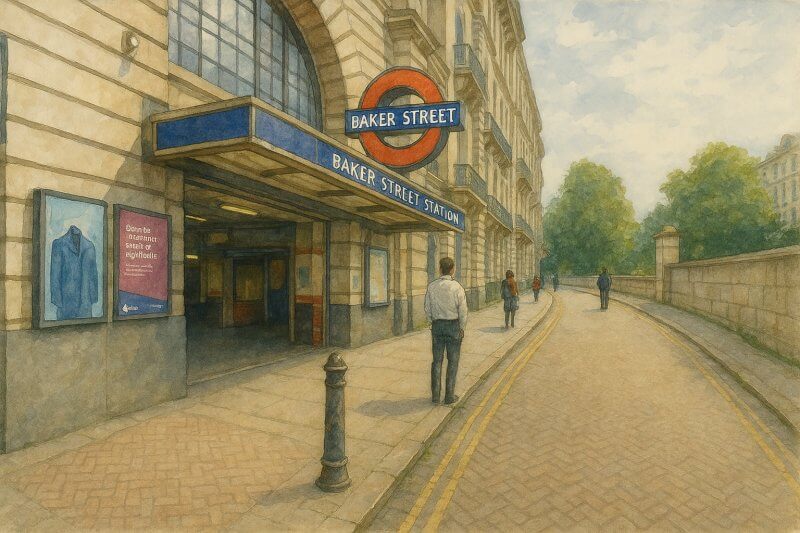
Painting of Baker Street Station of the London Underground (View full-size image here)
Fun Facts and Trivia
Here are some interesting tidbits about the Bakerloo Line:- It was one of the first lines to use escalators instead of lifts at underground stations, helping shape modern station design.
- Some of the stations still retain their original Edwardian tiling, which makes them visually distinct and historically rich.
- The southern extension to Camberwell has been proposed several times but has yet to be realised, making it one of the more talked-about potential expansions in Tube history.
- Maida Vale station was the first entirely staffed by women when it opened in 1915, due to male workers being called up for World War I.
Conclusion
The Bakerloo Line is a vital part of London’s transport heritage and continues to serve millions of people every year. With its historic stations, deep connections to the city’s fabric, and links between vibrant neighbourhoods and serene suburbs, it remains one of the most characterful lines on the Underground. Whether you're commuting or exploring, the Bakerloo Line offers a journey through both the heart and the history of London.Map of London Underground
List of London Underground Lines
Want to share your London travel experiences or get tips from fellow travellers?
Join the London Travel Tips Facebook GroupMore information for visiting London
Here are some related articles to help you get to know London better.- Cost of Living in London: Discover the true cost of living in London, including housing, transport, groceries, and more - plus tips for budgeting in one of the world's most expensive cities.
- Driving in London: Planning to drive in London? Learn about roads, car rentals, parking, tolls, and key tips for tourists and visitors from outside the capital.
- Driving Tips for Visiting London: Thinking of driving to London? Discover the best times to travel, congestion tips, parking apps, breakdown help, and petrol advice for a smoother journey.
- Evolution of London's Streets: Discover the fascinating history of how London's streets developed from ancient footpaths to today's complex network of roads across the capital.
- History of Immigration to London: Discover the rich history of immigration to London, from Huguenots to Bangladeshis, and how diverse communities have shaped the city's vibrant identity.
- How Big Is London Compared to Other World Cities?
- How London's Streets Measure Up: A Global Comparison of Road Widths
- How Streets of London are Named: Discover how London streets get their names, who decides them, and how historic, political, and public influences shape street naming in the capital.
- How the Grosvenor Family Came to Own Much of Mayfair, Belgravia and Pimlico: Explore how the Grosvenor family came to own much of Mayfair, Belgravia, and Pimlico, and learn about their historical connection (or lack thereof) with the British royal family and government.
- Living and working in London
- London's Quiet Collapse: How Living Standards Fell as Costs Skyrockted (1975-2025): Explore how London residents endured rising costs and falling living standards from 1975 to 2025 - from rocketing rents to wage stagnation and inflation.
- Marvel of the London Underground: Discover the history, challenges, and triumphs of the London Underground - the world's first underground railway and a vital transport lifeline for the UK capital since 1863.
- Moving to London: Expat Tips for Settling in Westminster: Essential advice for expats moving to London's Westminster: neighborhood insights, cost of living, transportation, housing, healthcare, schools, and tips to help you feel at home in the heart of the city.
- Places in London that aren't pronounced the way they're spelled
- Shopping in London: Discover London's diverse shopping scene
- Taking the bus in London: This is your complete guide to taking the bus when in London.
- The Anglican Faith: A Visitor's Guide to the Church of England: Learn about the Anglican faith and its deep ties to London's landmarks like Westminster Abbey and St Paul's Cathedral.
- Top 10 London Streets Every Visitor Must See: Discover London through its most iconic thoroughfares - 10 streets every visitor must experience. From historic Abbey Road to vibrant Camden High Street, explore culture, shopping, and hidden gems.
- Why are most roads in Central London so narrow? Learn why there are so few multi-lane roads and elevated highways in the heart of the city.
 Latest Pages & Updates
Buy Me A Coffee
If you enjoy the information I provide and want to support the work I do, please buy me a coffee! I appreciate it immensely, thank you so much!
