
Waterloo Bridge, London
Waterloo Bridge, London: History, Architecture & Views
Waterloo Bridge is a prominent road and footbridge crossing the River Thames in central London. It connects the bustling Strand area on the north bank with the cultural South Bank on the south side.The bridge is strategically positioned between Westminster Bridge to the west and Blackfriars Bridge to the east. It offers spectacular panoramic views of many London landmarks, including the London Eye, St Paul’s Cathedral, and the Houses of Parliament.
Key Roads and Connections
At the northern end, Waterloo Bridge feeds into the Strand and Aldwych, major roads in the City of Westminster. The southern end connects to Waterloo Road and Stamford Street in the London Borough of Lambeth.How Long is Waterloo Bridge?
Waterloo Bridge measures approximately 1,230 feet (375 metres) in length and spans across the Thames at one of its widest points in central London. The width of the bridge is around 80 feet (24.4 metres), accommodating four traffic lanes and pedestrian pavements on both sides.When Was Waterloo Bridge Built and Who Designed It?
The original Waterloo Bridge was designed by the Scottish civil engineer John Rennie and opened in 1817. It was originally known as the "Strand Bridge" during its planning stages.By the early 20th century, Rennie’s bridge had deteriorated and was eventually demolished in the 1930s. The current Waterloo Bridge, a reinforced concrete structure faced with Portland stone, was completed and officially opened on 10 December 1945.
It was designed by Sir Giles Gilbert Scott, the same architect responsible for the iconic red telephone box and Battersea Power Station. The bridge was constructed by the London County Council and is widely admired for its clean, modernist design.
Why is it Called Waterloo Bridge?
The bridge is named after the Battle of Waterloo, a decisive British victory against Napoleon Bonaparte in 1815. The battle took place in present-day Belgium and marked the end of the Napoleonic Wars.Although initially referred to as the Strand Bridge during planning and early construction, it was renamed "Waterloo Bridge" before its opening in 1817 to commemorate the battle’s significance in British history.
How Far is Waterloo Bridge from Charing Cross?
Waterloo Bridge is located just under 0.6 miles (1 kilometre) from Charing Cross, which is traditionally considered the central point of London.- By foot: It takes around 10–12 minutes to walk from Charing Cross to the middle of the bridge, depending on your pace.
- By car: Driving takes about 5–10 minutes, depending on traffic, but walking is usually faster in central London.
Nearest London Underground Stations
Waterloo Bridge is well served by public transport, with several London Underground stations nearby:- Waterloo Station (South Bank side): Served by the Jubilee, Northern, Bakerloo, and Waterloo & City lines.
- Embankment Station (North side): Served by the Bakerloo, Northern, District, and Circle lines.
- Temple Station (East of the bridge): Served by the District and Circle lines.
- Charing Cross Station (Northwest of the bridge): Served by the Bakerloo and Northern lines, and National Rail.
Architectural Style and Features
The current Waterloo Bridge is widely admired for its understated elegance. Constructed using reinforced concrete and clad in Portland stone, it embodies the modernist architectural style of the mid-20th century.It features five shallow arches and a simple, symmetrical profile that harmonises with the surrounding cityscape. Its minimalistic design gives greater prominence to the stunning views it affords rather than the structure itself.
A Unique Wartime Legacy
One of the most remarkable aspects of Waterloo Bridge is that much of it was built by women during the Second World War. With many male workers enlisted in the military, women took on major construction roles for the first time.This fact has earned Waterloo Bridge the affectionate nickname "The Ladies’ Bridge", though the contribution of these women builders wasn’t widely acknowledged until many decades later.
Famous Views and Popular Culture
Waterloo Bridge is famous for offering some of the best views in London. On a clear day, you can see:- To the west: Big Ben, the London Eye, and the Palace of Westminster.
- To the east: St Paul’s Cathedral, the City skyline, and Canary Wharf in the distance.
Who Uses Waterloo Bridge Today?
Waterloo Bridge is a key part of London’s road network and is heavily used by vehicles, cyclists, and pedestrians.It also acts as a visual and physical link between the cultural institutions on either side of the Thames. On the South Bank, you’ll find:
- The National Theatre
- Southbank Centre
- BFI Southbank
- Somerset House
- Covent Garden
- The West End theatres
Quick Facts: Waterloo Bridge
- Location: Central London, spanning the River Thames
- Length: Approximately 1,230 feet (375 metres)
- First Opened: 1817 (original), 1945 (current bridge)
- Architect: Sir Giles Gilbert Scott
- Named After: The Battle of Waterloo (1815)
- Nearest Tube Stations: Waterloo, Embankment, Temple, Charing Cross
- Architectural Style: Modernist with Portland stone facing
- Fun Fact: Built largely by women during WWII, earning it the nickname "The Ladies’ Bridge"
- Key Roads: Connects Strand and Aldwych (north) to Waterloo Road and Stamford Street (south)
- Distance from Charing Cross: Around 0.6 miles (1 km); 10–12 minutes on foot
Conclusion
Waterloo Bridge stands as more than just a crossing point over the Thames—it’s a testament to London's evolving history, architecture, and resilience. Whether you're strolling across it to take in breathtaking city views or learning about its wartime past, the bridge remains a meaningful symbol of the capital.Next time you’re in London, take a walk over Waterloo Bridge. It might just offer the most scenic stroll in the city.
Map of Waterloo Bridge, London
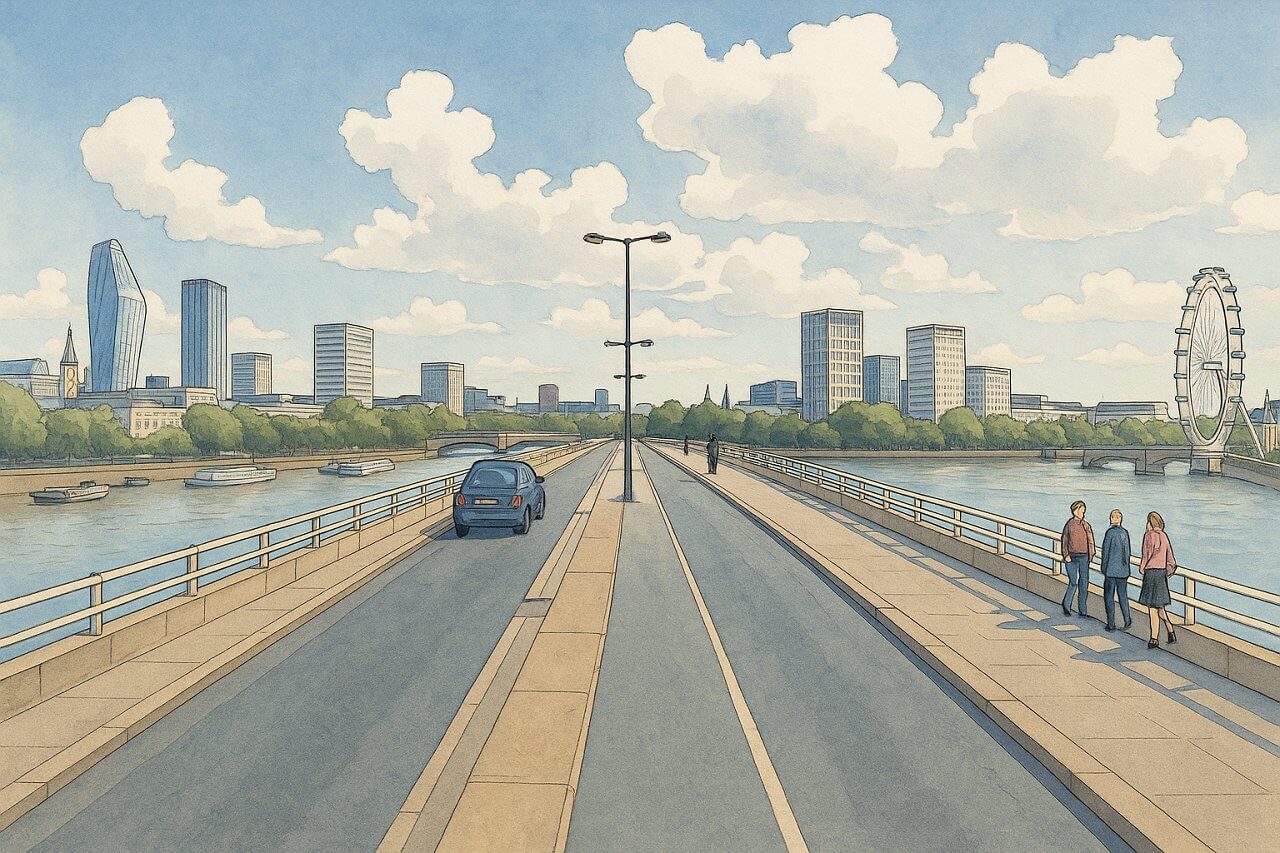
Painting of Waterloo Bridge, London (View image in full size)
Page Details
This page was created on 5 May 2025. Hi, my name is Timothy and created it from my research, for my own entertainment, knowledge and to satisfy my curiosity. I am providing the information to you in good faith and hope it is useful. I try to get the details as accurate as possible. I also try to update the page whenever I stumble on new details. So this and all my other pages are perpetual work in progress. If you discover any error, please politely inform me, pointing out where the error lies, and I will correct it as soon as possible. Your helpfulness will keep this page accurate, relevant and helpful to those who need the information.List of Bridges in London and Bridges in the United Kingdom
Want to share your London travel experiences or get tips from fellow travellers?
Join the London Travel Tips Facebook GroupMore information for visiting London
Here are some related articles to help you get to know London better.- Cost of Living in London: Discover the true cost of living in London, including housing, transport, groceries, and more - plus tips for budgeting in one of the world's most expensive cities.
- Driving in London: Planning to drive in London? Learn about roads, car rentals, parking, tolls, and key tips for tourists and visitors from outside the capital.
- Driving Tips for Visiting London: Thinking of driving to London? Discover the best times to travel, congestion tips, parking apps, breakdown help, and petrol advice for a smoother journey.
- Evolution of London's Streets: Discover the fascinating history of how London's streets developed from ancient footpaths to today's complex network of roads across the capital.
- History of Immigration to London: Discover the rich history of immigration to London, from Huguenots to Bangladeshis, and how diverse communities have shaped the city's vibrant identity.
- How Big Is London Compared to Other World Cities?
- How London's Streets Measure Up: A Global Comparison of Road Widths
- How Streets of London are Named: Discover how London streets get their names, who decides them, and how historic, political, and public influences shape street naming in the capital.
- How the Grosvenor Family Came to Own Much of Mayfair, Belgravia and Pimlico: Explore how the Grosvenor family came to own much of Mayfair, Belgravia, and Pimlico, and learn about their historical connection (or lack thereof) with the British royal family and government.
- Living and working in London
- London's Quiet Collapse: How Living Standards Fell as Costs Skyrockted (1975-2025): Explore how London residents endured rising costs and falling living standards from 1975 to 2025 - from rocketing rents to wage stagnation and inflation.
- Marvel of the London Underground: Discover the history, challenges, and triumphs of the London Underground - the world's first underground railway and a vital transport lifeline for the UK capital since 1863.
- Moving to London: Expat Tips for Settling in Westminster: Essential advice for expats moving to London's Westminster: neighborhood insights, cost of living, transportation, housing, healthcare, schools, and tips to help you feel at home in the heart of the city.
- Places in London that aren't pronounced the way they're spelled
- Shopping in London: Discover London's diverse shopping scene
- Taking the bus in London: This is your complete guide to taking the bus when in London.
- The Anglican Faith: A Visitor's Guide to the Church of England: Learn about the Anglican faith and its deep ties to London's landmarks like Westminster Abbey and St Paul's Cathedral.
- Top 10 London Streets Every Visitor Must See: Discover London through its most iconic thoroughfares - 10 streets every visitor must experience. From historic Abbey Road to vibrant Camden High Street, explore culture, shopping, and hidden gems.
- Why are most roads in Central London so narrow? Learn why there are so few multi-lane roads and elevated highways in the heart of the city.
 Latest Pages & Updates
Buy Me A Coffee
If you enjoy the information I provide and want to support the work I do, please buy me a coffee! I appreciate it immensely, thank you so much!
