
Tapah Travel Guide
 Tapah Travel Guide (AI generated on 10 September 2026)
Also available: Panduan Melawat Tapah
Tapah is a small town in Batang Padang District, Perak, Malaysia. Located on the main road between Ipoh and Kuala Lumpur, Tapah is best known as an important gateway to the highlands of Cameron Highlands. It is also a convenient base for exploring the waterfalls, hot springs, rivers, forests and rural landscapes of southern Perak.
Although Tapah itself is a relatively modest town, the surrounding Batang Padang area contains a considerable variety of natural attractions. Lata Kinjang, Lata Iskandar, Kuala Woh and the Sungai Klah hot springs are among the better-known destinations in the district. The town also has historical connections with the development of Perak's tin-mining and rubber economies.
For local travellers, Tapah makes a practical stop on a road trip through Perak or on the way to Cameron Highlands. For foreign visitors, it offers an opportunity to experience a smaller Malaysian town and the rural landscapes at the foot of the Titiwangsa Range.
Quick Facts
Town: Tapah
State: Perak
District: Batang Padang
Local authority: Tapah District Council (Majlis Daerah Tapah)
Postcode: 35000
Geographical setting: Foothills of the Titiwangsa Range, beside the Batang Padang River
Main road: Federal Route 1
Highway access: Tapah Interchange on the North-South Expressway
Highland route: Federal Route 59 towards Cameron Highlands
Known for: Lata Kinjang, Lata Iskandar, Kuala Woh, access to Cameron Highlands and Batang Padang's rural landscapes
Where Is Tapah?
Tapah is located in southern Perak, approximately between Ipoh and Kuala Lumpur. It is the administrative centre of Batang Padang District and lies close to the foothills of the Titiwangsa Range.
The town is situated beside the Batang Padang River. To the east, the landscape rises towards the mountains and the route to Cameron Highlands. To the west are the lower-lying agricultural and plantation areas of Batang Padang and the route towards Tapah Road and Teluk Intan.
The location has given Tapah an important role as a transport and service centre. The town is accessible from Federal Route 1 and the North-South Expressway, while Federal Route 59 begins here and climbs towards Cameron Highlands.
Why Visit Tapah?
Tapah is particularly suitable for travellers who enjoy combining a small-town visit with outdoor activities and scenic drives.
- Explore a traditional Perak town outside the major urban centres.
- Visit waterfalls in the surrounding Batang Padang countryside.
- Enjoy hot-spring recreation.
- Drive along the historic mountain road towards Cameron Highlands.
- Experience rural Malay, Chinese, Indian and Orang Asli communities.
- Explore the foothills and forest landscapes of the Titiwangsa Range.
- Use Tapah as a convenient stopping point between Kuala Lumpur and northern Perak.
- Combine Tapah with nearby Chenderiang, Bidor, Sungkai or Cameron Highlands.
The Meaning of the Name Tapah
According to the Perak land administration, the name Tapah is associated with the freshwater fish known as the tapah fish, scientifically Wallago attu.
Another local explanation connects the name with a Perak Malay expression said to mean "it does not matter". The fish explanation is the more commonly presented geographical explanation, but both traditions form part of the local understanding of the name.
The tapah fish is a large freshwater catfish found in rivers in South and Southeast Asia. The association between the fish and the town is therefore appropriate for a settlement historically connected with the Batang Padang river system.
Tapah and the Batang Padang District
Tapah is the administrative centre of Batang Padang District. The district covers a large area extending from the Kinta Valley area in the north towards the Muallim and Tanjung Malim area in the south.
Other important settlements in the district include Bidor, Sungkai, Temoh, Chenderiang, Tapah Road and Air Kuning. The district contains a mixture of towns, villages, plantations, agricultural land, forest and mountain areas.
Batang Padang is particularly notable for its natural attractions. Tourism Perak highlights its waterfalls and hot springs, including Lata Kinjang, Lata Iskandar, Kuala Woh and Sungai Klah.
A Brief History of Tapah
Tapah developed within the wider historical transformation of Perak brought about by tin mining, plantation agriculture and improved transportation.
Perak became one of the world's major tin-producing regions during the nineteenth century. The expansion of mining encouraged the growth of towns, roads and commercial networks throughout the state. Rubber subsequently became another major agricultural commodity, particularly during the British colonial period.
The Batang Padang region was connected to these wider economic developments. Tapah grew as a local administrative and commercial centre serving the surrounding settlements, mines and plantations.
The development of roads and railways further strengthened the town's position. Today, the route through Tapah remains important because it connects the west-coast transport network with the mountain road to Cameron Highlands.
Tapah and the Cameron Highlands Road
One of Tapah's most important geographical characteristics is that it is the traditional southern gateway to Cameron Highlands.
Federal Route 59 begins at Tapah and climbs eastwards through increasingly mountainous terrain towards the highlands. The journey passes through forested areas, waterfalls, Orang Asli settlements and mountain scenery before reaching Cameron Highlands.
The road is winding in places and should be driven carefully, particularly during rain. Heavy rainfall can reduce visibility, make the road surface slippery and increase the risk of falling branches or landslides.
Even travellers whose final destination is Cameron Highlands can benefit from stopping at Tapah or one of the attractions along the route.
Lata Kinjang
Lata Kinjang is one of the most recognisable waterfalls in Batang Padang District. It is located near Chenderiang and can be seen from the North-South Expressway as it passes through the Tapah area.
The waterfall descends dramatically along the forested hillside, making it one of the distinctive natural landmarks of the district. Tourism Perak identifies Lata Kinjang as one of the principal attractions of Batang Padang and includes it among the waterfalls associated with the Tapah–Cameron Highlands area.
Facilities at the recreational area have included food stalls, Orang Asli handicraft sellers and accommodation facilities. Availability of individual facilities can change, so visitors should check current conditions before travelling.
Lata Iskandar
Lata Iskandar is another well-known waterfall on the road between Tapah and Cameron Highlands. It is situated along Federal Route 59, making it a natural stopping point for travellers heading into the highlands.
The waterfall is surrounded by forest and is particularly attractive because of its accessibility from the main mountain road. Visitors can also find handicrafts and products associated with Orang Asli communities in the area.
For travellers driving to Cameron Highlands, Lata Iskandar provides an opportunity to break the journey and enjoy the tropical mountain environment before continuing uphill.
Kuala Woh Recreation Forest
Hutan Lipur Kuala Woh is a forest and river recreation area near Tapah. The area is associated with the Batang Padang river system and offers a cooler natural environment at the foot of the mountains.
Activities at river recreation areas can include picnicking, bathing and enjoying the surrounding forest. Conditions can change rapidly after heavy rainfall, however, and visitors should never enter the river when the water is rising or appears muddy and fast-moving.
Kuala Woh is particularly suitable for travellers who want a nature experience without undertaking a long mountain trek.
Sungai Klah Hot Springs
The Sungai Klah Hot Springs are among the better-known hot-spring attractions in Batang Padang. They are located near Sungkai, south of Tapah, and form part of the wider water-based tourism attractions of the district.
The hot springs are developed as a recreational destination, making them suitable for families and visitors who prefer organised facilities rather than wilderness recreation.
Sungai Klah can be incorporated into a wider Batang Padang itinerary together with Tapah, Bidor and Sungkai.
Orang Asli Communities
Orang Asli communities form an important part of the cultural landscape of Batang Padang. The district has numerous Orang Asli villages, particularly in the forested and mountainous areas.
Visitors may encounter Orang Asli handicrafts and products at some tourism locations, including along the route towards Cameron Highlands.
Travellers should remember that Orang Asli villages are homes and communities rather than open-air tourist attractions. Photography of people, homes or private activities should be undertaken only with permission, and visitors should not enter restricted areas.
The presence of Orang Asli communities also adds an important cultural dimension to the Tapah–Cameron Highlands route. The journey is not simply a climb from the lowlands to a highland resort; it passes through landscapes inhabited and used by communities with long histories in the region.
Tapah Town Centre
The town centre of Tapah is relatively compact and can be explored at a leisurely pace. Its commercial streets contain traditional shop lots, restaurants, small businesses and services catering mainly to local residents.
Tapah is not heavily commercialised as a tourist destination. This can be an advantage for travellers who want to experience the atmosphere of a working Malaysian town rather than a purpose-built tourist centre.
A morning visit is particularly suitable. Travellers can have breakfast, walk around the town and then continue towards one of the natural attractions in the surrounding district.
Local Food
Tapah has the everyday food culture typical of a multi-ethnic Malaysian town. Visitors can find Malay food, Indian-Muslim cuisine, Chinese coffee-shop food, noodles, rice dishes and local snacks.
Breakfast is a good time to explore the town's food scene. Traditional Malaysian breakfast dishes can often be found at coffee shops and roadside stalls.
Visitors travelling towards Cameron Highlands can also use Tapah as a final opportunity to buy food, drinks and other supplies before entering the mountain route.
Food for Muslim Travellers
Muslim travellers should have no difficulty finding Malay and Indian-Muslim food in Tapah. The town has an established Muslim community and several mosques.
Nevertheless, halal status should be confirmed when necessary, particularly at mixed-menu establishments. Travellers who require certified halal food should look for recognised halal certification or choose clearly Muslim-owned establishments.
When travelling along the Tapah–Cameron Highlands road, food choices become more dispersed. Muslim travellers may therefore prefer to eat or purchase provisions in Tapah before beginning the mountain journey.
Mosques and Prayer Facilities
Tapah has several mosques serving the local Muslim community. The town's mosques provide convenient places for Muslim travellers to stop for prayer when passing through the area.
For longer journeys into the countryside, visitors should plan their prayer stops because facilities become less frequent outside the main settlements.
When visiting a mosque, dress modestly and follow the rules of the individual mosque. Non-Muslim visitors should also respect the prayer times and any restrictions on access to the prayer hall.
Getting to Tapah
By Car
Tapah is particularly easy to reach by road. Federal Route 1 passes through the town and provides a direct connection with Ipoh to the north and Kuala Lumpur to the south.
The North-South Expressway has a Tapah interchange, allowing motorists to leave the expressway and reach the town. This makes Tapah one of the more convenient smaller towns in Perak for road travellers.
From Tapah, Federal Route 59 provides the main road connection towards Cameron Highlands.
By Train
Travellers using the railway network can use Tapah Road railway station, which is located at Tapah Road rather than in the centre of Tapah itself.
The distinction between Tapah and Tapah Road is important when planning a journey. Tapah is the main town and district administrative centre, while Tapah Road is a separate settlement and railway location to the west.
Travellers arriving by train should make onward transport arrangements if their destination is central Tapah or the Cameron Highlands route.
By Bus
Long-distance and regional buses operate through the wider Batang Padang area. Tapah is more accessible by bus than many rural settlements, but travellers should check current schedules because services and departure points can change.
Getting Around Tapah
A car is the most practical means of transport for exploring Tapah and its surrounding attractions. This is particularly true if your itinerary includes Lata Kinjang, Kuala Woh or the Cameron Highlands road.
The town centre itself can be explored on foot, while taxis or e-hailing services may be useful for shorter journeys. Availability outside the town centre may be limited.
Motorcycles are also suitable for experienced riders, but the mountain road towards Cameron Highlands requires particular caution because of its bends, gradients, rain and occasional heavy traffic.
Where to Stay
Tapah has accommodation suitable for travellers who want to spend a night in the town before continuing their journey. A wider range of hotels and resorts can be found in larger nearby destinations.
Staying in Tapah can be particularly useful for travellers who want to visit the surrounding waterfalls or hot springs without having to make the journey from Ipoh or Kuala Lumpur in one day.
Travellers whose main objective is to explore Cameron Highlands may instead continue up the mountain road and stay in the highlands.
For Local Travellers
Tapah works well as a short weekend destination for Malaysians, particularly when combined with several natural attractions in Batang Padang.
A simple itinerary could include breakfast in Tapah, Lata Kinjang or Kuala Woh during the morning, lunch in town and a drive along the Cameron Highlands road in the afternoon.
Families may prefer the more developed recreational attractions, while outdoor enthusiasts can use Tapah as a starting point for exploring the forests, rivers and waterfalls of the district.
For Foreign Travellers
For foreign visitors, Tapah offers an opportunity to see a part of Malaysia that is less tourist-oriented than Kuala Lumpur, Penang or Cameron Highlands.
The town illustrates how Malaysian settlements developed around transport routes, agriculture, mining and plantation industries. The surrounding countryside also demonstrates the close relationship between towns, forests, rivers and indigenous communities.
Tapah is particularly worthwhile for visitors travelling overland between Kuala Lumpur and northern Perak. Rather than treating it merely as a place to pass through, travellers can use it as a stopping point to explore the Batang Padang landscape.
Suggested One-Day Itinerary
Morning: Arrive in Tapah and have breakfast in the town centre. Explore the commercial streets and local shops.
Late morning: Drive to Lata Kinjang and spend some time at the waterfall and surrounding recreational area.
Lunch: Return towards Tapah for lunch, or eat at a suitable local establishment along the route.
Afternoon: Visit Kuala Woh or begin the drive towards Cameron Highlands, stopping at Lata Iskandar along the way.
Evening: Return to Tapah or continue to Cameron Highlands, depending on your accommodation plans.
Suggested Two-Day Itinerary
Day 1 – Tapah and Waterfalls: Explore Tapah town in the morning, then visit Lata Kinjang and Kuala Woh. Return to Tapah for the evening.
Day 2 – Mountain Road: Travel along Federal Route 59 towards Cameron Highlands, stopping at Lata Iskandar and other suitable viewpoints or attractions along the way.
An alternative second day is to travel south towards Sungkai and visit the Sungai Klah hot springs before continuing towards Bidor.
Tapah as a Gateway to Cameron Highlands
Although Cameron Highlands is much better known internationally, Tapah is important because it provides one of the historic approaches to the highlands.
The road from Tapah begins in the lowlands and gradually enters increasingly rugged terrain. The change in vegetation and temperature becomes noticeable as the road climbs. Waterfalls such as Lata Iskandar are among the most visible signs that the landscape is changing from lowland agricultural country to mountain forest.
Travellers should allow additional time for the journey rather than treating the road simply as a transport link. Stopping safely at designated areas makes the drive considerably more enjoyable.
Best Time to Visit
Tapah can be visited throughout the year. Morning is generally a comfortable time to explore the town, while the surrounding natural attractions can be visited according to weather and local conditions.
Rain is particularly important when visiting waterfalls and rivers. Heavy rainfall can cause water levels to rise rapidly, and visitors should never enter a river or waterfall when the current is strong or the water is becoming muddy.
For the Cameron Highlands road, rain can also reduce visibility and make the winding road more difficult to negotiate. Drivers should allow extra time and avoid rushing.
Practical Tips
- Tapah is a good place to refuel and buy food before travelling into the highlands.
- Carry drinking water when visiting outdoor attractions.
- Wear suitable footwear at waterfalls and forest recreation areas.
- Do not enter rivers during heavy rain or when water levels are rising.
- Drive carefully on Federal Route 59, particularly in wet weather.
- Respect Orang Asli villages and do not enter private or restricted areas without permission.
- Bring some cash because smaller rural businesses may not accept cards.
- Check current opening conditions before travelling to recreational attractions.
- Muslim travellers should plan prayer stops before heading into more remote areas.
- Check current KTM and bus schedules if using public transport.
How Long Should You Stay?
For travellers simply passing through Tapah, a few hours may be enough for a meal and a short exploration of the town.
One night is recommended if you want to visit one or two of the surrounding natural attractions at a relaxed pace.
Travellers interested in exploring the wider Batang Padang area can stay for two nights and include Lata Kinjang, Kuala Woh, Sungkai or the Tapah–Cameron Highlands route in their itinerary.
Nearby Destinations
- Chenderiang: A small settlement in Batang Padang District and the location of Lata Kinjang.
- Bidor: A larger town south of Tapah, known for its food culture and location along the main north-south road.
- Sungkai: A town south of Tapah with access to the Sungai Klah hot springs.
- Cameron Highlands: Malaysia's best-known highland resort area, reached from Tapah by Federal Route 59.
- Ipoh: Perak's state capital, with extensive food, mining, colonial and limestone heritage.
- Teluk Intan: A historic town in southern Perak, accessible from the Tapah area through the western part of Batang Padang.
Tapah for Muslim Travellers
Tapah is a practical destination for Muslim travellers because it has an established Muslim community, mosques and Malay food options. Prayer facilities are available in the town, while halal food can generally be found in Malay and Indian-Muslim establishments.
The main consideration is transport planning. Once travelling beyond Tapah into forested or mountainous areas, settlements and facilities become less frequent. It is therefore sensible to perform prayers, buy food and obtain other necessities before heading into more remote areas.
For families, the town and surrounding district can be combined with recreational attractions that do not require difficult hiking. Visitors should nevertheless supervise children closely around rivers, waterfalls and hot springs.
Tapah as a Base for Exploring Batang Padang
Tapah is more than simply a town on the road to Cameron Highlands. Its position makes it a useful base for discovering Batang Padang District, where lowland towns meet the foothills of the Titiwangsa Range.
The district's attractions include waterfalls, hot springs, rivers, forests, plantations and Orang Asli communities. The combination makes the area suitable for a variety of travellers, from families seeking recreational facilities to visitors interested in nature and rural landscapes.
For those travelling by road through Perak, Tapah is therefore worth considering as a destination in its own right rather than merely a stopping point.
Final Thoughts
Tapah is a small Perak town with an important geographical role. Situated on the main north-south road and at the foot of the route to Cameron Highlands, it connects the lowlands of Batang Padang with the mountains of the Titiwangsa Range.
Its greatest attractions are found around the town rather than within the commercial centre itself. Lata Kinjang, Lata Iskandar, Kuala Woh and the wider Batang Padang countryside provide opportunities to experience waterfalls, rivers and tropical forest, while the town offers food, local services and a glimpse into everyday life in rural Perak.
For local and foreign travellers alike, Tapah is particularly rewarding when incorporated into a wider road trip. A journey combining Tapah, its waterfalls, the Cameron Highlands road and the other towns of Batang Padang can provide a useful introduction to the natural and cultural diversity of southern Perak.
Map of Tapah, Perak
Categories of sights in Tapah
Places of Worship in Tapah
- Church of St Mary (GPS: 4.20223, 101.25903)

- Sri Athi Muneeswarar Temple (GPS: 4.20392, 101.25887)

Medical Institutions in Tapah
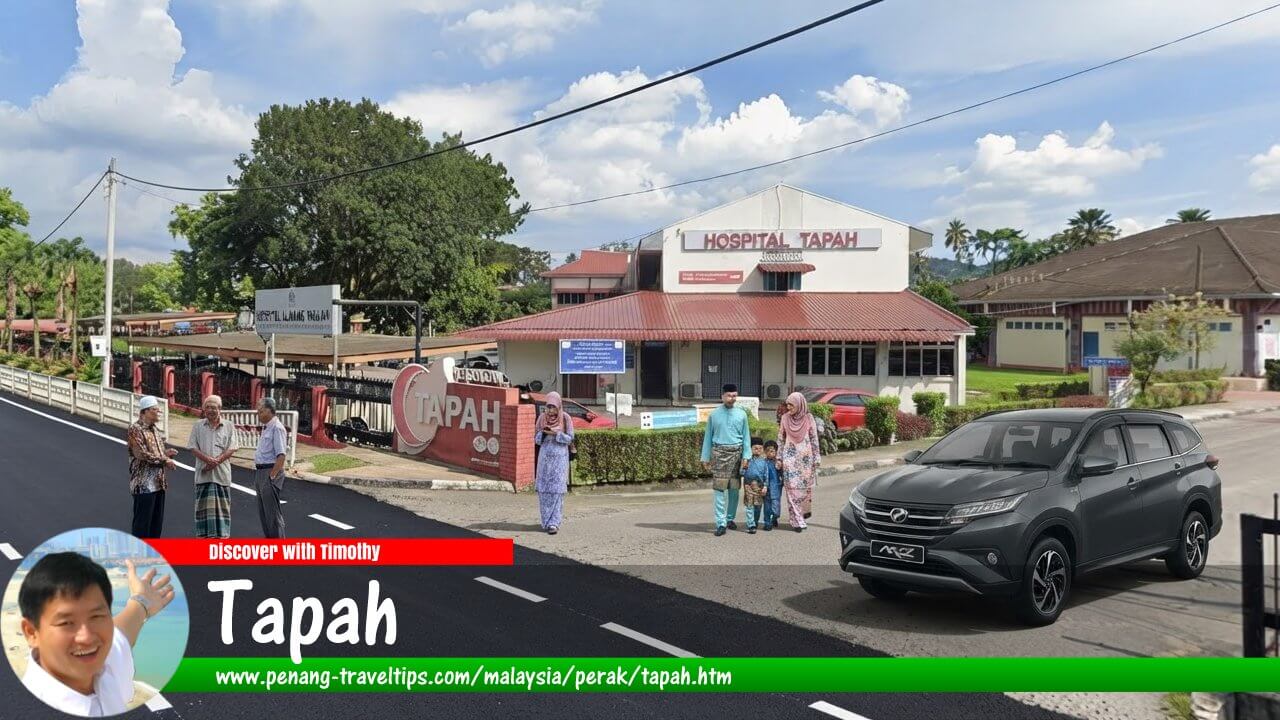
- Hospital Tapah (GPS: 4.20114, 101.25947)

Tapah is  on the Map of towns in Perak
References
- Pejabat Tanah dan Galian Perak – Info Tapah
- Majlis Daerah Tapah – Latar Belakang
- Tourism Perak – Batang Padang
- Kerajaan Negeri Perak – My Local Stats Batang Padang
- Tourism Perak – Tourism Clusters
- Tourism Perak – Perak Fun Map
- Kerajaan Negeri Perak – Brief History of Perak
- Tapah, Perak – Penang Travel Tips
Page Details
This page was created on 15 September 2026. Hi, my name is Timothy and created it from my research, for my own entertainment, knowledge and to satisfy my curiosity. I am providing the information to you in good faith and hope it is useful. I try to get the details as accurate as possible. I also try to update the page whenever I stumble on new details. So this and all my other pages are perpetual work in progress. If you discover any error, please politely inform me, pointing out where the error lies, and I will correct it as soon as possible. Your helpfulness will keep this page accurate, relevant and helpful to those who need the information.Buy Me A Coffee
If you enjoy the information I provide and want to support the work I do, please buy me a coffee! I appreciate it immensely, thank you so much!
