
Fitzrovia, London
Fitzrovia: The Heart of Historic and Creative London
A Neighbourhood with History, Character, and Creativity
Located in central London, Fitzrovia is a vibrant and eclectic area nestled between Marylebone and Bloomsbury to the west and east, and Soho to the south.Fitzrovia lies within both the City of Westminster and the London Borough of Camden, positioning it perfectly between some of London’s most iconic areas.
It is often described as both bohemian and elegant, a place where creative energy meets historical charm, making it a fascinating part of the capital for locals and visitors alike.
Size and Population of Fitzrovia
Fitzrovia covers a relatively compact area, roughly 0.28 square miles (0.73 square kilometres).Despite its modest size, it has a vibrant and active community, with an estimated population of around 8,000 residents as of 2024.
The area's central location, diverse housing, and proximity to major London institutions make it one of the most desirable and dynamic neighbourhoods in the city.
Map of Fitzrovia, London
Roads in Fitzrovia
- Bedford Avenue
- Bedford Square
- Berners Street
- Bloomsbury Street
- Charlotte Street
- Cleveland Street
- Eastcastle Street
- Goodge Street
- Great Portland Street
- Great Russell Street
- Great Titchfield Street
- Margaret Street
- Market Place
- Mortimer Street
- Newman Street
- Oxford Street
- Percy Street
- Rathbone Place
- Rathbone Street
- Riding House Street
- Streatham Street
- Tottenham Court Road
- Wells Street
- Winsley Street
The History of Fitzrovia
Fitzrovia developed gradually during the 18th and early 19th centuries, originally consisting of elegant townhouses for London's burgeoning middle class.The name "Fitzrovia" began to be used informally in the 1930s and 1940s, popularised by artists, writers, and bohemians who frequented the Fitzroy Tavern on Charlotte Street.
Although the name was initially informal, it gained widespread usage over the decades and is now the accepted name for the area.
In the past, Fitzrovia was known for its artistic and intellectual residents, including writers like George Orwell and Virginia Woolf, adding to its enduring cultural cachet.
Demographics of Fitzrovia
Today, Fitzrovia's demographics reflect a rich blend of ages, professions, and backgrounds.The area is home to:
- Young professionals who appreciate its central location and vibrant atmosphere.
- Families drawn to its relatively quiet streets and proximity to good schools and parks.
- Students attending nearby University College London (UCL) and other institutions.
- Long-time residents who maintain the sense of community that Fitzrovia is known for.
Real Estate Prices in Fitzrovia
As of early 2025, Fitzrovia’s real estate prices are among the higher ranges compared to many parts of London, reflecting its desirability and prime location.The average property price in Fitzrovia is approximately £1.7 million for a two-bedroom flat of between 800 to 1,100 square feet (75 to 100 sq metres), whereas the overall average for London sits around £730,000. In more luxurious spots of Fitzrovia such as Charlotte Street or Fitzroy Square, £1.7 million wil get you a smaller space, more like 750 to 850 square feet, but finished to a very high specification.
Rental prices are also high, with one-bedroom flats typically ranging from £2,500 to £3,500 per month depending on condition and exact location.
While expensive, Fitzrovia remains slightly more affordable than some of its immediate neighbours like Mayfair and Marylebone, offering an appealing balance of prestige and value.
Important Buildings and Landmarks in Fitzrovia
Fitzrovia boasts an impressive selection of historic and modern landmarks, including:- BT Tower: One of London’s most recognisable structures, originally built as the Post Office Tower in the 1960s.
- Fitzroy Tavern: A historic pub on Charlotte Street, famous for its literary and artistic clientele.
- All Souls Church, Langham Place: A stunning 19th-century church designed by architect John Nash.
- University College Hospital: A major teaching hospital located along Euston Road.
- Pollock’s Toy Museum: A quirky museum dedicated to traditional toys and toy theatres, housed in two historic buildings on Whitfield Street.
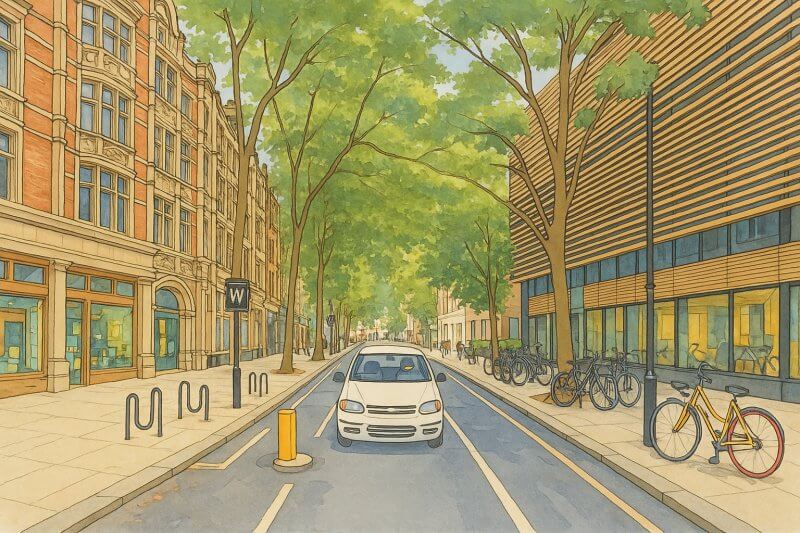
Painting of Fitzrovia (View full-size image here)
The Characteristics of Fitzrovia
Fitzrovia is known for its unique blend of characteristics, combining elements of:- Historic charm: Georgian and Victorian architecture line many of its streets.
- Creative energy: A long-standing hub for media, advertising, and design businesses.
- Urban village feel: Despite its central location, Fitzrovia has a residential, community-focused atmosphere.
- Diverse dining: A fantastic range of independent cafés, fine dining restaurants, and historic pubs.
- Green spaces: Small parks and squares like Fitzroy Square and Crabtree Fields offer a breath of fresh air.
Nearest London Underground Stations
Fitzrovia is extremely well served by public transport, with several Underground stations within easy walking distance:- Goodge Street Station: Served by the Northern Line.
- Warren Street Station: Served by the Northern and Victoria Lines.
- Tottenham Court Road Station: Served by the Central, Northern, and Elizabeth Lines.
- Oxford Circus Station: Served by the Bakerloo, Central, and Victoria Lines.
- Great Portland Street Station: Served by the Circle, Hammersmith & City, and Metropolitan Lines.
Fun Fact About Fitzrovia
One particularly fun fact about Fitzrovia is that the BT Tower, once the tallest building in London, was officially a state secret!For many years, its existence was not officially acknowledged, and it did not even appear on official maps despite being visible from miles around.
Today, the BT Tower remains an iconic symbol of London’s skyline and a quirky part of Fitzrovia’s legacy.
List of Places in London, Map of Places in London
Want to share your London travel experiences or get tips from fellow travellers?
Join the London Travel Tips Facebook GroupMore information for visiting London
Here are some related articles to help you get to know London better.- Cost of Living in London: Discover the true cost of living in London, including housing, transport, groceries, and more - plus tips for budgeting in one of the world's most expensive cities.
- Driving in London: Planning to drive in London? Learn about roads, car rentals, parking, tolls, and key tips for tourists and visitors from outside the capital.
- Driving Tips for Visiting London: Thinking of driving to London? Discover the best times to travel, congestion tips, parking apps, breakdown help, and petrol advice for a smoother journey.
- Evolution of London's Streets: Discover the fascinating history of how London's streets developed from ancient footpaths to today's complex network of roads across the capital.
- History of Immigration to London: Discover the rich history of immigration to London, from Huguenots to Bangladeshis, and how diverse communities have shaped the city's vibrant identity.
- How Big Is London Compared to Other World Cities?
- How London's Streets Measure Up: A Global Comparison of Road Widths
- How Streets of London are Named: Discover how London streets get their names, who decides them, and how historic, political, and public influences shape street naming in the capital.
- How the Grosvenor Family Came to Own Much of Mayfair, Belgravia and Pimlico: Explore how the Grosvenor family came to own much of Mayfair, Belgravia, and Pimlico, and learn about their historical connection (or lack thereof) with the British royal family and government.
- Living and working in London
- London's Quiet Collapse: How Living Standards Fell as Costs Skyrockted (1975-2025): Explore how London residents endured rising costs and falling living standards from 1975 to 2025 - from rocketing rents to wage stagnation and inflation.
- Marvel of the London Underground: Discover the history, challenges, and triumphs of the London Underground - the world's first underground railway and a vital transport lifeline for the UK capital since 1863.
- Moving to London: Expat Tips for Settling in Westminster: Essential advice for expats moving to London's Westminster: neighborhood insights, cost of living, transportation, housing, healthcare, schools, and tips to help you feel at home in the heart of the city.
- Places in London that aren't pronounced the way they're spelled
- Shopping in London: Discover London's diverse shopping scene
- Taking the bus in London: This is your complete guide to taking the bus when in London.
- The Anglican Faith: A Visitor's Guide to the Church of England: Learn about the Anglican faith and its deep ties to London's landmarks like Westminster Abbey and St Paul's Cathedral.
- Top 10 London Streets Every Visitor Must See: Discover London through its most iconic thoroughfares - 10 streets every visitor must experience. From historic Abbey Road to vibrant Camden High Street, explore culture, shopping, and hidden gems.
- Why are most roads in Central London so narrow? Learn why there are so few multi-lane roads and elevated highways in the heart of the city.
 Latest Pages & Updates
Buy Me A Coffee
If you enjoy the information I provide and want to support the work I do, please buy me a coffee! I appreciate it immensely, thank you so much!
